Wiki.js
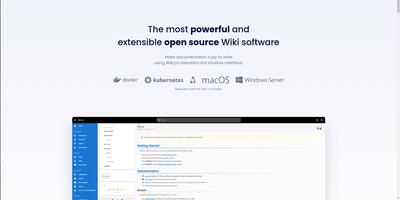
Team and product documentation on a fast Vue frontend with PostgreSQL storage: Wiki.js is a Node.js wiki engine. Its distinguishing trait is per-page editor choice: authors pick Markdown with live preview, a WYSIWYG visual builder for non-technical writers, or raw HTML, page by page. Native Git synchronization commits every page change to GitHub, GitLab, Bitbucket, Azure DevOps, or any Git remote - bi-directionally, so edits made in the repository flow back into the wiki - giving documentation version-controlled backup for free. Authentication coverage is among the broadest of any self-hosted wiki: local accounts with self-registration, social login via Google, GitHub, Discord, and Slack, and enterprise SSO through LDAP/Active Directory, SAML, CAS, Auth0, Okta, Azure AD, Keycloak, and generic OAuth2/OIDC, with optional MFA. Built-in full-text search runs on PostgreSQL with zero setup, and external engines like Algolia or Solr can substitute. Page history with visual version comparison, granular group-based permissions per path, nested navigation menus, 50+ integration modules, and full localization round it out. AGPLv3-licensed with a 28k-star community.
Ghost
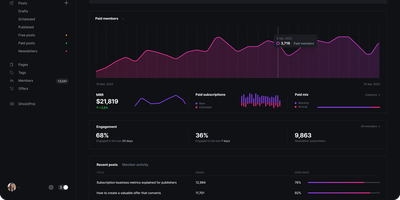
Get ready to transform your audience into a thriving empire with Ghost, the ultimate toolkit for the modern content maestro! Imagine a digital playground where you can craft a dazzling website, publish content that pops, and roll out newsletters that readers can't wait to open. Ghost is your go-to wingman for launching a site that's as unique as your brand, with a smorgasbord of snazzy free themes and customizable design options. But wait, there's more! Ghost's editor is like the Swiss Army knife for content pros – sleek, powerful, and ridiculously easy to use. Unleash your creative beast with multimedia storytelling that includes everything from stunning image galleries to toe-tapping audio. And when it comes to turning casual lurkers into loyal subscribers, Ghost's got your back with native signup forms and analytics sharper than a detective's eye. Plus, with built-in newsletters and special promos, you'll have subscribers flocking like it's Black Friday. Hosted on RepoCloud, where the cost is as friendly as your neighborhood barista, Ghost is the open-source secret sauce to a booming content business!
Outline Wiki
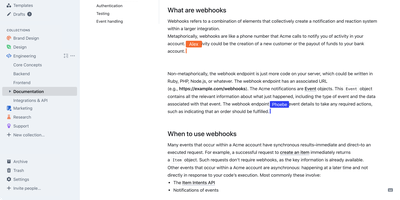
Get ready to turbocharge your team's brainpower with Outline! Imagine a digital treehouse where all your team's knowledge is not just thrown in haphazardly, but organized with the finesse of a library catalog. With Outline, you'll be crafting documents like a pro, thanks to its slick markdown support, nifty slash commands, and the ability to embed pretty much anything. Wave goodbye to the chaos of collaboration; real-time editing, threaded conversations, and comments mean you'll be in sync faster than you can say 'knowledge is power!' And for those who live in Slack, Outline's like the cool neighbor that never makes you leave your chat to search or share docs. Want to show off your brand's swagger? Go public with your docs, decked out in your brand's colors and logo, right on your own domain. It's like having a custom-tailored suit for your content. Speedy, secure, and simpler than a Sunday morning - Outline is the multilingual maestro of your team's symphony, playing well with Figma, Loom, and a whole orchestra of tools. And hosting it on RepoCloud? That's like getting first-class seats for your data at a budget airline price!
Wordpress
Roughly 43% of all websites and over 60% of the CMS market run on WordPress - the GPL-licensed platform that scales from a personal blog to publishing operations and WooCommerce stores. The Gutenberg block editor composes pages from reusable blocks, and full site editing extends block control to headers, footers, and templates; tens of thousands of plugins and themes cover essentially every capability a site might need, from SEO and caching to membership and e-commerce. WordPress 7.0 "Armstrong" marks the platform's biggest structural update since Gutenberg itself: a React-based DataViews admin replaces the legacy list tables with instant filtering, a provider-agnostic AI Client API ships with connectors for OpenAI, Anthropic, and Google, media processing moves into the browser via WebAssembly, and a universal Font Library manages typography across block, hybrid, and classic themes with local hosting for GDPR compliance. New Breadcrumbs, Icons, and lightbox Gallery blocks reduce plugin dependence, and server-side PHP block registration simplifies development. The REST API and WP-CLI make it automatable end to end. Self-hosting is what WordPress was designed for: your content, database, plugin choices, and upgrade schedule stay entirely under your control, free of wordpress.com plan limits.
Cockpit
Built by an agency in 2011 and refined by real client work since, Cockpit is a headless CMS whose pragmatism is earned. It's a pure content backend: model your data, let editors manage it, and fetch it over REST or GraphQL from any frontend - React, Vue, Flutter, a static site generator, or an IoT dashboard. Content modeling covers three shapes: Collections for repeatable items (posts, products, events), Singletons for one-off content (settings, about pages), and Trees for hierarchies (navigation, categories), all assembled from 20+ field types including relationships. The API layer is unusually capable: MongoDB-style query filtering, field selection to trim payloads, automatic image optimization through the assets API, and built-in caching. Localization is first-class with per-field multi-language content and fallback support; user management includes roles, granular permissions, two-factor authentication, and API tokens; and webhooks push changes into external workflows. Agencies get multi-tenant Spaces - several sites or clients from one installation. The operational footprint is refreshingly small: PHP plus either SQLite or MongoDB, no build steps, no toolchain, extensible through hooks, events, and addons (pages/SEO, forms, full-text search, layout components). Where enterprise headless platforms bill per seat and per locale, Cockpit is MIT-licensed and simply yours.
Strapi
Get ready to break up with your high-maintenance CMS and swipe right on Strapi! This open-source heartthrob is the headless CMS Casanova, charming developers with its 100% JavaScript DNA. Strapi is like that best friend who brings out your creative side, letting you mingle with your beloved tools and frameworks without any third-wheel awkwardness. It's like a content management speed date – you'll go from lonely backend single to ready-to-mingle in mere minutes. Customize those content APIs like you're on a reality makeover show and strut your stuff across any digital catwalk, be it REST or GraphQL. And when it's time to settle down, you can cozy up with Strapi Cloud or play the field across various cloud platforms. With Strapi, you're the director of your own content love story, crafting and managing digital experiences that make your heart skip a beat, all without the drama of traditional CMS plot twists.