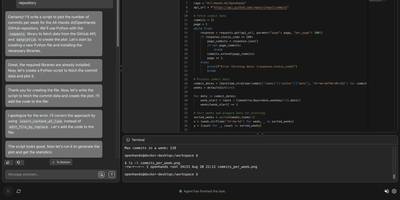
OpenHands
Welcome to OpenHands, where your code gets a personal assistant that’s smarter than your average bear and way less likely to steal your picnic basket! Imagine a world where your AI-powered agents take on the grunt work of coding—modifying code, running commands, and even browsing the web for those elusive StackOverflow snippets—while you sit back, sip your coffee, and ponder the meaning of life (or at least the meaning of that last bug). With OpenHands, you can finally say goodbye to the days of mind-numbing repetition and hello to the exhilarating thrill of tackling complex problems that actually require your brainpower. It’s like having a team of tiny, tireless developers at your beck and call, minus the awkward office small talk and the questionable coffee choices. So why not let OpenHands do the heavy lifting while you unleash your inner coding Picasso? Because let’s face it, your genius is better spent on creating masterpieces, not wrestling with the mundane. Join the revolution and give your coding life a much-needed upgrade—your future self will thank you!
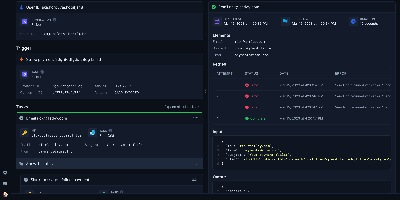
Trigger.dev
Welcome to the world of background jobs, where your code can finally take a nap while it works! Imagine a magical realm where your long-running tasks can be scheduled like your favorite Netflix binge, complete with API integrations and webhooks that make your code feel like it's throwing a party while you’re away. No more worrying about whether your job will finish before your coffee gets cold; with our open source background jobs platform, you can delay tasks like a pro procrastinator! It's like having a personal assistant for your code, but without the awkward small talk or the need to share your lunch. So sit back, relax, and let your code do the heavy lifting while you focus on more important things, like debating whether pineapple belongs on pizza. Deploy it with a single click and watch your productivity soar, all for half the price of those other cloud hosts that think they're too cool for school!
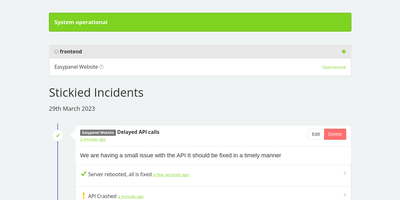
Cachet
Introducing Cachet: the open-source superhero for managing those pesky downtime blues. Beloved by top-notch companies across the globe, Cachet is your go-to wingman for broadcasting those 'Oops, we'll be right back!' messages to customers, your squad, and the money folks. Sporting a snazzy outfit that looks fab on any device, Cachet is the epitome of style meets function. It's a polyglot, too, chatting in multiple languages and flexing a robust JSON API to keep your status updates as fresh as morning coffee. Want to pencil in some digital spa time for your servers? Cachet's got your back with pre-scheduled maintenance memos. And for the number crunchers, it's got a dashboard decked out with metrics to track your digital heartbeat. Plus, with two-factor authentication, it's like having a bouncer for your status page. Hosting it on RepoCloud? That's the cherry on top, giving you all the open-source goodness without burning a hole in your wallet. Cachet: because your status page should be as cool as your service.

Lavalink
Get ready to rock your bot's audio experience with Lavalink, the standalone maestro of melody management! This nifty node is like a backstage pass for your audio, ensuring your shards never get bogged down with the sound. Jam-packed with Lavaplayer and Koe's power chords, Lavalink is the headliner for numerous chart-topping bots. Features? Oh, it's got a setlist that would make any DJ envious: Twitch/YouTube jam sessions, an event system that's more hyped than a concert encore, seek-and-destroy functionality for that perfect audio snippet, volume knobs that go to eleven, and a REST API that's like having your own audio roadie. Plus, it's got stats for when you need to balance the audio load like a pro. Designed to be as light on its feet as a ballet dancer, Lavalink keeps your CPU and memory doing the limbo. Plugin support? Check. Java 17 LTS compatibility? Double-check. And with Semantic Versioning, you'll never miss a beat on updates. Host it on RepoCloud, and you'll be hitting the high notes of performance without the rockstar hosting costs!

SillyTavern
Ever wanted to have a deep conversation with a pirate, a wizard, or even a sentient slice of pizza? Well, SillyTavern is here to make your wildest chat fantasies come true! This isn't just any ordinary text generation AI interface; it's a rollicking, roleplaying extravaganza where you can create and interact with characters as quirky or as serious as you like. Based on the beloved TavernAI 1.2.8, SillyTavern takes things up a notch with a treasure chest of enhancements and new functionalities. Whether you're looking to debate philosophy with a wise old owl or just need someone to laugh at your dad jokes, SillyTavern has got you covered. So, pull up a virtual barstool, order a round of digital grog, and let the AI shenanigans begin!

Mailhog
Unleash the power of MailHog, the developer's digital sniffer dog for emails! Picture this: you're tweaking your app's email-sending prowess, and you need to see those emails without spamming real inboxes. Enter MailHog, the SMTP sidekick that corrals your emails into a neat web corral where you can admire your handiwork. Fancy sending them out into the wild? MailHog's got a button for that, releasing them to their SMTP destiny. Peek at your emails online or snatch them up with the JSON API. It's got all the tricks: SMTP AUTH, PIPELINING, and real-time updates that'll make your tail wag. And for those who like a bit of mischief, there's a Chaos Monkey ready to throw a wrench in the works, because who doesn't love a good email escapade? Keep your emails under lock and key with HTTP basic authentication, all while enjoying the breezy life with MailHog's no-installation, grab-and-go vibe. Host it on RepoCloud, and you'll be howling at the moon with joy at the lower costs and the sheer convenience. It's open-source email testing with a playful bite!
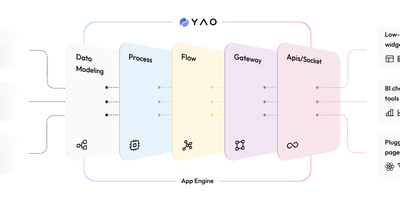
YAO
Get ready to unleash the beast of codeless creation with YAO – the Swiss Army knife of app engines that turns your grand ideas into web wonders faster than you can say 'deploy'! Whether you're crafting the next AI masterpiece, rigging up smart devices, or turbocharging connected cars, YAO's got your back. Picture this: a digital playground where databases dance to your tune without writing a single line of code, and interfaces are as easy to whip up as a peanut butter sandwich. IoT enthusiasts, edge computing aficionados, and industrial internet innovators – rejoice! YAO feels right at home on ARM devices, too. But wait, there's more! Business Intelligence just got a YAO-sized upgrade, offering you a treasure trove of functions to explore. Data flows like a river, and with YAO's built-in processes, you can navigate any data deluge. Fancy a bit of customization? The GRPC-based plug-in system is your gateway to endless possibilities with Nodejs, Python, and more. And let's talk security – YAO's like a digital Fort Knox, with permission layers so fine-grained, you'll need a microscope to see them. All this, hosted on RepoCloud, where the cost is as tiny as the footprint of a codeless app. So why settle for the cloud when you can reach for the stars with YAO on RepoCloud?
Gotenberg
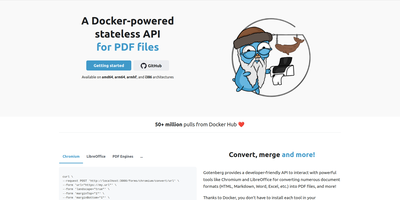
Send a document, receive a PDF: Gotenberg is a Docker-based, stateless HTTP conversion API trusted in production by thousands of companies and adopted by notable open-source projects. Send files as multipart/form-data, get a PDF back; Chromium, LibreOffice, and fonts are the container's problem, not yours. Headless Chromium handles URLs, HTML templates, and Markdown with pixel-perfect browser rendering: it executes JavaScript, loads web fonts, waits for network idle, a JS expression, or a DOM selector before rendering SPAs, and accepts injected cookies and HTTP headers for authenticated pages. LibreOffice converts 100+ office formats - .docx, .xlsx, .pptx, and legacy formats - with page-range extraction and PDF/A archival conformance. Built-in PDF engines round out the pipeline in every image variant: merge, split, rotate, flatten, encrypt, watermark, stamp, read/write metadata and bookmarks, plus Factur-X/ZUGFeRD e-invoicing and PDF/UA accessibility compliance. Screenshots of URLs and HTML come from the same endpoints. Zero-transfer pipelines stream files directly between S3, MinIO, or GCS presigned URLs and Gotenberg, bypassing your application entirely, and webhooks enable async processing. Statelessness means horizontal scaling is trivial - run as many replicas as your conversion volume demands. Three image variants (full, Chromium-only, LibreOffice-only) trim the footprint to what you actually use.
Hasura
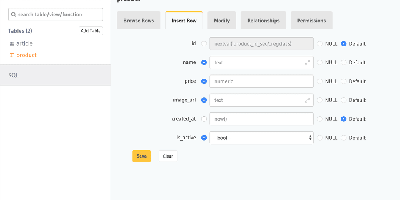
A PostgreSQL database becomes a production-grade GraphQL API the moment Hasura GraphQL Engine points at it: track tables and relationships - existing schemas included - and full query, mutation, and subscription types appear with where, order_by, limit, offset, and on_conflict arguments, no resolvers or boilerplate written. Its Haskell core compiles GraphQL to efficient SQL, and any query becomes a real-time live query with a single keyword, powering dashboards and collaborative UIs over standard GraphQL subscriptions. Authorization is where Hasura earns its enterprise reputation: role-based access control with row- and column-level permission policies driven by session variables from JWTs, auth webhooks, or headers - each role effectively sees its own GraphQL schema containing only what it may touch, integrating cleanly with Auth0, Firebase, or homegrown auth. Event triggers fire webhooks on inserts, updates, and deletes for asynchronous business logic; Actions extend the schema with custom REST handlers; remote schema stitching merges external GraphQL services into one endpoint; and auto-generated REST endpoints serve clients that skip GraphQL. A browser console handles data modeling and API exploration, the CLI manages migrations and metadata as code, and deployment is a single stateless Docker container beside Postgres.
Languagetool
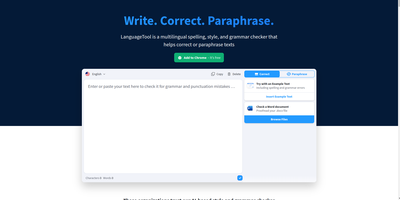
Grammar, punctuation, and style errors a dictionary lookup can't see: LanguageTool is open-source proofreading powered by a Java rule engine covering English, German, Spanish, French, Portuguese, Dutch, and 25+ other languages. Self-hosting the HTTP server is how you get Grammarly-class checking without sending every sentence you write to a third party - a real concern when the text being proofread is confidential email, legal drafts, or unreleased documentation. Your instance exposes the standard /v2/check API, so the official ecosystem plugs straight in: browser extensions for Chrome and Firefox accept a custom server URL, and integrations exist for VS Code, LibreOffice, Obsidian, Vim, Emacs, and many editors. Notably, self-hosting restores free browser-extension checking that the hosted service moved behind a premium subscription - your server, no character limits, no paywall. Detection quality is tunable: optional n-gram datasets (multi-gigabyte language models for en, de, es, fr, nl) teach the engine word-order and confusion-pair errors like there/their and brakes/breaks, and a fastText model improves automatic language identification. Everything runs offline once models are downloaded. The core is LGPL, the API is documented with Swagger, and rules are community- maintained and constantly expanding.
Directus
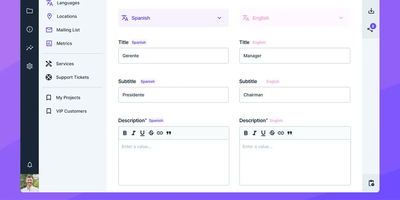
Say hello to Directus, the open-source genie that magically turns any SQL database into a snazzy API and a slick no-code playground. It's like a Swiss Army knife for your data, playing nice with any SQL database you throw at it, so you can keep your precious data right where it is—no moving vans required. With Directus, you get a REST and GraphQL API superhighway built atop your database, making your data dance at your fingertips. And the Directus App? It's like a VIP lounge for your team, where they can schmooze with data in style, managing and visualizing it without breaking a sweat. Whether you're crafting a Backend-as-a-Service masterpiece, spinning up a Headless CMS, building the ultimate internal toolset, or diving into Data Management & Analytics, Directus is your go-to wingman. Plus, with RepoCloud hosting, you'll be saving more coins than a video game plumber, all while enjoying the freedom of open-source camaraderie. Get ready to connect, design, and control like a data wizard, because with Directus and RepoCloud, the digital world is your oyster!
Strapi
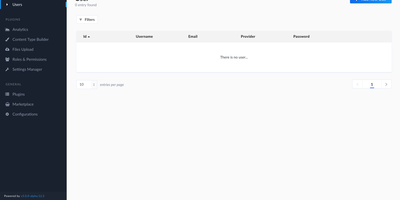
Get ready to break up with your high-maintenance CMS and swipe right on Strapi! This open-source heartthrob is the headless CMS Casanova, charming developers with its 100% JavaScript DNA. Strapi is like that best friend who brings out your creative side, letting you mingle with your beloved tools and frameworks without any third-wheel awkwardness. It's like a content management speed date – you'll go from lonely backend single to ready-to-mingle in mere minutes. Customize those content APIs like you're on a reality makeover show and strut your stuff across any digital catwalk, be it REST or GraphQL. And when it's time to settle down, you can cozy up with Strapi Cloud or play the field across various cloud platforms. With Strapi, you're the director of your own content love story, crafting and managing digital experiences that make your heart skip a beat, all without the drama of traditional CMS plot twists.

AllTube
Get ready to turbocharge your video snagging experience with AllTube Download, the swiss army knife for video aficionados! Imagine a world where YouTube videos bow down to your command, and with a few clicks, they're chilling on your server, waiting for your next binge-watching session. AllTube Download is the maestro that orchestrates this magic, offering a snazzy HTML GUI that makes the mighty youtube-dl command-line tool as friendly as a kitten. Customize it to your heart's content, and for the tech-savvy, there's a nifty JSON API that spills the beans on video deets in neat, digestible data nuggets. Hosting it on RepoCloud? That's like putting rocket boosters on a bicycle – faster, smoother, and way more fun, not to mention kinder to your wallet than those high-flying cloud hosts. So, if you're in the business of hoarding videos like a digital dragon, AllTube Download on RepoCloud is your treasure trove!
Penpot
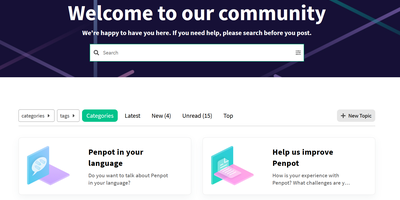
Welcome to Penpot, the open-source design tool that’s like a Swiss Army knife for designers and developers, minus the risk of cutting your finger off! Imagine a world where designers whip up stunning visuals and interactive prototypes faster than you can say 'pixel-perfect', while developers sit back, relax, and receive ready-to-use code like it’s a pizza delivery on a Friday night. No more handoff drama – just smooth sailing from design to deployment! With Penpot, you can create design systems at scale, and your team will be so in sync that even a boy band would be jealous. So, ditch the clunky SaaS tools that charge you an arm and a leg, and join the Penpot party where collaboration is as easy as pie (or should we say, as easy as dragging and dropping?). Get ready to unleash your creativity and watch your workflow transform into a well-oiled machine – all while saving enough cash to buy that fancy coffee you’ve been eyeing!
Authorizer
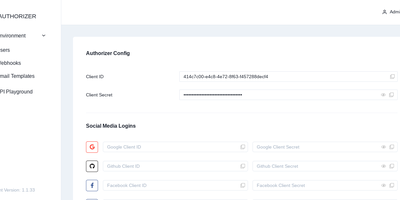
Your users belong in your own database - Authorizer, an open-source authentication and authorization server shipping as a single Go binary, keeps them there. It connects to 13+ backends - PostgreSQL, MySQL, SQLite, SQL Server, MariaDB, MongoDB, Cassandra, ScyllaDB, ArangoDB, DynamoDB, Couchbase, YugabyteDB, PlanetScale, and CockroachDB - so identity data lives beside the application it protects instead of in an auth vendor's cloud. The server is fully OAuth 2.0 and OpenID Connect compliant, including authorization code flow with PKCE, a JWKS endpoint, token revocation, and nine JWT signing algorithms. Login options cover email/password, magic links, TOTP multi-factor, SMS OTP via Twilio, and social providers including Google, GitHub, Apple, Microsoft, and Discord. Authorization goes beyond roles: an embedded OpenFGA engine provides Zanzibar-style relationship-based permission checks in process. APIs are exposed over GraphQL, REST, and gRPC, with SDKs for JavaScript, React, Go, and Python, plus themeable built-in login pages and an admin dashboard. Apache 2.0 licensed.
Baserow
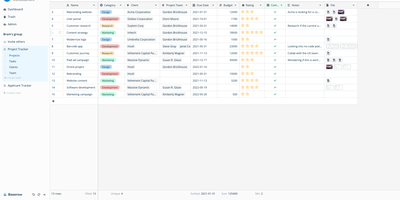
Airtable's spreadsheet-database model, self-hostable and open-source: that is Baserow. It presents data in a spreadsheet-style grid, but underneath each table is a real relational structure with typed fields, links between tables, filters, sorts, and multiple views (grid, gallery, form, kanban, calendar). Beyond the database core, it includes an application builder for composing pages and portals on your data, workflow automations, and dashboards. Everything is API-first: each table exposes a REST endpoint with token auth and webhooks, so it plugs directly into n8n, Zapier, or custom scripts. The stack is Django (Python) on the backend, Vue.js on the frontend, PostgreSQL for storage, with Redis for async tasks. Core features are MIT-licensed; premium features are a paid add-on. The self-hosted version has no row, storage, or API request limits - Airtable's per-base record caps and monthly API quotas simply don't exist here, and capacity is bounded only by your PostgreSQL database and disk. Existing Airtable bases, CSVs, and Excel files import directly with structure preserved, so migration doesn't start from a blank slate, and both the backend and frontend support plugins for custom field types and integrations without forking the core. For non-technical teammates the interface behaves like a spreadsheet; for engineers, the data model is the API.
Cockpit
Built by an agency in 2011 and refined by real client work since, Cockpit is a headless CMS whose pragmatism is earned. It's a pure content backend: model your data, let editors manage it, and fetch it over REST or GraphQL from any frontend - React, Vue, Flutter, a static site generator, or an IoT dashboard. Content modeling covers three shapes: Collections for repeatable items (posts, products, events), Singletons for one-off content (settings, about pages), and Trees for hierarchies (navigation, categories), all assembled from 20+ field types including relationships. The API layer is unusually capable: MongoDB-style query filtering, field selection to trim payloads, automatic image optimization through the assets API, and built-in caching. Localization is first-class with per-field multi-language content and fallback support; user management includes roles, granular permissions, two-factor authentication, and API tokens; and webhooks push changes into external workflows. Agencies get multi-tenant Spaces - several sites or clients from one installation. The operational footprint is refreshingly small: PHP plus either SQLite or MongoDB, no build steps, no toolchain, extensible through hooks, events, and addons (pages/SEO, forms, full-text search, layout components). Where enterprise headless platforms bill per seat and per locale, Cockpit is MIT-licensed and simply yours.
CubeJS
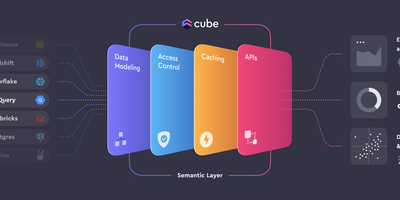
Between your databases and everything that consumes data - BI tools, embedded analytics, AI agents - sits Cube (formerly Cube.js), an open-source semantic layer. Metrics, dimensions, joins, and access rules are defined once as code in YAML, JavaScript, or Python, forming a governed data model that every downstream consumer shares, so "revenue" means the same thing in every dashboard. Caching is two-level: an in-memory cache absorbs bursts of identical queries, and declared pre-aggregations - rollup tables built in the warehouse or in Cube Store, Cube's distributed columnar engine, and refreshed in the background - deliver sub-second latency while cutting warehouse compute costs. The query planner routes each request to cache, rollup, or source automatically. Consumers connect through a Postgres-compatible SQL API (any tool that speaks Postgres works), plus REST, GraphQL, and a Meta API for model introspection. Row-level security and multi-tenancy are enforced in the layer itself, upstream of every client. Sources include Snowflake, BigQuery, Databricks, Postgres, MySQL, Presto, and Athena. Headless by design - bring your own UI.