Open Source App Cloud Marketplace
Deploy, host, and scale with one click, at half the cost. Then customize with AI agents.
Dify
Dify turns the notoriously complex process of building production-grade AI applications into a visual drag-and-drop experience that teams can actually ship and maintain. With over 87,000 GitHub stars and backing from prominent investors, the platform has become the go-to open-source LLMOps solution for organizations that refuse to be locked into proprietary AI stacks. The visual workflow canvas lets developers wire together LLM calls, conditional logic, iteration loops, tool invocations, and human-in-the-loop checkpoints without writing boilerplate integration code. Its RAG pipeline engine handles the full document lifecycle from ingestion of PDFs, Word documents, and HTML through configurable chunking strategies, embedding with models from OpenAI or open-source alternatives, vector storage in Weaviate, Qdrant, Pinecone, or pgvector, and hybrid semantic-plus-keyword retrieval with citation tracking. Dify integrates with hundreds of model providers including OpenAI GPT-4o, Anthropic Claude, Google Gemini, Mistral, Llama, and any OpenAI-compatible endpoint like Ollama for fully local inference. The agent framework supports both ReAct and function-calling strategies with 50-plus built-in tools spanning Google Search, DALL-E, Stable Diffusion, WolframAlpha, and custom API definitions. Published apps can be deployed as hosted web interfaces, embedded chat widgets, REST API endpoints, or MCP-compatible tools. Enterprise features include role-based access control, SSO integration, and audit logging. A built-in marketplace enables teams to share and reuse model providers, tools, and workflow templates across projects. Running on a dedicated VPS on RepoCloud with guaranteed CPU, RAM, and SSD, full root SSH access, and a browser serial console. Apache 2.0 licensed with an open-source community edition.

Lavalink
Get ready to rock your bot's audio experience with Lavalink, the standalone maestro of melody management! This nifty node is like a backstage pass for your audio, ensuring your shards never get bogged down with the sound. Jam-packed with Lavaplayer and Koe's power chords, Lavalink is the headliner for numerous chart-topping bots. Features? Oh, it's got a setlist that would make any DJ envious: Twitch/YouTube jam sessions, an event system that's more hyped than a concert encore, seek-and-destroy functionality for that perfect audio snippet, volume knobs that go to eleven, and a REST API that's like having your own audio roadie. Plus, it's got stats for when you need to balance the audio load like a pro. Designed to be as light on its feet as a ballet dancer, Lavalink keeps your CPU and memory doing the limbo. Plugin support? Check. Java 17 LTS compatibility? Double-check. And with Semantic Versioning, you'll never miss a beat on updates. Host it on RepoCloud, and you'll be hitting the high notes of performance without the rockstar hosting costs!
Hasty Paste
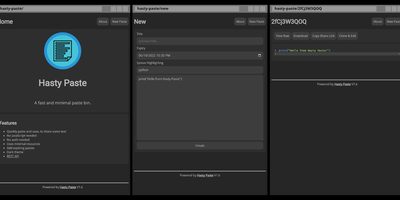
Paste some text, hit save, share the link - Hasty Paste is a fast, minimal pastebin written in Python on the async Quart framework, named, by its author's own admission, "because you use it so fast without a care in the world." No accounts, no authentication, no friction - built for the everyday case of handing a debug log, config snippet, or stack trace to someone in tech support or a chat channel. Pastes get randomly generated IDs, with an optional "long" ID mode that makes brute-force URL guessing impractical, and expiry times ensure throwaway content actually gets thrown away. Optional Pygments syntax highlighting makes code readable, a dark theme spares your eyes, and the whole interface works without JavaScript - it renders in terminal browsers and under the strictest script blockers. Storage is a custom flat-file system (no database), caching runs internally or through Redis for busier instances, and a REST API plus the companion "Hastily Paste It" CLI script enable piping command output straight into a paste from the terminal. The Alpine-based Docker image is tiny, resource usage is minimal, and the license is AGPL.
Flame
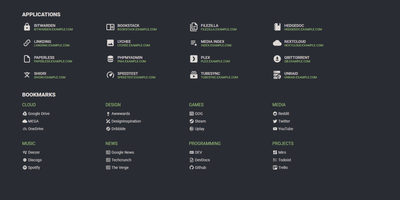
A server full of scattered services becomes one clean application hub under Flame - a self-hosted startpage where every bit of configuration happens in built-in GUI editors, never a config file. Applications and bookmarks are created, edited, and organized into categories directly in the browser, and favorites pin to the homescreen for one-click access. The integrated search bar filters your apps and bookmarks locally as you type, and prefix shortcuts (like /g for Google) route queries to any of 11 web search providers or custom ones you define, making Flame a genuine browser homepage rather than a static link wall. Docker integration is the standout for homelabs: mount the Docker socket, add flame.type, flame.name, and flame.url labels to containers, and new services appear on the dashboard automatically - Kubernetes Ingress annotations work the same way. A weather widget shows temperature, cloud coverage, and animated conditions for your coordinates, and password authentication protects settings and items. Appearance is deeply customizable with 15 built-in color themes, a custom theme builder, and full custom CSS support. The stack is Node.js with SQLite behind a React frontend - light, fast, and inspired by the minimalist SUI design.
Tolgee
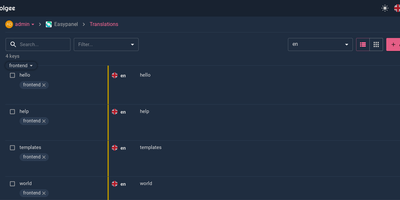
Hold Alt/Option, click any string in your running app, and edit the translation in place: Tolgee is an open-source localization platform built the way developers wish translation worked - changes save straight to the platform with no hunting through JSON or PO files. In-context editing works even in production via the Tolgee Tools browser extension, which injects credentials without touching source code, so a client or colleague with zero coding skills can translate the product inside the product. The SDKs (React, Angular, Vue, Svelte, plus iOS and Android) extract context from each UI element and capture one-click screenshots, giving both human translators and machines the surrounding meaning that raw string files lose. Autonomous translation uses that context: new keys are instantly filled from translation memory or machine translation (DeepL, Google Translate, AWS Translate), with optional human review afterward - shipping no longer waits on a translation agency. A CLI handles import/export, a REST API covers automation, a Figma plugin bridges design, and an MCP server lets AI coding assistants search keys, create translations, and trigger machine translation without leaving the editor. Self-hosting this Crowdin/Phrase/Lokalise alternative keeps every string, screenshot, and API key on your infrastructure.
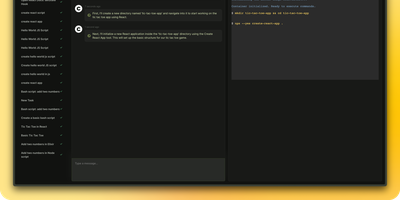
Codel
Meet your new digital sidekick, a fully autonomous AI Agent ready to tackle complex tasks and projects across terminals, browsers, and editors. It's like having a super-smart assistant who never needs coffee breaks!
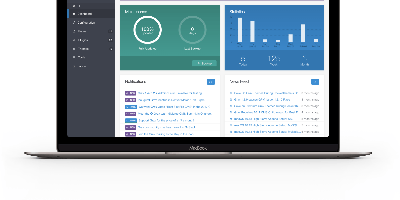
Grav
No database anywhere in the stack: Grav, the leading flat-file CMS, builds every page from a folder of Markdown and YAML on PHP, Symfony components, Twig templating, and Doctrine caching. That architecture is the whole argument: content is Git-versionable, rsync-able, and lock-in-free; pages render in well under 100ms without database round-trips; and backup means copying a directory. Content authors write Markdown (or plain HTML), configure with readable YAML, and define custom page structures via blueprint files that generate editing forms automatically. The optional Admin panel adds a polished editing layer: dashboard with site activity, page management with a syntax-highlighted editor and live preview, drag-and-drop media uploads, one-click plugin/theme updates, and normal/expert modes for form-based or raw YAML editing. The ecosystem runs deep - hundreds of open-source plugins and themes installed through the GPM package manager, with an event-hook architecture that gives plugins full control over the request lifecycle, and downloadable skeletons providing entire pre-built sites. Grav 2.0 modernizes the stack (PHP 8.3+, Symfony 7, Twig 3) and adds a first-party REST API, an MCP server for AI agents, and a SvelteKit single-page admin with real-time collaborative editing. Ideal for docs, blogs, and marketing sites. MIT-licensed.
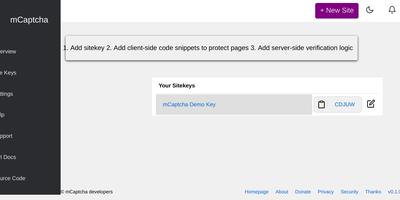
mCaptcha
The CAPTCHA bargain - annoy your users and feed their behavior to Google - gets replaced with economics by mCaptcha. Instead of image puzzles, it uses SHA256 proof-of-work: every visitor's browser silently solves a small computational challenge (via a WebAssembly library) before submitting a form. Humans never notice the milliseconds; bots hammering your site must burn more compute sending requests than your server spends answering them, which makes attacks more expensive than defense - the property that also makes mCaptcha genuine DoS protection, not just bot filtering. Written in Rust, the system is fully automated: difficulty scales with traffic, so challenges stay trivial in normal conditions and harden under attack. The privacy and accessibility wins are structural rather than promised: no tracking, no profiling, no user-pattern data collection, and no visual puzzles that exclude users with visual or cognitive impairments - the design was published in Communications of the ACM. Rate limiting is IP-independent, so users behind NATs, VPNs, or Tor get the same experience instead of endless challenge loops, and proofs resist replay attacks, neutering captcha farms. Migration is deliberately easy: the API is compatible with reCAPTCHA and hCaptcha, making it a drop-in replacement. AGPL-licensed core with proprietary-friendly client libraries.
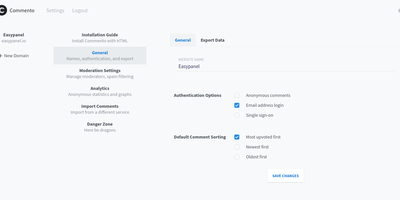
Commento
Unleash the chatterbox in your website with Commento, the widget that turns monologues into dialogues faster than you can say 'engagement'! Picture this: a symphony of upvotes for the wisdom droppers and a gentle nudge of downvotes for the not-so-enlightened. It's like having a bouncer for your blog's comment section, but with markdown muscle that lets your audience flex their formatting finesse—bold, italic, and everything typographically tasty. And for the maestros of moderation? You've got the power to freeze fiery threads, banish the blabber, and put the timeout corner to good use. Wave goodbye to spam-a-lot invaders with a detection system that's more alert than a caffeinated meerkat. Plus, with nested replies, your comment section will be more organized than a librarian's bookshelf. No sign-up hoopla means more gab for everyone, and customization options that let you dress up your widget to match your website's snazzy suit. Host it on RepoCloud, and you'll be saving coins while your community thrives. Now, isn't that comment-worthy?

Meilisearch
Get ready to turbocharge your digital haystack with Meilisearch Cloud, the open-source search engine that's more electrifying than a double espresso shot for your search bar! Imagine a world where your users can find the needle in the haystack before you can say 'Meili-whoa!' – that's the sub-50-millisecond promise of this search sorcerer. Wave goodbye to the days of head-scratching configurations; Meilisearch is like that friend who just gets you, offering smart, zero-config search setups. It's the Swiss Army knife of full-text search engines, slicing through every use case with the precision of a gourmet chef. Whether your users are typing in English, Esperanto, or Elvish, Meilisearch is the polyglot pal you never knew you needed, automatically tuning into any language. Fancy yourself a bit of a search maestro? Go ahead, orchestrate your own ranking symphony with custom relevancy rules. And because we're all about keeping secrets, Meilisearch comes with API keys and tenant tokens to keep your searches as secure as a vault. Want to go the extra mile? Unleash the power of geo searches and let your users find treasures nearby. With Meilisearch Cloud hosted on RepoCloud, you're not just saving coins compared to those spendy cloud hosts; you're also joining a band of open-source rockstars. So, strap in and prepare to deliver a search experience that's as customizable as a build-a-bear workshop, all with just a few lines of code!
Chatpad
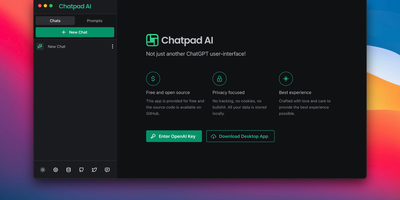
Why should your chat history live on someone else's servers? Chatpad AI - a React/TypeScript front end for the OpenAI API, built on the Mantine component library - is designed around that question. Enter your own OpenAI API key and start chatting with GPT models; every conversation, prompt, and setting is stored locally in your browser via DexieJS over IndexedDB, with no tracking, no cookies, and no backend database at all. That architecture is the point - the Docker image is just Nginx serving static files, making it one of the lightest AI deployments in the catalog, and pay-per-token API pricing typically undercuts a ChatGPT Plus subscription for moderate use. The interface earns its "premium quality" tagline with the details: a persona selector that switches communication styles per conversation, a saved-prompts library for messages you reuse constantly, organized chat history, and full data export/import so conversations move between browsers or into backups as files you control. A JSON config file customizes defaults - models, API endpoints, UI options - without rebuilding the image. AGPL-licensed, with desktop builds available upstream. For teams that want ChatGPT's utility with a self-hosted, zero-telemetry footprint, Chatpad is the minimal, sane answer.
Clickhouse
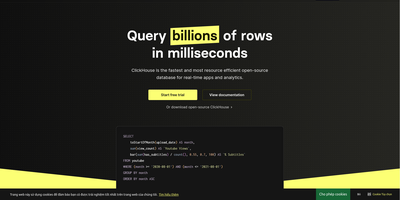
Get ready to turbocharge your data with ClickHouse, the open-source speedster of databases that's perfect for real-time applications and analytics that just can't wait. Imagine querying a sea of billions of rows and getting answers faster than you can snap your fingers - that's ClickHouse for you! It's like having a data Swiss Army knife, compatible with everything from databases to data lakes and even that dusty CSV file you forgot on your desktop. Built with a column-oriented design, ClickHouse is the Usain Bolt of Online Analytical Processing (OLAP), leaving traditional databases huffing and puffing in the background. It squeezes every ounce of power from your system resources to deliver lightning-fast analytical insights. Whether you're setting up shop on your own gear or floating on the cloud, ClickHouse is as flexible as a gymnast. And the cherry on top? You don't even need a server to run quick queries on local files. Join the cool kids' data club with members like Disney+ and Uber, and let RepoCloud be your low-cost, high-fun host for this data party!
Flowise
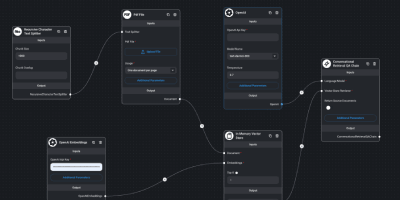
Drag nodes onto a canvas and ship an LLM app: Flowise is an open-source visual builder for AI agents and LLM applications, written in Node.js on LangChain.js and licensed Apache-2.0. You assemble flows by dragging nodes onto a canvas: models, prompts, memory, vector stores, retrievers, and tools, then wire them together and test in the built-in chat panel. Three builder types cover increasing complexity: Assistant for simple RAG chat over uploaded files, Chatflow for single-agent systems with techniques like rerankers and Graph RAG, and Agentflow for multi-agent orchestration with branching, looping, shared flow state, and human-in-the-loop checkpoints. Over 100 integrations connect data sources, vector databases, and both proprietary and open-source models, plus MCP client and server nodes for standard tool interop. Finished flows are exposed as REST APIs, embedded chat widgets, or via JS and Python SDKs - each flow gets an endpoint the moment it is saved, removing the deployment gap between a working prototype and something your application can call. Execution logs, visual step debugging, and external log streaming trace behavior, while input moderation and rate limiting act as guardrails; RBAC, SSO, and workspaces cover team deployments. Self-hosting keeps prompts, encrypted credentials, and conversation data on your own instance, which matters when flows handle internal documents or customer data - and wiring a model, prompt, memory, and vector store on the canvas replaces the boilerplate a hand-coded LangChain project would need.

LibreChat
Every major model provider behind one ChatGPT-style interface: LibreChat spans OpenAI, Anthropic, Google, Azure, AWS Bedrock, Vertex AI, Groq, Mistral, OpenRouter, DeepSeek, and any OpenAI-compatible endpoint including local Ollama. You can switch models mid-conversation and compare providers without changing tools. Its Agents framework builds no-code custom assistants with tool access via Model Context Protocol servers, file search over uploaded documents through an optional pgvector-backed RAG service, and a sandboxed Code Interpreter that executes Python, JavaScript, Go, C++, Java, PHP, and Rust. Artifacts render React components, HTML, and Mermaid diagrams directly in chat, and image generation works through DALL-E and other configured providers. Multi-user support is enterprise-grade, with OAuth, SAML, LDAP, and two-factor authentication, per-user conversation history in MongoDB, and Meilisearch-powered search across all messages and files, plus reusable presets, forkable threads, and persistent memory across conversations. The economics favor teams: instead of a ChatGPT Plus seat per person, everyone shares one instance billed per API token, with access to every provider rather than one - and providers see individual API calls, not your accumulated organizational knowledge. Deployment is Docker Compose; API keys and endpoints are configured through .env and librechat.yaml.
Freshrss
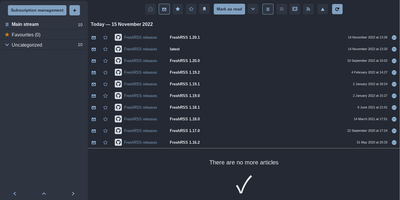
Where Miniflux strips reading down, FreshRSS gives you knobs - the feature-rich pole of self-hosted RSS, comfortable with thousands of feeds. It's a multi-user PHP aggregator (host family and friends on one instance, with an anonymous reading mode) with the reading workflow refined over a decade: favorites, custom tags, powerful filter and search queries, three reading views, and statistics that reveal each site's publishing frequency - useful for pruning subscriptions. Two properties make it the standard choice. First, the Google Reader-compatible API (plus a Fever API) syncs with virtually every serious RSS client - Reeder, NetNewsWire, ReadYou, FeedMe, Fluent Reader - so your phone reads from your server. Second, native WebSub support means compatible sources (WordPress, Blogger, Medium, Friendica) push new articles instantly instead of waiting for polling. A 50+ extension ecosystem adds what truncated feeds omit - full-text content fetching, reading-time estimates, trending views, auto-unsubscribe for dead feeds - alongside community themes and custom CSS. OPML import/export keeps subscriptions portable, a CLI handles administration, and article sharing posts to many services. AGPL-licensed, running on SQLite, MySQL, or PostgreSQL. Feedly Pro's feature set, minus Feedly's subscription and its algorithms.
Radarr
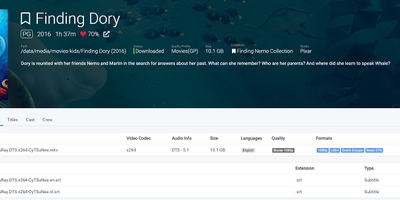
The movie half of the *arr stack: Radarr is a .NET collection manager that automates acquiring films for Usenet and BitTorrent users the way Sonarr does for TV. Add a movie once and Radarr handles the rest: it monitors indexers and RSS feeds, grabs a matching release the moment one appears, sends it to SABnzbd, NZBGet, qBittorrent, Deluge, Transmission, rTorrent, or another connected download client, then imports, sorts, and renames the file into your library structure. Quality profiles are the control surface - define allowed resolutions and a cutoff, and Radarr keeps upgrading files automatically, replacing a DVD rip when a Blu-ray release lands. Custom formats go further, scoring releases by codec, HDR metadata, release group, streaming source, or arbitrary regex so the copy you want always wins the pick. Failed downloads retry with another release automatically; a manual search shows every candidate and explains why one was skipped. Release parsing recognizes director's cuts, special editions, AKA titles, and hardcoded subs. Plex and Kodi integration handles notifications, library refreshes, and metadata like posters, trailers, and subtitles, and a calendar view tracks upcoming releases. It pairs naturally with Jellyseerr for request management and shares its API conventions with the whole *arr ecosystem.
Remmina
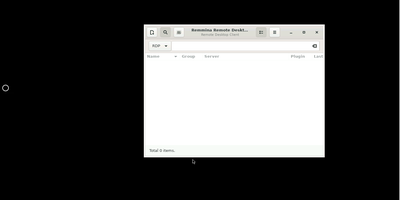
Get ready to teleport your desktop experience with Remmina, the Swiss Army knife of remote desktop clients! Perfect for the digital nomad or the midnight-oil-burning sysadmin, Remmina lets you juggle multiple remote machines like a circus performer, with a smorgasbord of network protocols at your fingertips - RDP, VNC, SPICE, you name it! Crafted with love in GTK, it's as comfy on a jumbotron as it is on a pocket-sized screen. Dive in at http://yourhost:3000/ or take the secure plunge via https://yourhost:3001/. And thanks to its Docker Baseimage KasmVNC heritage, you can toggle features like a light switch, customizing your remote control experience. Host it on RepoCloud, and you'll save enough to treat yourself to a fancy coffee - because who needs overpriced cloud hosting when you've got the open-source haven of RepoCloud?

draw-a-ui
Ever wished you could just doodle your dream website on a napkin and have it magically appear on the internet? Well, put down that napkin and pick up tldraw! This wizardry of an app lets you sketch out your wireframe like a true artist (or a toddler with a crayon, no judgment here) and then sends it off to GPT-4-Vision, which somehow understands your masterpiece and returns a shiny, fully functional HTML file with Tailwind CSS. It's like having a web developer genie in a bottle, minus the three-wish limit and the awkward small talk. So go ahead, draw your wildest web dreams and watch them come to life, no coding required. Just don't forget to sign your artwork!