Memos
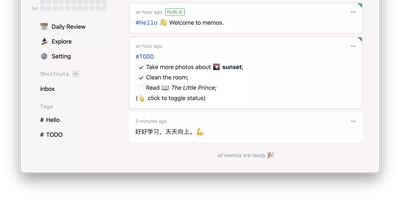
Open the page, write a Markdown note, move on - Memos is a lightweight, self-hosted service built for quick capture. Instead of folders, notebooks, and titles, it presents a timeline: open the page, write a Markdown note, and move on. Notes support headings, code blocks with syntax highlighting, task lists, tables, and file attachments, with tags auto-extracted from #hashtags in the text. Each memo carries a visibility level, private, protected (logged-in users), or public, so one instance works as a personal log, a small team wiki, or a lightweight microblog. The backend is a single Go binary with a React frontend, around 50 MB of memory at runtime and a ~20 MB Docker image, so it fits comfortably on the smallest instance size with near-zero maintenance. SQLite is the default store, with MySQL and PostgreSQL supported for multi-user deployments needing more concurrency, and full REST and gRPC APIs - Connect RPC for browsers, gRPC-Gateway for external tools - make capture scriptable from CLIs, bots, and automation platforms. Fast full-text search spans all memos, pinned notes keep references handy, and a masonry view suits visual browsing. MIT-licensed with zero telemetry; content is stored as plain Markdown in a database you control, so notes remain readable, exportable, and free of proprietary formats.
NocoDB
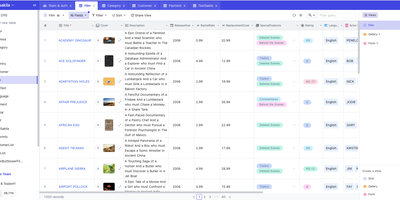
Any existing relational database becomes a collaborative, Airtable-style smart spreadsheet under NocoDB. It connects to PostgreSQL, MySQL, MariaDB, SQL Server, or SQLite, introspects the schema - tables, relationships, indexes - and renders it as interactive Grid, Gallery, Kanban, Calendar, and Form views without migrating a single row. Your business data stays in your database; NocoDB keeps only its own metadata (view configs, permissions, webhooks) in a separate store. Every connected table automatically gets REST APIs with Swagger documentation, effectively turning legacy databases into modern backends. The spreadsheet layer adds 20+ field types including formulas, lookups, rollups, links, attachments, and currency, plus sorting, filtering, grouping, and multi-field editing. Views can be locked or shared publicly with password protection, role-based access control scopes permissions per user, and webhooks plus CSV, Excel, and Airtable import round out integration. An ERD view visualizes the schema. Built with Node.js and Vue, deployed via Docker, handling millions of rows.
OpenUI
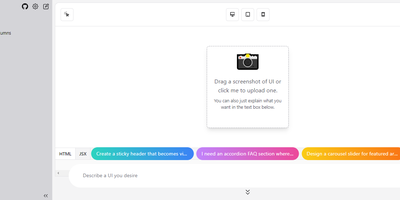
Describe a component in natural language and watch it render: OpenUI, from Weights & Biases, is an open alternative to Vercel's v0. Type a prompt like "a dark-themed dashboard with a sidebar and charts" and the LLM renders working HTML with Tailwind styling live in the browser. You then iterate conversationally, asking for changes until the design is right, and convert the result to React, Svelte, or Web Components for use in a real project. The backend is Python with LiteLLM routing, so it works with OpenAI, Anthropic, Gemini, Groq, and Mistral API keys, or fully offline against local Ollama models, including vision models like LLaVA that can generate UI from screenshot input - feed a screenshot and the model reproduces or riffs on an existing interface. Generated markup is inspectable at any point, with light and dark mode toggles, theme selection, and responsive previews across device sizes. The practical effect is compressing the mockup-review-revise loop from hours to minutes: a described layout renders in seconds and iterates through follow-up prompts, and because output converts to real framework code, prototypes feed directly into production codebases instead of staying trapped in a design tool. Self-hosting keeps unreleased product interfaces and prompts on your own server, and LiteLLM routing lets you pick the model per task - a cheap fast model for rough drafts, a stronger one for final passes, or free local models for unlimited experimentation.
Nzbget
Written in optimized C++ where competitors use Python or Java, NZBGet saturates fast connections while idling on CPU and RAM - which is why the performance-obsessed Usenet downloader has long been the client of choice for NAS boxes, Raspberry Pis, and routers as much as full servers. The engineering shows in the recovery pipeline. Instead of shelling out to par2cmdline, NZBGet integrates the par2 source directly and exploits its knowledge of exactly which articles failed - quick par-verification checks only what needs checking, and its own multicore repair implementation runs 2-3x faster than the external tool on the same hardware. Fast par-rename deobfuscates scrambled filenames in seconds without a full verification pass, and rar-rename recovers names for multivolume archives even when no par2 files exist. DirectWrite assembles articles straight into sparse destination files, skipping temporary-file churn entirely, with an article cache and queue-pausing options to eliminate disk contention. Automation is complete: a remote web interface, full JSON-RPC API, RSS feeds with duplicate detection, scheduling and prioritization, and an extension manager for Python and Bash scripts triggered by download events. Sonarr, Radarr, and every major indexer integrate natively.
Octobox
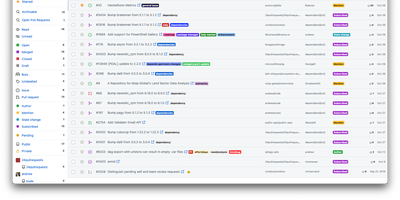
What Gmail did for email, Octobox does for GitHub notifications: an ephemeral, unmanageable stream becomes an inbox you can actually triage. GitHub marks notifications read the moment you glance at them and lets old ones vanish days later; heavy maintainers end up building elaborate Gmail filter systems just to cope. Octobox - a Ruby on Rails app over PostgreSQL - syncs your notifications into a persistent inbox with an explicit archived state: mark a thread done, and if the issue or PR sees new activity, it pops back automatically, so nothing silently falls through. Triage is keyboard-driven with Gmail-style shortcuts (j/k to navigate, e to archive, m to mute, s to star), and multi-select clears noisy repositories in bulk. Filtering is where it earns its keep: slice by repository, organization, type, action, state, reason, CI status, labels, author, assignee, or bot origin, combine prefix search filters, and pin favorite searches to the sidebar. The optional GitHub App enriches entries with live PR/CI status and labels so you can decide without clicking through. Auto-archive rules clear merged PRs and closed issues; muting and snoozing silence the rest. A REST API supports integrations. Self-hosting keeps your notification metadata - a map of everything you work on - on your own server.
Odoo
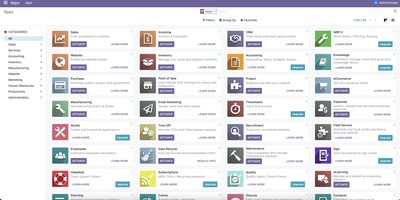
Roughly 40 integrated business apps forming a full ERP: Odoo's open-source suite runs companies end to end. The Community Edition, licensed LGPL-3.0, ships roughly 40 apps covering CRM, sales, invoicing, basic accounting (journals, chart of accounts, taxes, reconciliation), inventory and warehouse management with multi-step routes, manufacturing with BOMs and work orders, purchasing, project management, timesheets, HR, a website builder, and eCommerce. Each app works standalone, but they share one PostgreSQL database and one data model, so a confirmed sale updates stock, triggers procurement, and posts invoices without integration glue. The modular design means you enable only the apps you need and extend with 40,000+ community modules from the Odoo app store covering nearly any vertical requirement. Inventory supports multi-warehouse stock, reordering rules, and lot and serial tracking with barcode-ready operations; manufacturing ties BOMs, work orders, and work-center routing directly to sales demand and stock levels; and the website builder sells straight from your product catalog with payment provider integrations. You can start with just CRM and invoicing on day one and switch on inventory or eCommerce later - new apps integrate with existing data instantly because the schema is shared. The server is Python with an XML/JavaScript view layer, and because data lives in plain PostgreSQL there is no proprietary format: you can query, back up, migrate, and extend business data directly, with unlimited users and no per-seat licensing - where enterprise ERP pricing is per user per month, headcount here costs nothing.
Open WebUI
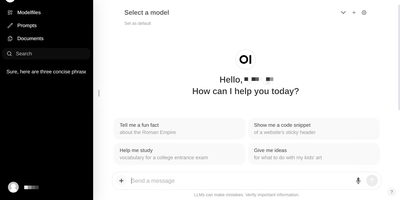
Large language models get a polished front end that can run fully offline: Open WebUI is the self-hosted front end of choice. It talks to local model runners, primarily Ollama, and to any OpenAI-compatible API, so LM Studio, vLLM, Groq, Mistral, OpenRouter, and cloud providers all plug into the same chat interface and can be mixed per conversation. RAG is built in: upload files to knowledge bases or reference them in chat with the # command, backed by a choice of nine vector databases (ChromaDB and PGVector officially maintained) and multiple extraction engines including Tika and Docling, with hybrid BM25-plus-vector search and cross-encoder reranking. Web search results from providers like SearXNG, Brave, and Tavily inject directly into conversations. Extensibility comes from Python tools and functions that run inside the chat, a Pipelines plugin framework, and native MCP support. Multi-user features include RBAC, SSO, and group permissions, and the instance itself exposes an OpenAI-compatible API your own apps can call.
Passbolt
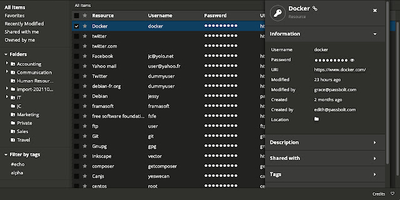
Security-conscious IT departments pick Passbolt for its cryptography: every user holds an OpenPGP key pair, and shared credentials are encrypted individually to each recipient's public key - real end-to-end encryption, not a vault password handed around. All crypto runs client-side in the mandatory browser extension (distributed and signed through the Chrome and Firefox stores, deliberately separating the crypto code from the server that stores ciphertext); private keys and passphrases never touch your instance, and the server admin cannot read a single secret. Authentication uses the challenge-based GpgAuth protocol, secrets are digitally signed to verify sender integrity, and metadata encryption extends protection to resource names and URLs. Day to day it behaves like a polished commercial manager: auto-fill and auto-save in forms, strong password generation, anti-phishing protection, TOTP storage, folder hierarchies shared per-user or per-group with fine-grained permissions and instant cryptographic revocation. Native iOS, Android, and desktop apps ship alongside a JSON API, CLI, and SDKs for CI/CD secret retrieval and rotation. The PHP server runs on MariaDB and is AGPL-licensed open source - including the paid tiers' codebase - with published security audits.
PeerTube
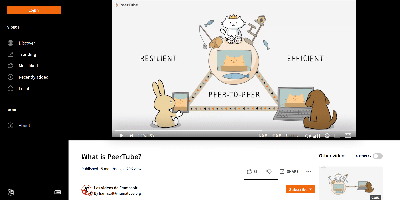
The fediverse's answer to YouTube comes from French non-profit Framasoft: PeerTube is a TypeScript/Angular video platform where hundreds of independently operated instances federate over ActivityPub into one network. Videos you publish are discoverable across the whole video fediverse, and viewers can follow your channels from Mastodon or any ActivityPub platform - or plain RSS - without needing an account on your instance. The namesake innovation attacks video hosting's core cost problem: alongside HLS delivery, an optional WebRTC-based P2P layer lets concurrent viewers' browsers share video segments with each other, so a video going viral distributes its own bandwidth demand instead of crushing your server; instance redundancy extends this by letting friendly instances cache each other's videos. Livestreaming is first-class - stream via OBS or any RTMP software, host permanent streams, enable replays, and interact through live chat. Creators get channels, playlists, analytics, built-in video editing (trim, watermark), and an embeddable player for any website. There are no ads, no data mining, and no recommendation algorithm engineered for watch-time - the project's explicit design stance. Admins control federation policy, P2P settings, and theming; a plugin system extends the rest. AGPL-licensed, 300+ contributors, in active development since 2015.
Plausible
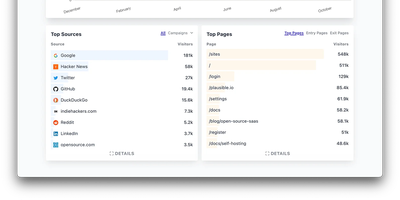
Built as a direct rejection of the adtech model, Plausible is the best-known privacy-first web analytics tool - lightweight, cookie-free, and open-source. It sets no cookies and stores no personal data: unique visitors are counted via a hash of IP plus User-Agent that rotates every 24 hours and is never stored raw, so no consent banner is required and GDPR compliance is structural rather than contractual. The tracking script is under 1 KB - orders of magnitude lighter than GA - and the dashboard is a deliberate contrast to GA4's sprawl: one fast-loading page with visitors, sources, top pages, countries, devices, and UTM breakdowns, filterable by any dimension. Custom events and goals track signups and clicks, Google Search Console integration pulls in search queries, scheduled email reports keep stakeholders updated, and the Stats API (v2) plus CSV export feed data anywhere. This is the AGPL-licensed Community Edition, the same Elixir codebase that powers Plausible's cloud service, running as three containers: the web app, PostgreSQL for accounts, and ClickHouse for event storage - which means self-hosters get direct SQL access to raw analytics data the cloud version never exposes. Traffic data stays entirely on your server, with no visitor caps or per-pageview pricing.
Roundcube
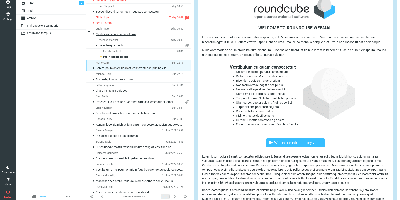
Two decades of continuous development made Roundcube the standard-bearer of open-source webmail - a PHP IMAP client that gives any mail server a polished, application-like interface in the browser. It connects to whatever IMAP/SMTP stack you run - Dovecot, Postfix, a hosted mailbox - and delivers the full desktop-client experience: drag-and-drop message management, threaded conversation views, full MIME and HTML mail handling, find-as-you-type address book with groups and LDAP connectors, multiple sender identities, full-text search, and spell checking in dozens of languages. The default Elastic skin is genuinely responsive, working as well on a phone as a desktop, and the entire UI is skinnable. The plugin API is where deployments get shaped: managesieve exposes server-side filter management in the UI, enigma brings PGP encryption and signing via GnuPG, markasjunk trains spam filters, zipdownload batches attachments, password lets users change credentials, and attachment_reminder catches the classic forgotten-attachment email - among hundreds of community plugins. Built-in caching keeps large mailboxes fast, IMAP ACLs and shared folders support team setups, and XSS protection is engineered into the rendering pipeline. It scales from a single personal mailbox to unlimited users, backed by MySQL, MariaDB, PostgreSQL, or SQLite. GPL-licensed with regular security releases.
PowerDNS-Admin
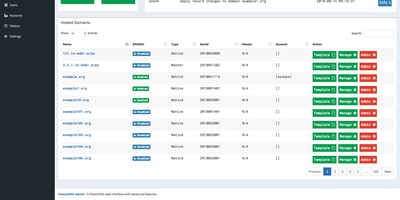
Raw zone files and API calls become something a whole team can operate safely once PowerDNS-Admin puts its web interface in front of a PowerDNS authoritative server. It's a Python/Flask application covering full forward and reverse zone management, with the touches that matter in daily DNS work: zone templates for stamping out consistent new domains, easy IPv6 PTR record editing (reverse zones by hand are misery), full IDN/Punycode support for internationalized domains, and DynDNS 2 protocol support so routers and scripts can update records the way they would against a commercial dynamic-DNS service. Access control is enterprise-grade: local users, LDAP against OpenLDAP or Active Directory, SAML, and OAuth via Google, GitHub, Azure, or OpenID Connect, hardened with TOTP two-factor authentication. Role-based permissions extend to zone-specific access control - hand a developer their project's zone without exposing the rest of your namespace - and activity logging records who changed which record when, the audit trail bare PowerDNS never gives you. The dashboard monitors PDNS service configuration and statistics, and its own API exposes zone and record management for automation on top of the UI. Runs against MySQL/MariaDB or PostgreSQL, talking to PowerDNS through its REST API. MIT-licensed.
SerpBear
Unlimited domains, unlimited keywords, daily Google position checks with stored history and trend charts: SerpBear is an open-source search engine rank tracker. Retrieval works through your choice of third-party SERP APIs - ScrapingAnt, ScrapingRobot, SerpApi, SearchApi, HasData - or your own proxy IP pool, and a flexible scrape-strategy system (Basic, Custom, or Smart, set globally or per domain) works around Google's removal of the 100-results-per-page parameter by choosing how many pages to check per keyword. Google Search Console integration adds real visit counts, impressions, and click-through rates per tracked keyword and surfaces top-performing pages and countries; Google Ads integration supplies monthly search volumes and auto-generates keyword ideas from your site's content. Email notifications report position changes daily, weekly, or monthly, a built-in REST API feeds dashboards and reporting tools, and data exports to CSV. Built with Next.js on SQLite, deployed via Docker, installable as a PWA on mobile - with no per-keyword or monthly SaaS fees.
Dokuwiki
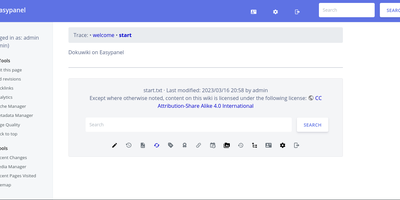
Unleash the power of collective knowledge with DokuWiki, the open-source wiki wizard that's as easy to use as a peanut butter sandwich (minus the sticky fingers). No database? No problem! DokuWiki's got you covered with its sleek syntax that's as clean as your grandpa's Sunday hat. It's the apple of the eye for admins everywhere, thanks to its no-sweat maintenance, backup simplicity, and plug-and-play integration. Lockdown your secrets or share your smarts with DokuWiki's built-in Fort Knox-like access controls and authentication magic. Whether you're building a digital library of Alexandria or just jotting down your world-changing ideas, DokuWiki's plugin treasure trove transforms it from a mere wiki into your digital Swiss Army knife. Collaborate like a band of merry scribes, with swift updates and a historical archive of every brainwave and typo. Ideal for everything from a corporate brain bank to your personal idea dump, a how-to guide, a team's digital war room, or even an intranet that doesn't make you yawn. And with RepoCloud hosting, you'll be saving more dough than a budget bakery, all while customizing your DokuWiki experience from newbie-friendly tweaks to crafting your own digital extensions. So why wait? Make DokuWiki your go-to for shared wisdom without the heavyweight price tag!
Prowlarr
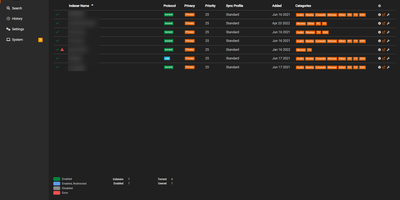
Configure each indexer once, not five times: Prowlarr is the indexer hub of the *arr stack, removing the most tedious duplication in a media automation setup. Instead of configuring the same torrent trackers and Usenet indexers separately in Sonarr, Radarr, Lidarr, Readarr, and Mylar3, you add each one once in Prowlarr and it syncs them to every connected app automatically, complete with category mappings; with Full Sync enabled, adding or removing an indexer propagates everywhere, and a tracker URL change is a one-place fix. Coverage is the deepest available: 500+ torrent trackers with definitions added constantly, 24 native Usenet indexers, generic Newznab and Torznab support for anything else, and custom Cardigann YML definitions with JSON and XML parsing for obscure sources. Built on the same .NET/React base as its siblings, it also earns a place as a search tool in its own right: unified manual search queries every indexer simultaneously at a category level, and you can push multiple releases straight to your download clients without touching Sonarr or Radarr. Health checks and status notifications flag failing indexers, per-indexer statistics track success rates and response times so you can cull unreliable sources, and per-indexer proxy support (SOCKS4/5, HTTP, FlareSolverr) handles trackers behind Cloudflare.
Rallly
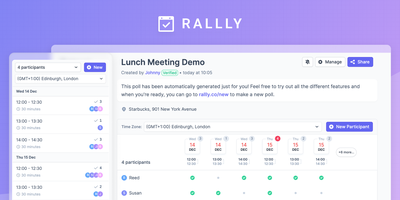
What Doodle did before ads and paywalls took over: Rallly (three L's) lets you propose a few dates, share a link, and watch an availability grid fill in - no email threads, no forced accounts, no "$6.95/month to remove ads." The availability grid makes the winning slot obvious at a glance, comments on each poll keep the "I can do Tuesday if we start late" discussion attached to the decision instead of buried in chat, and email notifications fire as votes and comments arrive. When consensus lands, finalize the winning option and everyone gets notified. The stack is modern TypeScript - Next.js, tRPC, Prisma over PostgreSQL, Tailwind - with a clean, genuinely mobile-friendly UI, dark mode, and community translations in 10+ languages. Self-hosting means unlimited polls and unlimited participants with meeting data on your server rather than a scheduling SaaS. It pairs naturally with Cal.com: Rallly answers "which time works for everyone?", Cal.com handles "book a slot on my calendar." AGPL-licensed.
SearXNG
Up to 280 search services - Google, Bing, DuckDuckGo, Brave, Qwant, Startpage - aggregated without tracking or profiling: SearXNG is a privacy-respecting metasearch engine (AGPL-3.0, successor to Searx). Your instance queries the upstream engines on your behalf: your IP address, cookies, and search history never reach them, tracker parameters are stripped from result URLs, and an optional image proxy fetches thumbnails server-side so result pages leak nothing. It can even route outbound queries through Tor for full anonymity. Search is organized into categories - general, images, videos, news, maps, music, IT, science, files - with bang shortcuts for targeting specific engines, and every source can be enabled, disabled, or weighted per category in settings.yml. A plugin system adds calculators, hash tools, tracker removal, and unit conversions inline, and preferences (themes, safe search, languages, engine selection) persist in cookies rather than server-side accounts. The real argument for running your own instance rather than trusting a public one is control: you decide the logging policy (none), the engine mix, rate limiting, and who gets access - making it the default search backend for browsers, families, and teams that want Google-quality results without the profile.
Silicon Notes
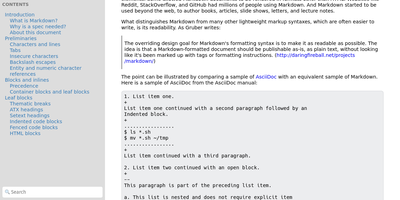
"Somewhat lightweight, low-friction" is how Silicon Notes' author describes the personal knowledge base - written after DokuWiki's editor "drove me mad" and no existing wiki quite fit. The philosophy is that small frequent annoyances compound into cognitive load with no return, so everything here is optimized for frictionless daily use. Notes are written in plaintext Markdown and rendered as clean HTML with Pygments syntax highlighting for code blocks; pages get bi-directional relationships (backlinks), so the knowledge base becomes a connected web rather than a folder tree; and full-text plus title search retrieves anything fast. A table of contents lives in the left sidebar - "where it belongs" - editable while you read without scrolling away. Page history tracks revisions for auditing and rollback, JSON export/import keeps everything portable, and the mobile layout is genuinely usable. The stack is deliberately minimal: Python and Flask with Mistune for Markdown and SQLite for storage - no big frameworks, just a few small dependencies. One honest caveat: there is no built-in authentication, so deploy it behind a VPN, private network, or reverse-proxy auth layer. For a solo engineer's brain, it is exactly enough.