
Ntfy
Get ready to elevate your notification game with ntfy – it's like having a personal town crier for the digital age! This nifty little app turns your phone or desktop into a buzzing hub of updates, all thanks to the magic of HTTP-based chit-chat. Whether you're knee-deep in code or just waiting for that marathon script to finally say 'I'm done!', ntfy is your go-to for keeping in the loop. Just pop the app onto your trusty smartphone, pick a topic that tickles your fancy, and voilà – you're the master of messages! And the best part? It's as free as your grandma's love, but you can throw some coin their way with a premium plan if you're feeling generous. Host it on RepoCloud, and you'll be saving more dough than a budget bakery – all while supporting the open-source vibe!
Plex
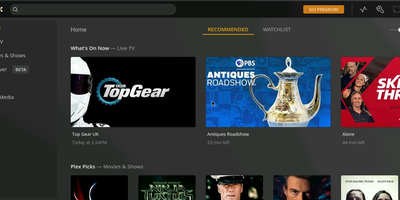
Get ready to unleash your inner media mogul with Plex Media Server, the app that transforms your ho-hum device lineup into a snazzy, streaming powerhouse! Picture this: your entire media empire—be it the tear-jerking dramas, toe-tapping tunes, or those vacation snaps that scream 'I need a better camera'—all at your fingertips, ready to beam across the cosmos to whatever gadget you fancy. Whether you're glued to your smartphone, worshipping the console gods, or binging on the big screen, Plex has got your back. And with networking styles like the bridge (not the one you cross), host (not the one with the most), and macvlan (not a type of pasta), you'll connect faster than you can say 'pass the popcorn'. Plus, with Intel Quick Sync flexing its muscles for hardware transcoding, your streams will be smoother than a jazz sax solo. Host it all on RepoCloud, where the cost is as tiny as the fine print on your phone contract, and you'll be the streaming sensation of the neighborhood!
Roundcube
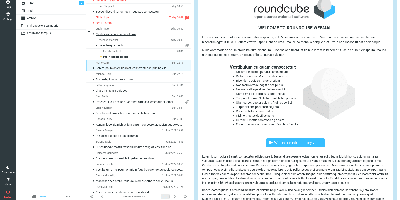
Two decades of continuous development made Roundcube the standard-bearer of open-source webmail - a PHP IMAP client that gives any mail server a polished, application-like interface in the browser. It connects to whatever IMAP/SMTP stack you run - Dovecot, Postfix, a hosted mailbox - and delivers the full desktop-client experience: drag-and-drop message management, threaded conversation views, full MIME and HTML mail handling, find-as-you-type address book with groups and LDAP connectors, multiple sender identities, full-text search, and spell checking in dozens of languages. The default Elastic skin is genuinely responsive, working as well on a phone as a desktop, and the entire UI is skinnable. The plugin API is where deployments get shaped: managesieve exposes server-side filter management in the UI, enigma brings PGP encryption and signing via GnuPG, markasjunk trains spam filters, zipdownload batches attachments, password lets users change credentials, and attachment_reminder catches the classic forgotten-attachment email - among hundreds of community plugins. Built-in caching keeps large mailboxes fast, IMAP ACLs and shared folders support team setups, and XSS protection is engineered into the rendering pipeline. It scales from a single personal mailbox to unlimited users, backed by MySQL, MariaDB, PostgreSQL, or SQLite. GPL-licensed with regular security releases.
Directus
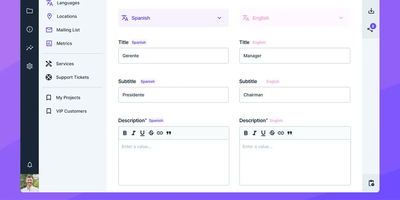
Say hello to Directus, the open-source genie that magically turns any SQL database into a snazzy API and a slick no-code playground. It's like a Swiss Army knife for your data, playing nice with any SQL database you throw at it, so you can keep your precious data right where it is—no moving vans required. With Directus, you get a REST and GraphQL API superhighway built atop your database, making your data dance at your fingertips. And the Directus App? It's like a VIP lounge for your team, where they can schmooze with data in style, managing and visualizing it without breaking a sweat. Whether you're crafting a Backend-as-a-Service masterpiece, spinning up a Headless CMS, building the ultimate internal toolset, or diving into Data Management & Analytics, Directus is your go-to wingman. Plus, with RepoCloud hosting, you'll be saving more coins than a video game plumber, all while enjoying the freedom of open-source camaraderie. Get ready to connect, design, and control like a data wizard, because with Directus and RepoCloud, the digital world is your oyster!
Filerun
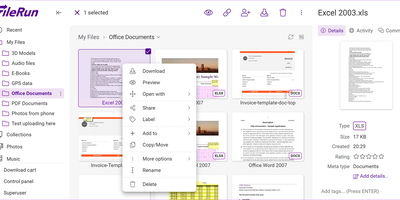
Imagine a digital treasure chest where you're the pirate king, and that's FileRun for you! It's your very own, ultra-private digital locker, akin to a Google Drive that's sworn an oath of loyalty only to you. With FileRun, you can summon your files from any server with a snap of your fingers – no importing shenanigans or scanning sorcery required. It's like having a teleportation portal for your data with FTP, SMB, and WebDAV access that mirrors your file maneuvers in real-time. Want to keep your files in sync? FileRun's desktop apps are like loyal sync-hounds, keeping your digital life in harmony. And for the jet-setters, mobile apps ensure your files are just a tap away, no matter where your adventures take you. Photo aficionados, rejoice! FileRun is a photo management wizard, conjuring thumbnails at lightning speed, offering a stroll down memory lane with timeline browsing, and understanding your photos' inner secrets with metadata support. Create virtual photo albums from scattered folders and share them like a modern-day bard online. The new virtual drive feature is like having an invisible backpack for your files – access them directly without the heavyweight of disk space. Collaborate like a true open-source knight with guest users and file requests, making file collection as easy as a medieval fair. FileRun's plugin posse allows you to edit, view, and convert files with the ease of a court jester's flip. With automatic file versioning and a trash folder for oopsies, your files are as safe as in a dragon-guarded castle. Customize FileRun to flaunt your branding colors and make it yours. Secure, feature-stuffed, and with a mobile experience smoother than a minstrel's tune, FileRun on RepoCloud is the cost-effective way to keep your digital realm in order!

pgweb
Inspect a PostgreSQL database right now, without installing pgAdmin or exposing Postgres to the internet - pgweb answers that recurring need. It's a Go application from Dan Sosedoff, a decade in development, shipped as a single statically-linked binary with zero dependencies - the Docker image is essentially just the executable - that puts a clean browser UI in front of any PostgreSQL 9.1+ server. Connect via URL string or host/port credentials, and browse tables, views, and sequences from the sidebar; selecting a table shows its rows immediately alongside tabs for structure, indexes, and constraints. The Query tab executes arbitrary SQL with query history, and the Explain Query button renders the query plan - estimated cost, row counts, execution strategy - which makes pgweb a quick performance-triage tool, not just a browser. Results and entire tables export to CSV, JSON, or XML in a click. Connectivity is more flexible than its size suggests: native SSH tunneling (password or key) reaches databases behind firewalls, server bookmarks make switching instances instant, and an optional multi-session mode handles several databases concurrently. For a RepoCloud stack full of Postgres-backed apps, one pgweb instance is the universal inspection hatch. MIT-licensed, actively maintained.
Zipline
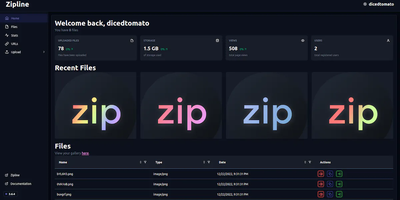
ShareX and file uploads, next generation: Zipline is a Node.js/React/PostgreSQL server that turns screenshot sharing and file hosting into something you run yourself instead of renting from Imgur or a paid image host. The core workflow is built around ShareX: generate an .sxcu config from your account settings, import it, and every screenshot or clipboard capture uploads to your domain with a short link copied automatically. Uploads accept any file type, organized with folders and tags, with token-protected uploading, optional password protection, view-limited auto-deletion, image compression, metadata stripping, automatic video thumbnails, and chunked/partial uploads for large files. File URLs come in configurable formats - UUIDs, dates, random alphanumerics, original names, even zero-width spaces. A built-in URL shortener adds vanity slugs, passwords, view caps, and custom domains. Discord embeds are first-class: customize OG metadata titles, descriptions, and colors so links unfurl exactly how you want, and fire fully customizable Discord or HTTP webhooks on each upload. Authentication is serious: OAuth2 (Discord, GitHub, Google, OIDC), TOTP two-factor, and passkeys, with invite-based registration and per-user quotas for shared instances. Storage targets local disk or any S3-compatible backend, a full REST API automates everything, and custom themes plus a PWA round out the experience.

Minecraft Server
Get ready to craft, mine, and host like a pro with the itzg/minecraft-server app! This digital wizardry ensures your Minecraft escapades are never behind the times by magically summoning the latest stable version of the Minecraft server at launch. Want to be a version virtuoso? No problemo! You can pick your potion, be it a specific release or the freshest snapshot, and wield the power to tailor your pixelated playground. Console knights, mobile adventurers, and Windows warriors, rejoice! There's a Bedrock Server with your name on it for that buttery-smooth blocky bliss. And because we're not about that 'complicated' life, the classic port 25565 is ready to roll out the red carpet directly to your host machine. Host your blocky realms on RepoCloud, where the cost is as tiny as a block of dirt, but the fun is as big as a mountain biome!
PsiTransfer
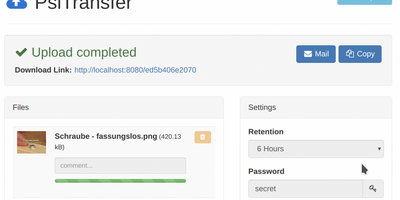
Upload files, get a share link, let it expire: PsiTransfer is a self-hosted WeTransfer with no accounts, no logins, and no third-party cloud with size caps and metadata harvesting. The engineering focus is large files over imperfect networks. Uploads use the tus.io resumable protocol, so a dropped connection on a multi-gigabyte video resumes exactly where it stopped once you're back online; downloads support HTTP range headers for the same resilience, and everything streams, so file size is bounded by your disk rather than memory. Files organize into upload buckets with retention you control: expire after a set time (up to weeks) or after a one-time download, with automatic cleanup when links lapse. Recipients need nothing installed - they open the link, preview files in modal views, and grab everything as a zip or tar.gz archive with one click. Buckets can be password-protected (AES-encrypted download lists), and security-through-obscurity is done properly: bucket URLs use hashed UUID tokens and stored filenames are replaced with UUIDs. An optional admin page (enabled by setting an admin password) lists bucket information and storage. The Vue.js frontend ships under 100 KB gzipped and is fully responsive. Honest caveat from the author: no end-to-end payload encryption yet. BSD-licensed, Docker-ready.
Mstream
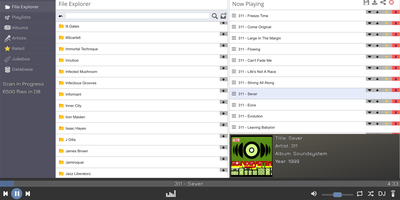
"The easiest music streaming server available" is mStream's own billing, and the claim holds up: a lightweight Node.js app that turns a folder of audio files into a private streaming service in minutes, no external database required. Its filesystem-based design is the clever part - the API mirrors your folder structure, so you can browse and play music immediately, before any library scan finishes, and your organization on disk is your organization in the app. It streams flac, mp3, wav, ogg, opus, aac, and m4a, which matters to the audiophile crowd: FLAC plays uncompressed, bit-perfect, with gapless playback for live albums and continuous mixes. The web player runs anywhere a browser does and packs personality - a Milkdrop-style visualizer (Butterchurn), playlist sharing via links, and drag-and-drop uploads straight through the file explorer. Native iOS and Android apps add the feature streaming subscriptions can't match: sync your collection to your phone for true offline playback of music you own. Multi-user support assigns separate directories and permissions per account. Resource usage is famously light - mStream is tested on multi-terabyte libraries and runs happily on a Raspberry Pi, so a small RepoCloud instance serves a lifetime's collection. GPL-licensed, with zero listening-habit telemetry.
Emby
Point Emby at your movie, music, and photo libraries and it becomes a private streaming service: metadata and artwork arrive from TMDB and TVDB, everything lands in a polished browsable interface, and media transcodes on the fly whenever a client can't play the original format. The client reach is the selling point: native apps span Android TV, Apple TV, Google TV, Fire TV, Roku, LG and Samsung smart TVs, iOS, Android, Apple CarPlay, Android Auto, plus web browsers and desktop apps for Windows, macOS, and Linux, and DLNA devices are auto-detected for casting and remote control. Multi-user support gives each household member their own account, watch history, favorites, and recommendations, with genuinely capable parental controls: content restrictions, access schedules, time limits, and live monitoring with remote control of kids' sessions. Live TV works with hardware tuners like HDHomeRun or M3U playlists, with free guide data in the US, Canada, and UK. The server and core features are free; an optional Premiere key adds hardware-accelerated transcoding, DVR recording, offline sync, and Cinema Mode intros.
Appsmith
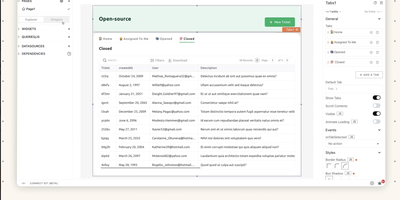
Admin panels, database GUIs, dashboards, approval flows, customer support consoles - Appsmith builds the internal tools your team keeps postponing, on an open-source low-code platform. The UI assembles from 45+ drag-and-drop widgets - tables with server-side pagination and inline editing, charts, forms, lists, buttons - which bind to data through {{ }} JavaScript expressions anywhere in the editor. Datasources cover PostgreSQL, MySQL, MongoDB, MS SQL, Redis, Snowflake, and more, plus any REST or GraphQL API, with SaaS integrations and AI query support for prompt-based steps inside apps. When the widget library falls short, custom widgets are plain JavaScript, HTML, and CSS, and external JS libraries can be imported, which keeps the platform extensible where pure no-code tools hit walls. Git-based version control enables branch-based collaboration, review, and rollback of app definitions. Queries and JS objects hold the business logic layer between datasources and UI. Self-hosted via Docker or Kubernetes, with role-based access control for published apps.

Photoview
Snap-happy shutterbugs, rejoice! Photoview is like a personal butler for your pixels, smartly sorting your snapshots and vids into a swanky digital gallery. Glide through gigabytes of glossy high-res memories with the grace of a gazelle. It's like having a psychic librarian who knows exactly where every photo and video is shelved, thanks to its magical sync with your file system. Wave goodbye to manual updates; this clever curation companion refreshes your collection as you add new moments to your montage. Fancy a bit of privacy? No problemo! Each user gets their own secret stash of media, locked down tighter than a drum with usernames and passwords. Want to flaunt your latest landscape shot or adorable kitten video? Share away with links that are as public or as hush-hush as you like. Photoview's got a knack for nosing out EXIF metadata, so you can see the 'who, what, when, and where' of every image, and even pin them to a map like a globetrotting detective. On the move? The iOS mobile version lets you peek at your portfolio on-the-fly. From RAW riddles to video voodoo, Photoview handles it all, dishing out thumbnails and web-optimized videos with the ease of a master chef. All this, hosted on RepoCloud, where the cost is as tiny as the thumbnails it creates, but the value is as vast as your ever-growing gallery of life's moments.
HumHub
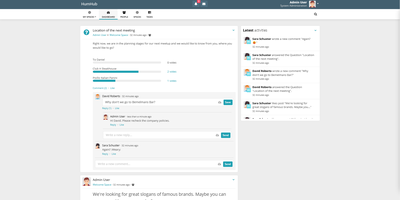
Workplace and Yammer's pattern on your own server, with GDPR compliance by construction rather than contract: HumHub is an open-source enterprise social network from Germany. Built in PHP on Yii2, it organizes everything around four concepts. Users get rich profiles with follows and interactions. Spaces are the structural unit - rooms for departments, projects, events, or clubs, with per-Space permissions, notification settings, and email summaries, and operators can auto-map users into the right Spaces. Content covers posts, wiki pages, photos and video, events, and tasks, with multi-level comments, versioning, archiving, moderation reporting, and filterable full-text search across everything. Modules make it a platform: roughly 80 install-and-activate extensions including Calendar, Wiki, Polls, Tasks, Gallery, News, direct-message Mail, OnlyOffice document editing, Advanced LDAP, SAML and JWT SSO, a RESTful API, mass user import, Translation Manager, and a Theme Builder with custom pages - every one optional and toggleable at runtime. That module economy is why HumHub serves such varied deployments: corporate intranets, city governments, universities, political parties, and nonprofits all configure the same core differently. Requirements are a plain LAMP stack - PHP 8.1+ and MySQL/MariaDB - making it one of the easiest community platforms to operate long-term.
linkding
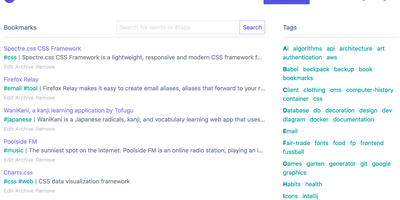
For people who found del.icio.us perfect and everything since bloated, linkding is the bookmark manager - a Django application whose entire design goal is saving and finding links with zero friction. Paste a URL and it fetches the title, description, favicon, and preview image automatically; organize with tags, search full-text across everything, mark bookmarks unread for read-it-later, attach Markdown notes, and bulk-edit whole selections at once. Its answer to link rot is archiving: bookmarked pages can be snapshotted automatically, either submitted to the Internet Archive or saved as local HTML files, and a documented SingleFile browser-extension integration uploads full self-contained page captures straight to your instance. Official Firefox and Chrome extensions (plus a bookmarklet) make saving a one-click habit, the UI installs as a Progressive Web App on mobile, and multi-user support with bookmark sharing - to users or logged-out guests - covers families and teams, with SSO via OIDC when needed. The REST API (create, search, filter by tag) has spawned a genuine ecosystem of community mobile apps and libraries. Operationally it is famously boring in the best way: one small container, SQLite by default, automated migrations, and a zero-breaking-changes policy. Import and export use standard Netscape HTML. MIT-licensed.
Gitea
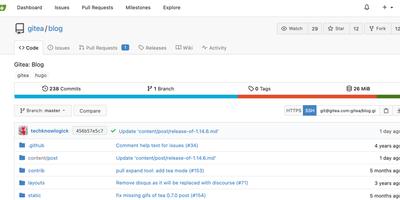
Get ready to turbocharge your code capers with Gitea, the DevOps dynamo that's lighter than a feather and slicker than a greased byte! This nifty platform is your one-stop shop for herding those pesky code commits from the wild plains of planning all the way to the bustling metropolis of production. Fancy a stroll through the annals of commit history? Gitea's got you covered. Need to merge like a pro? Check. And for the Git gurus, we're talking tags, cherry-picking fiestas, and hooks that would make Captain Hook jealous. But wait, there's more! Unleash the power of Gitea Actions, the CI/CD sidekick that plays nice with GitHub Actions, ensuring your deployment dance is as smooth as a robot doing the moonwalk. Juggle issues, labels, and kanban boards like a coding circus star, and manage over 20 flavors of package management – because variety is the spice of source code. Hosted on RepoCloud, where the cost is as tiny as a bug in a nano-simulator, Gitea is the open-source hero that's all about flexing to fit your workflow, while keeping things tighter than a duck's waterproof feathers when it comes to security. So why settle for less when you can customize, collaborate, and create with the best, all while saving your coins? Gitea and RepoCloud: where code dreams come true, without the nightmare bills!
Jirafeau
Upload a file, get a unique download link and a separate delete link - Jirafeau has done exactly this one thing since 2008. It is plain PHP with no database, no mail server, no JavaScript framework, and no external dependencies - files and metadata live on the filesystem, which is why it runs on nearly anything and why it has outlasted most of its imitators. Uploads use the HTML5 file API, so PHP's post_max_size ceiling does not constrain file size, with live progress showing speed, percentage, and time remaining. Every upload takes options: expiration from one minute to a year to unlimited, self-destruct after first download, and password protection with configurable policy - passwords can be optional, required, or server-generated with complexity rules. Server-side encryption (modern builds use XChaCha20-Poly1305) stores files encrypted at rest with the decrypt key embedded only in the download URL, never on the server, so a compromised host cannot read the contents. Unencrypted deployments get file-level deduplication - identical files stored once with multiple links. Upload access can be gated by password lists or IP allowlists, a small admin panel manages stored files, and a CLI cleanup script handles expired files via cron. Recipients can preview supported files in-browser.
Filezilla Client
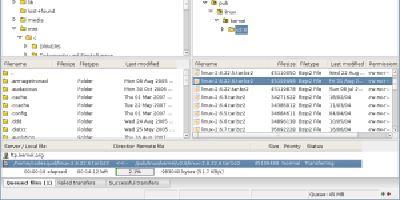
Zip through the digital skies with FileZilla Client, the speed-demon of file transfer programs! This nifty app plays nice with FTP, FTPS, and SFTP, and doesn't discriminate against your platform of choice. It's like having a Swiss Army knife for your files, complete with a user-friendly graphical interface that even your grandma could love. Imagine sending pictures so crisp and fast, your web browser won't know what hit it. FileZilla Client is a master of disguise, supporting multiple architectures and whispering sweet nothings to the internet via HTTP or HTTPS. Tired of playing the 'who's got the permissions?' game? Set your user PUID and group PGID to keep the peace between your host OS and the container. And for the control freaks in the room, you can even tweak the umask settings to tell your services how to behave inside their container homes. Host it on RepoCloud, and you'll be the file-transferring hero you always knew you could be, without burning a hole in your wallet!