Openblocks
description_humorous
CyberChef
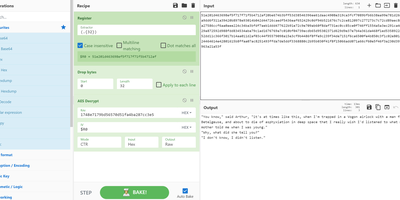
GCHQ open-sourced its "Cyber Swiss Army Knife", and CyberChef became the web app security analysts, incident responders, and CTF players reach for when data needs decoding, decrypting, or dissecting. Its interface is four panes: paste or drag input (files up to 2GB), search a categorized library of hundreds of operations, drag them into a recipe with arguments, and read the output. Operations span Base64, hex, and XOR encoding; AES, DES, and Blowfish encryption; classical ciphers from Caesar to Railfence; hashes and checksums; compression; regex and string extraction of IPs, domains, and URLs; timestamp conversion; and parsers for IPv6, X.509 certificates, and more. Recipes chain arbitrarily - convert from a hexdump then decompress, decrypt AES pulling the IV from the cipher stream, or let the Magic operation auto-detect several layers of nested encoding. Auto Bake re-runs the recipe live as input or arguments change, Step executes one operation at a time for debugging, and flow control (forks, subsections, registers) applies different operations to different parts of the data. Recipes save to files or share as URLs encoding the full pipeline. Crucially, CyberChef is entirely client-side JavaScript - nothing uploads anywhere - and self-hosting guarantees an unmodified copy inside your own network, where malware artifacts belong.
Nzbget
Written in optimized C++ where competitors use Python or Java, NZBGet saturates fast connections while idling on CPU and RAM - which is why the performance-obsessed Usenet downloader has long been the client of choice for NAS boxes, Raspberry Pis, and routers as much as full servers. The engineering shows in the recovery pipeline. Instead of shelling out to par2cmdline, NZBGet integrates the par2 source directly and exploits its knowledge of exactly which articles failed - quick par-verification checks only what needs checking, and its own multicore repair implementation runs 2-3x faster than the external tool on the same hardware. Fast par-rename deobfuscates scrambled filenames in seconds without a full verification pass, and rar-rename recovers names for multivolume archives even when no par2 files exist. DirectWrite assembles articles straight into sparse destination files, skipping temporary-file churn entirely, with an article cache and queue-pausing options to eliminate disk contention. Automation is complete: a remote web interface, full JSON-RPC API, RSS feeds with duplicate detection, scheduling and prioritization, and an extension manager for Python and Bash scripts triggered by download events. Sonarr, Radarr, and every major indexer integrate natively.
Nextcloud
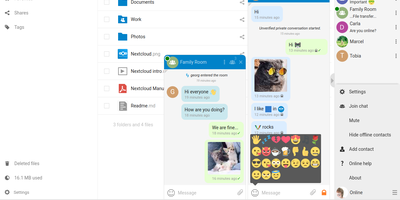
Google Workspace and Microsoft 365, replaced by a platform you actually control: Nextcloud is the self-hosted digital workspace. Files is the core: file storage and sync across desktop, mobile, and web clients, with sharing, versioning, and collaboration built in. Around it, Talk provides private text chat, audio/video conferencing with screen sharing, SIP integration, and persistent voice rooms; Groupware bundles calendar, contacts, and mail with delegation support; and Office offers two collaborative suites - the Collabora-based option with deep ODF support, and Euro-Office, whose local-processing architecture delivers strong Microsoft Office compatibility and fast browser rendering with reduced server load. The Nextcloud Assistant threads AI through the platform via a context-aware sidebar, Whiteboard covers visual collaboration, Flow handles automation, and an app ecosystem of hundreds of extensions adds everything from Kanban boards to end-to-end encryption. Hub 26 brings a lighter UI with a unified app switcher and Nextcloud Governance for organizations under strict regulatory requirements. This is the flagship of data sovereignty: your files, chats, calendars, and documents live on your server, under your jurisdiction, with GDPR compliance by architecture rather than by contract.
Netbox
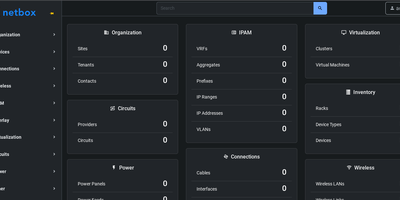
Get ready to crown NetBox as the reigning monarch of your network kingdom! This all-encompassing wizardry tool is your go-to grimoire for every byte and bolt in your digital dominion. From the mystical lands of power circuits to the vast expanse of virtual vistas, NetBox conjures up a crystal-clear map of your network's noble lineage, including IP addresses, VLANs, and the secret tunnels of cabling. It's like having a network nanny, but instead of babysitting, it's automating and monitoring your network's every move, ensuring your configurations are as sharp as a knight's sword. With NetBox, you'll be the Merlin of DCIM, wielding visibility and control over your enterprise realm with the ease of a magic wand. And when it comes to IP Address Management, think of it as your enchanted spell book, safeguarding your IP treasures from the dragons of data entry blunders. Customizable to the core, NetBox is ready to integrate and expand, fitting into your kingdom like the perfect piece in a game of thrones. Host it on RepoCloud, and you'll save enough gold to fill a dungeon, all while keeping the open-source spirit alive and kicking!

Cusdis
Comments for small sites without Disqus's baggage: Cusdis is a lightweight, privacy-first, open-source comment system for embedding under blog posts and articles. The embedded JavaScript SDK is about 5 KB gzipped (Disqus is roughly 24 KB), sets no cookies, runs no tracking, and does not require readers to create an account or sign in before commenting. Integration is two lines: a container div with your app ID and an async script tag, with ready-made adapters for common frameworks and static site generators. Moderation is approval-based - new comments stay hidden until you approve them from the dashboard, and email notifications include a Quick Approve link that approves or replies to a comment from your phone without logging in. A webhook fires on every new comment for integrations like Telegram notifications. The widget ships with built-in i18n and dark mode. The stack is TypeScript and Next.js with a Prisma data layer, deployable via Docker with PostgreSQL. Deliberately minimalist: no ads, no reader profiling, and your comment data lives in your own database.
Limesurvey
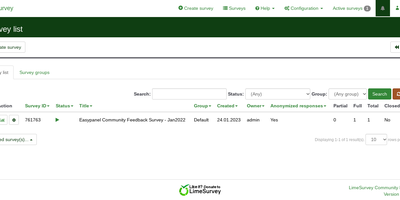
Step right up to the survey fiesta with LimeSurvey, the undisputed heavyweight champion of the survey world! This zesty platform is your golden ticket to survey nirvana, where you can whip up everything from a breezy poll to a brain-busting questionnaire with more twists and turns than a telenovela. Perfect for the curious student, the savvy professional, or the enterprise with questions galore, LimeSurvey is the Swiss Army knife of feedback tools – and it won't cost you a dime! Wave goodbye to the yawn-inducing forms of yesteryear and say 'Hola!' to a world where conditional logic dances the salsa with complex validation rules. And for the scholarly crowd, LimeSurvey rolls out the red carpet, offering a treasure trove of open-source goodies that'll make research institutes and universities do the academic conga. With templates so user-friendly they practically hold your hand, and a customer service squad ready to leap to your aid, LimeSurvey hosted on RepoCloud is the piñata of possibilities – just waiting for you to take a swing!
SearXNG
Up to 280 search services - Google, Bing, DuckDuckGo, Brave, Qwant, Startpage - aggregated without tracking or profiling: SearXNG is a privacy-respecting metasearch engine (AGPL-3.0, successor to Searx). Your instance queries the upstream engines on your behalf: your IP address, cookies, and search history never reach them, tracker parameters are stripped from result URLs, and an optional image proxy fetches thumbnails server-side so result pages leak nothing. It can even route outbound queries through Tor for full anonymity. Search is organized into categories - general, images, videos, news, maps, music, IT, science, files - with bang shortcuts for targeting specific engines, and every source can be enabled, disabled, or weighted per category in settings.yml. A plugin system adds calculators, hash tools, tracker removal, and unit conversions inline, and preferences (themes, safe search, languages, engine selection) persist in cookies rather than server-side accounts. The real argument for running your own instance rather than trusting a public one is control: you decide the logging policy (none), the engine mix, rate limiting, and who gets access - making it the default search backend for browsers, families, and teams that want Google-quality results without the profile.
Nango
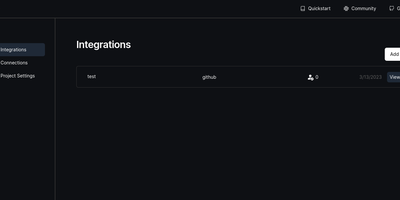
The integrations your SaaS product offers its own users - that is what Nango, an open-source product-integrations platform, exists to build. It solves the repetitive infrastructure work behind every third-party API connection: OAuth flows, API key handling, token refresh, encrypted credential storage, rate-limit backoff, retries, and multi-tenant connection management. It ships pre-built auth configurations for 800+ APIs. Your users connect their accounts through an embeddable, white-label Connect UI, and your backend then reads or writes data through Nango's proxy, SDKs, or REST API without ever touching raw credentials. Integration logic is written as TypeScript functions covering actions, scheduled data syncs, and webhook processing - all running on one runtime with retries, checkpointing, and per-connection logs built in. Syncs pull records incrementally on a schedule, one-way or two-way, which suits RAG pipelines, search indexing, and keeping local copies of external data current. Selected actions can also be exposed as tool schemas or through a built-in MCP server, so AI agents operate on user-connected accounts without ever handling provider credentials. Auth support spans OAuth 2.0, OAuth 1.0a, API keys, basic auth, and JWT, and observability - logs, metrics, failure detection, and a reconnect flow for expired credentials - is scoped per customer connection for easier support debugging. Works with any backend language. Self-hosting on RepoCloud keeps all customer credentials and synced data on infrastructure you control, which matters for data residency and compliance requirements.
Qdrant
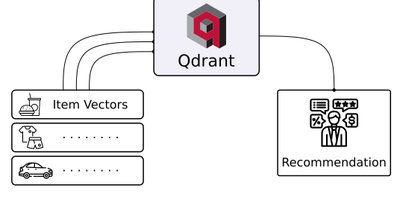
Embark on a quest with Qdrant, the Herculean vector database that's flexing its muscles to revolutionize AI apps. Imagine a digital genie that grants you the power to sift through high-dimensional space with the ease of a cosmic search engine. It's not just an API service; it's your ticket to transforming brainy embeddings into superstar applications that can match, search, and recommend like a boss. Qdrant is like the Swiss Army knife for data types, handling everything from witty string banter to numerical ninja ranges, and even geo-locations with a sense of wanderlust. It's cloud-native, so it grows with your ambitions, scaling horizontally like it's training for the digital Olympics, all while being as resource-efficient as a monk. Host it on RepoCloud, and you'll be building semantic neural search castles in the sky in no time, understanding user antics as they unfold, and spotting similar images or duplicate doppelgängers with the sharpness of an eagle. It's the open-source powerhouse that makes your data dance to the tune of innovation, all at a cost that keeps your wallet as happy as a clam at high tide!

NocoDB
Any existing relational database becomes a collaborative, Airtable-style smart spreadsheet under NocoDB. It connects to PostgreSQL, MySQL, MariaDB, SQL Server, or SQLite, introspects the schema - tables, relationships, indexes - and renders it as interactive Grid, Gallery, Kanban, Calendar, and Form views without migrating a single row. Your business data stays in your database; NocoDB keeps only its own metadata (view configs, permissions, webhooks) in a separate store. Every connected table automatically gets REST APIs with Swagger documentation, effectively turning legacy databases into modern backends. The spreadsheet layer adds 20+ field types including formulas, lookups, rollups, links, attachments, and currency, plus sorting, filtering, grouping, and multi-field editing. Views can be locked or shared publicly with password protection, role-based access control scopes permissions per user, and webhooks plus CSV, Excel, and Airtable import round out integration. An ERD view visualizes the schema. Built with Node.js and Vue, deployed via Docker, handling millions of rows.

Metabase
The most widely deployed open-source BI tool, Metabase is a visualization and query layer that sits on top of your existing databases without ingesting or copying data. Non-technical users ask questions through a visual query builder with drill-through menus that answer follow-ups like "broken down by month" without writing a new query, while analysts use the native SQL editor with variables and templates for complex work. Questions assemble into interactive dashboards with filters, auto-refresh, fullscreen mode, and custom click behavior, and dashboard subscriptions email or Slack scheduled reports to stakeholders. It connects to 20+ data sources including PostgreSQL, MySQL, MongoDB, SQL Server, BigQuery, Snowflake, Redshift, and ClickHouse - always querying in place, so there is no second data store to secure, sync, or pay for, and results are always current. Models and metrics let a data team define official, reusable starting points so self-service stays consistent, collections with permissions organize content, and alerts fire when a metric crosses a threshold. The practical effect is cutting the ad-hoc query queue that lands on the data team, since non-technical staff can answer their own questions. Written in Clojure, licensed AGPL, and shipped as a single JAR or Docker image with an embedded application database - a working BI instance runs before most tools finish their installer - the open-source edition has no limits on users, dashboards, or connected databases, where commercial BI platforms price per viewer as well as per creator.
Budibase
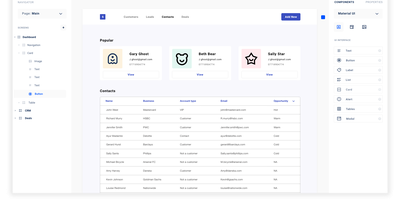
Unleash the power of Budibase, the open-source superhero that transforms mere mortals into tool-creating wizards! Wave goodbye to the dark ages of time-consuming tool development and say hello to lightning-fast app conjuring. With Budibase, you don't need a spellbook (or coding experience) to whip up custom internal tools and forms faster than you can say 'Abracadabra!' Connect with your existing database, charm data from a Rest API, enchant a CSV into submission, or craft from the ether with Budibase's own mystical database. Drag, drop, click, and—voilà!—automated workflows and dazzling designs appear out of thin air. Join the league of over 75,000 teams who've harnessed Budibase to accelerate their business operations to warp speed. Need to secure your data treasures, automate the mundane, or streamline your kingdom's processes? Budibase has got your cape. Plus, hosting on RepoCloud means you'll save a treasure chest of gold compared to those other cloud giants!
SerpBear
Unlimited domains, unlimited keywords, daily Google position checks with stored history and trend charts: SerpBear is an open-source search engine rank tracker. Retrieval works through your choice of third-party SERP APIs - ScrapingAnt, ScrapingRobot, SerpApi, SearchApi, HasData - or your own proxy IP pool, and a flexible scrape-strategy system (Basic, Custom, or Smart, set globally or per domain) works around Google's removal of the 100-results-per-page parameter by choosing how many pages to check per keyword. Google Search Console integration adds real visit counts, impressions, and click-through rates per tracked keyword and surfaces top-performing pages and countries; Google Ads integration supplies monthly search volumes and auto-generates keyword ideas from your site's content. Email notifications report position changes daily, weekly, or monthly, a built-in REST API feeds dashboards and reporting tools, and data exports to CSV. Built with Next.js on SQLite, deployed via Docker, installable as a PWA on mobile - with no per-keyword or monthly SaaS fees.
Baserow
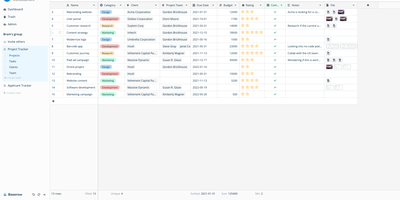
Airtable's spreadsheet-database model, self-hostable and open-source: that is Baserow. It presents data in a spreadsheet-style grid, but underneath each table is a real relational structure with typed fields, links between tables, filters, sorts, and multiple views (grid, gallery, form, kanban, calendar). Beyond the database core, it includes an application builder for composing pages and portals on your data, workflow automations, and dashboards. Everything is API-first: each table exposes a REST endpoint with token auth and webhooks, so it plugs directly into n8n, Zapier, or custom scripts. The stack is Django (Python) on the backend, Vue.js on the frontend, PostgreSQL for storage, with Redis for async tasks. Core features are MIT-licensed; premium features are a paid add-on. The self-hosted version has no row, storage, or API request limits - Airtable's per-base record caps and monthly API quotas simply don't exist here, and capacity is bounded only by your PostgreSQL database and disk. Existing Airtable bases, CSVs, and Excel files import directly with structure preserved, so migration doesn't start from a blank slate, and both the backend and frontend support plugins for custom field types and integrations without forking the core. For non-technical teammates the interface behaves like a spreadsheet; for engineers, the data model is the API.
Botpress
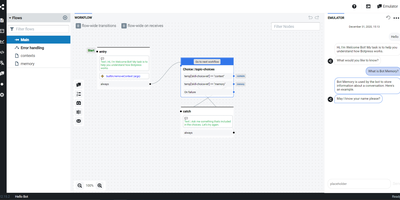
Build, deploy, and monitor chatbots and LLM-powered agents on one open-source conversational AI platform: Botpress. Its Studio is a visual development environment: a drag-and-drop canvas arranges conversation logic with nodes for messages, questions, choices, and actions, while a built-in emulator simulates conversations for debugging before anything goes live. Agents ground their answers in a knowledge base assembled from uploaded documents, ingested websites, and past conversations via retrieval-augmented generation, and the LLM layer connects to multiple model providers - GPT-4, Claude, Mistral - with a configurable model strategy. An autonomous engine handles reasoning, tool orchestration, persistent memory across sessions, and sandboxed code execution, and custom code actions in TypeScript extend agents past prebuilt workflows. Over 100 integrations deploy the same bot to WhatsApp, Telegram, Slack, Microsoft Teams, and web chat, and connect it to HubSpot, Zendesk, Zapier, and arbitrary APIs and webhooks. Human handoff, conversation analytics, and quality monitoring cover production operation. Originating in 2017 from a Montreal team, the community edition is developed openly on GitHub.
Rallly
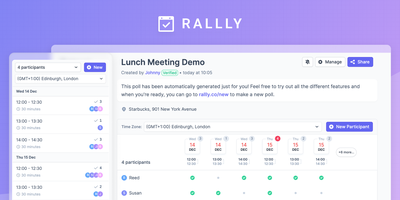
What Doodle did before ads and paywalls took over: Rallly (three L's) lets you propose a few dates, share a link, and watch an availability grid fill in - no email threads, no forced accounts, no "$6.95/month to remove ads." The availability grid makes the winning slot obvious at a glance, comments on each poll keep the "I can do Tuesday if we start late" discussion attached to the decision instead of buried in chat, and email notifications fire as votes and comments arrive. When consensus lands, finalize the winning option and everyone gets notified. The stack is modern TypeScript - Next.js, tRPC, Prisma over PostgreSQL, Tailwind - with a clean, genuinely mobile-friendly UI, dark mode, and community translations in 10+ languages. Self-hosting means unlimited polls and unlimited participants with meeting data on your server rather than a scheduling SaaS. It pairs naturally with Cal.com: Rallly answers "which time works for everyone?", Cal.com handles "book a slot on my calendar." AGPL-licensed.

Jellyfin
Unleash the kraken of your media collection with Jellyfin! This open-source maestro of media turns your server into a personal streaming powerhouse. Picture this: your entire cinematic universe, TV binges, concert halls, and even your digital bookshelf, all at the tips of your fingers, ready to beam to any gadget you own. Jellyfin is like a Swiss Army knife for your media – it slices, dices, and serves up live TV and DVR, so you can catch the latest episode or save it for a rainy day. And with SyncPlay, you can synchronize your watch parties across the globe, because who doesn't love a good movie with friends? Available on all the cool kid platforms, Jellyfin ensures you're never more than a click away from your media munchies. Plus, with a GNU GPL license, it's more free than a bird – modify, remix, and share to your heart's content. And the cherry on top? Jellyfin is a privacy ninja, dodging trackers and keeping your data out of the clutches of the digital overlords. Host it on RepoCloud, and you'll be saving coins faster than a video game plumber, all while enjoying the open-source camaraderie!