Khoj
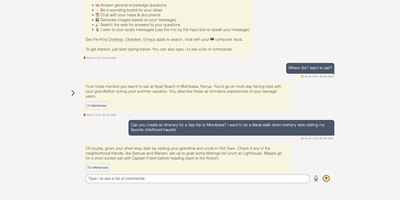
A self-hosted "second brain": Khoj indexes your own files and answers questions from them, parsing Markdown (whole Obsidian vaults included), org-mode, PDF, Word, plain text, Notion pages, GitHub repositories, and images described by a vision model, then embedding everything with sentence-transformers into a vector index for semantic search and RAG with cited sources. Any LLM backend works: local models like Llama, Qwen, or Mistral via Ollama, or cloud models like GPT, Claude, and Gemini. You can build custom agents, each with its own persona, scoped knowledge base, chat model, and tools such as web search and code execution. Scheduled automations run recurring research and deliver newsletters or notifications to your inbox, and research mode performs multi-hop web searches with inline citations. Access it from a browser, the Obsidian plugin, Emacs, desktop, or WhatsApp - all clients connect to the same self-hosted instance, making Khoj one of the few AI assistants Emacs users can point at decades of org files. Semantic search means recall works without exact keywords: "that paper about forecasting with transformers" surfaces the right PDF even when you cannot remember its title. Switching LLM backends never requires re-indexing your documents, and with a local model via Ollama, even inference stays on hardware you control - journals, research, and private notes are never sent anywhere. Python/FastAPI stack, AGPL-licensed, with PostgreSQL storage.

Prometheus
Meet Prometheus, the monitoring superhero you never knew you needed! Forget about those boring old dashboards that look like they were designed in the 90s—Prometheus brings your metrics to life with the flair of a disco ball at a developer party! This open-source marvel collects data from your targets faster than you can say "scalability" and alerts you when things go south, ensuring you're always one step ahead of disaster (or at least one alert ahead). With its time-series storage, you can track your application's performance like a hawk, while PromQL lets you query data in real-time, making you feel like a data wizard casting spells. Plus, it plays well with others—integrating seamlessly with Docker, Kubernetes, and even your favorite alerting tools like Alertmanager, which means you'll get notifications via email, Slack, or carrier pigeon (okay, maybe not the last one). So, if you're tired of your monitoring tools being about as useful as a chocolate teapot, give Prometheus a whirl and watch your infrastructure shine brighter than your last side project!
Jenkins
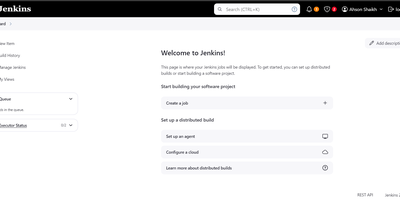
Welcome to Jenkins, the over-caffeinated automation server that’s like having a personal assistant who never sleeps and always remembers your build commands! Imagine a world where your software development process is smoother than a freshly brewed cup of coffee – that’s Jenkins for you! It’s the ultimate wingman for developers, tirelessly working behind the scenes to ensure your code is built, tested, and deployed faster than you can say 'continuous integration.' With Jenkins, you can finally stop worrying about those pesky manual tasks and focus on what really matters: arguing with your colleagues over the best pizza toppings during sprint meetings. Plus, it runs in servlet containers like Apache Tomcat, so you can feel fancy while you automate your way to success. So why not let Jenkins take the wheel while you kick back, relax, and enjoy the sweet, sweet taste of automated bliss? Your code will thank you, and so will your sanity!

Whoogle
Google's search results without Google's surveillance: Whoogle is a self-hosted proxy that strips the tracking and keeps the results. Your query goes from browser to your Whoogle instance, which fetches results from Google with a randomly generated User Agent and strips everything hostile before returning them: no ads or sponsored content, no third-party JavaScript or cookies, no AMP links, no URL tracking tags like utm_source, no referrer header - and Google sees your server's IP, never yours. Unlike metasearch engines that blend sources, Whoogle proxies Google exclusively, so result quality is exactly what you'd get logged out and incognito, minus the noise. A lightweight Flask app configured entirely through environment variables, it supports DuckDuckGo-style bang shortcuts, autocomplete suggestions, safe search, per-country and per-language filtering, site blocklists, and automatic rewriting of social links to privacy front-ends like Nitter and Invidious. Privacy hardening goes further: built-in Tor routing makes Google see an exit node instead of your server, HTTP/SOCKS proxy support covers other setups, and POST-based queries keep search terms out of logs. Light, dark, and fully custom CSS themes plus browser search-engine registration make it a drop-in default on desktop and mobile. Stateless, tiny, and trivial to run.
YOURLS
Ever wanted to shorten your URLs without feeling like you just handed over your life savings to a corporate giant? Enter YOURLS, the self-hosted URL shortener that lets you take control of your links like a boss! With a sleek interface that’s easier to navigate than your grandma’s Facebook page, you can create and manage short URLs while keeping your branding intact. Plus, it’s got plugins galore—because who doesn’t love a little extra functionality? And let’s not forget the detailed analytics that’ll make you feel like a data scientist, tracking clicks like a hawk on a mission. Accessible on ports 8080 and 8081, YOURLS is like the Swiss Army knife of URL shortening, but without the risk of cutting yourself. So why let the big guys take your links hostage when you can self-host your own? Deploy YOURLS today and give your URLs the makeover they deserve, all while saving enough cash to treat yourself to that fancy coffee you’ve been eyeing!
AgentGPT
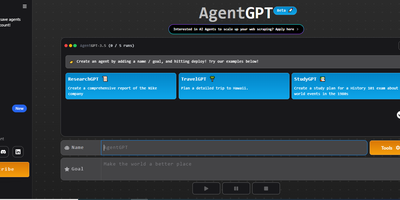
Meet AgentGPT, your personal AI sidekick that’s more ambitious than your last New Year’s resolution! Ever wanted a digital buddy who doesn’t just sit around binge-watching cat videos? With AgentGPT, you can name your own AI and send it on a quest to conquer the universe—or at least your to-do list! This little genius will brainstorm tasks, execute them with the precision of a caffeinated squirrel, and learn from its triumphs and failures (hopefully fewer of the latter). Imagine your AI trying to figure out how to make the perfect cup of coffee while simultaneously planning your next vacation. It’s like having a personal assistant who never sleeps, never eats, and definitely doesn’t judge you for that third slice of pizza. So, if you’re ready to unleash an autonomous agent that’s smarter than your average bear and more motivated than your last gym membership, hop on the AgentGPT train and watch your goals take flight! 🚀
Trigger.dev
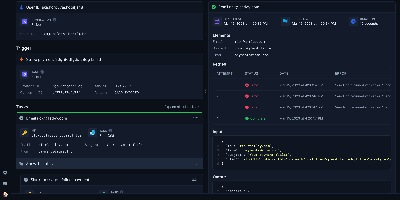
Welcome to the world of background jobs, where your code can finally take a nap while it works! Imagine a magical realm where your long-running tasks can be scheduled like your favorite Netflix binge, complete with API integrations and webhooks that make your code feel like it's throwing a party while you’re away. No more worrying about whether your job will finish before your coffee gets cold; with our open source background jobs platform, you can delay tasks like a pro procrastinator! It's like having a personal assistant for your code, but without the awkward small talk or the need to share your lunch. So sit back, relax, and let your code do the heavy lifting while you focus on more important things, like debating whether pineapple belongs on pizza. Deploy it with a single click and watch your productivity soar, all for half the price of those other cloud hosts that think they're too cool for school!
GroqNotes
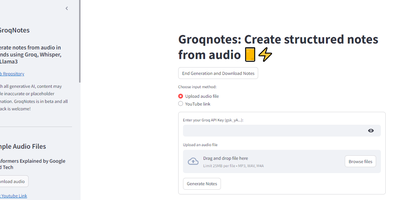
Introducing Groqnotes, the app that takes your audio lectures and transforms them into organized notes faster than you can say 'I should have paid more attention in class!' With the power of Groq's Whisper API, this Streamlit marvel listens to your lectures and then channels its inner librarian to create structured notes that even your future self will thank you for. It’s like having a personal assistant who never sleeps, fueled by a mix of Llama3-8b and Llama3-70b—because why settle for one when you can have two brainy llamas working for you? The larger model crafts the grand architecture of your notes, while the speedy one fills in the juicy details, ensuring you get the best of both worlds. So, whether you’re cramming for finals or just trying to make sense of your professor's 3-hour monologue on quantum physics, Groqnotes has got your back. Say goodbye to chaotic scribbles and hello to notes that are as organized as your sock drawer (or at least, we hope so)! Get ready to impress your classmates and maybe even your professors with notes that look like they were crafted by a team of caffeinated scholars. Groqnotes: because who needs sleep when you have structured notes?
Quant-UX
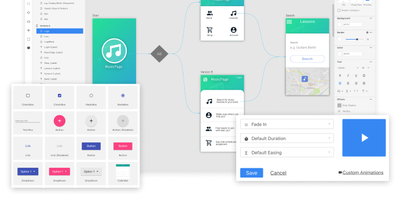
Most design tools stop at prototyping; Quant-UX also measures how real users actually perform with the prototype. The visual editor creates prototypes that behave like real apps - functional input widgets, animations, form validation, data binding across screens, and business logic modeled with REST requests and decision elements. Design systems are first-class, with components, design tokens, and master screens; if you design elsewhere, drop in image files or import from Figma. Testing is a shared link or QR code - no installs on the tester's side. Define user tasks up front, and Quant-UX records every session: click heatmaps show where users found (or missed) actionable elements, user journey graphs expose lost users, drop-off charts reveal where tasks stall, and success rates and task KPIs are extracted automatically into a dashboard. An A/B test operator wires two design variants into one prototype and compares task duration, success rate, and interaction counts. In-prototype surveys collect qualitative feedback alongside the numbers, and an AI assistant generates prototype fragments like styled forms on request. The RepoCloud deployment runs the full stack - frontend, backend, and WebSocket server containers over MongoDB - so all test recordings and research data stay on your infrastructure.
Aptabase
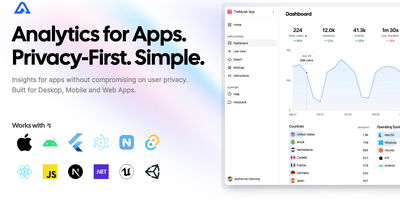
Web analytics tools ignore native mobile, desktop, and game apps; Aptabase was built for exactly those. If Firebase Analytics would force a privacy-policy footnote you don't want to write, this is the alternative - session-based metrics with no cookies, no IDFA or GAID, no device fingerprinting, and a daily-rotated salt that makes cross-day re-identification mathematically impossible. That design means GDPR, CCPA, and PECR compliance out of the box and "Data Not Collected" App Store privacy labels without ATT prompts. The SDK coverage is the widest in its category: eleven first-party libraries spanning Swift, Kotlin, Flutter, React Native, Tauri, Electron, .NET MAUI, NativeScript, Unity, Unreal Engine, and JavaScript for web - each MIT-licensed, following platform conventions, and accepting a custom host parameter that points at your instance. Integration is minutes: initialize with an app key, call trackEvent with optional properties, and the dashboard shows sessions, events, app versions, OS breakdowns, and country-level geography. The self-hosted stack is a .NET server over PostgreSQL for metadata and ClickHouse for high-volume event ingestion, giving cloud-parity features under an AGPL license. For indie iOS/Android apps, Electron and Tauri tools, and Unity or Unreal games, it replaces Firebase without the Google entanglement.
Penpot
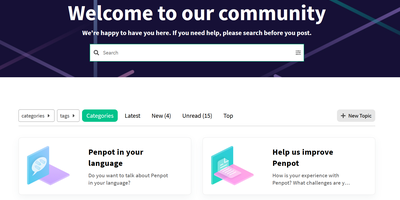
Welcome to Penpot, the open-source design tool that’s like a Swiss Army knife for designers and developers, minus the risk of cutting your finger off! Imagine a world where designers whip up stunning visuals and interactive prototypes faster than you can say 'pixel-perfect', while developers sit back, relax, and receive ready-to-use code like it’s a pizza delivery on a Friday night. No more handoff drama – just smooth sailing from design to deployment! With Penpot, you can create design systems at scale, and your team will be so in sync that even a boy band would be jealous. So, ditch the clunky SaaS tools that charge you an arm and a leg, and join the Penpot party where collaboration is as easy as pie (or should we say, as easy as dragging and dropping?). Get ready to unleash your creativity and watch your workflow transform into a well-oiled machine – all while saving enough cash to buy that fancy coffee you’ve been eyeing!
OpenHands
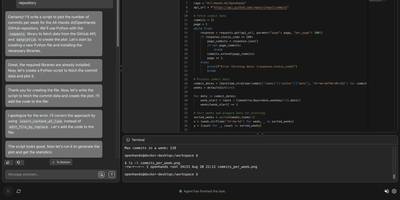
Welcome to OpenHands, where your code gets a personal assistant that’s smarter than your average bear and way less likely to steal your picnic basket! Imagine a world where your AI-powered agents take on the grunt work of coding—modifying code, running commands, and even browsing the web for those elusive StackOverflow snippets—while you sit back, sip your coffee, and ponder the meaning of life (or at least the meaning of that last bug). With OpenHands, you can finally say goodbye to the days of mind-numbing repetition and hello to the exhilarating thrill of tackling complex problems that actually require your brainpower. It’s like having a team of tiny, tireless developers at your beck and call, minus the awkward office small talk and the questionable coffee choices. So why not let OpenHands do the heavy lifting while you unleash your inner coding Picasso? Because let’s face it, your genius is better spent on creating masterpieces, not wrestling with the mundane. Join the revolution and give your coding life a much-needed upgrade—your future self will thank you!

Coolify
Any SSH-accessible Linux box - VPS, bare metal, Raspberry Pi, EC2 - becomes a Heroku-like deployment environment under Coolify, an open-source, self-hostable platform-as-a-service. Connect a GitHub, GitLab, Bitbucket, or Gitea repository and every push builds and deploys automatically via Nixpacks, a Dockerfile, or Docker Compose, with Traefik reverse proxying, automatic Let's Encrypt certificates, and per-branch preview deployments with their own URLs. Databases - PostgreSQL, MySQL, MariaDB, MongoDB, Redis - provision in a few clicks, and a catalog of 280+ one-click service templates covers WordPress, n8n, Grafana, MinIO, Plausible, and more, replacing an afternoon of Compose YAML with a two-minute operation. One dashboard manages multiple servers, with Docker Swarm available for clustering. Backups go to any S3-compatible storage with one-click restore, a browser terminal gives real-time server access, and a full API supports CI/CD integration. All configuration lives on your own servers, so resources keep running even without Coolify. Apache 2.0 licensed.
Groqnotes
Ever wished your lecture notes could magically organize themselves while you daydream about your next coding project? Enter Groqnotes, the Streamlit app that turns your audio ramblings into structured, coherent notes faster than you can say 'Whisper API.' Using Groq's Whisper to transcribe your audio and a tag team of Llama3-8b and Llama3-70b models, this app is like having a personal assistant who never misses a detail. The larger Llama3-70b handles the heavy lifting of creating a solid note structure, while the nimble Llama3-8b fills in the content with the grace of a caffeinated coder. Say goodbye to messy notebooks and hello to organized brilliance, all without lifting a finger. Just click, speak, and let Groqnotes do the rest. It's like magic, but with more llamas.
OpnForm
description_humorous

Maybe Finance
Roughly $1M of development work, open-sourced: Maybe Finance began as a $249/year commercial personal finance product before the company released it all. It aggregates bank accounts, credit cards, loans, investments, crypto, and real estate into a single net worth dashboard with historical trend charts - replacing the spreadsheet that usually glues a whole portfolio together. Transactions are categorized and tagged with rules, with merchant tracking and search across imported or synced activity; budgets track spending by category against plan; and the investment view follows holdings, cost basis, and returns across brokerage accounts. Multi-currency support converts accounts held in different currencies into a single reporting currency, bank synchronization works through Plaid where supported, and manual CSV import covers any institution. An optional AI assistant answers questions grounded in your own financial data. Because the app was built as a paid product with professional design before being open-sourced, its interface quality exceeds most community finance tools - and self-hosting means your balances and transactions are not monetized by a free app or gated behind an annual subscription. The stack is Ruby on Rails with Hotwire on PostgreSQL, licensed AGPL-3.0 and deployed via Docker. The original repository is archived; development continues in the community fork Sure, compatible with the same self-hosted setup.
SQL Chat
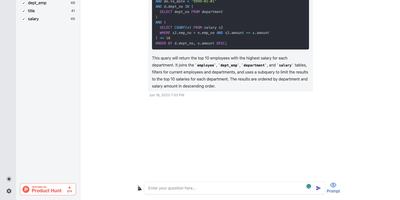
Describe what you want in plain language and get real SQL against your real schema: SQL Chat is an open-source, chat-based SQL client from the Bytebase team. Instead of writing queries in a traditional editor, you connect a database and describe what you want in plain language; the AI reads your schema automatically, generates SQL that references real table and column names, executes it, and returns tabular results in the conversation. Follow-up messages refine the query, so exploration becomes a dialogue - narrow a result set, add a join, change an aggregation - without retyping statements. It supports MySQL, PostgreSQL, SQL Server, TiDB Cloud, and OceanBase from one interface, and covers modification as well as reads: insert, update, and delete operations phrased conversationally. Built with Next.js and TypeScript, it deploys as a single stateless Docker container in single-user mode - connection profiles live in the browser, so there is nothing server-side to maintain. A custom AI endpoint setting routes inference through any OpenAI-compatible API, including self-hosted models, and an optional database-backed mode adds accounts and quotas for offering the tool to a team. MIT-licensed.
Dialoqbase
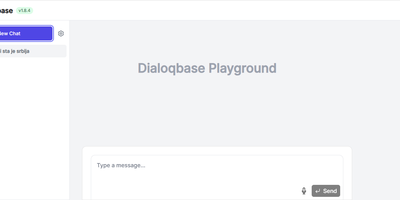
Retrieval-augmented chatbots on your own knowledge base - that is the whole mission of Dialoqbase, an open-source bot-building platform. Feed it content through a broad set of data loaders - web pages and full crawls, sitemaps, PDFs, DOCX, CSV, plain text, GitHub repositories, YouTube videos, and MP3/MP4 audio - and it handles the whole RAG pipeline in one self-contained app: chunking, embedding, vector storage, and LLM querying. The distinguishing architecture choice is PostgreSQL with pgvector for embedding storage and similarity search, which removes the separate vector-database dependency, and Redis-backed Bull queues for ingesting large documents without blocking the API. Model choice is wide open: OpenAI, Anthropic Claude, Google Gemini, Cohere, Fireworks, Hugging Face, local models via Ollama, and any OpenAI-compatible endpoint, with an equally broad list of embedding providers. Finished bots embed on any website with customizable styling or deploy to Telegram, Discord, and WhatsApp, and an API creates and manages bots programmatically. Multi-user support adds registration limits and per-user bot quotas. MIT-licensed and free for commercial use.