
Hammond
When Clarkson, the once-popular fuel logger, stopped receiving updates, Hammond stepped in as its logical successor - a self-hosted vehicle expense tracker. Written in Go with a Vue.js interface and SQLite storage - a single lightweight container, no external database - it tracks every cost your vehicles generate: fuel fill-ups with cost, volume, and odometer readings; maintenance and repairs; and arbitrary other expenses, each attachable with photos and documents stored against the vehicle. The multi-user, multi-vehicle design is what sets it apart from phone apps: a household or small business adds all its vehicles and all its drivers, shares vehicles across users, and every fill-up lands in one ledger no matter who was driving. The Quick Entries feature respects how expenses actually happen - snap a photo of the receipt or pump screen at the gas station, then complete the structured entry later when you have a minute. Reporting works at both the vehicle level (cost per distance, fuel economy trends) and across the whole fleet. Migration matters here: importers for Clarkson, Fuelly, and Drivvo bring years of fill-up history along, so switching does not mean starting your data over.
Keycloak
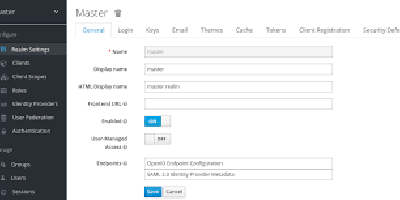
Unlock the magic of seamless sign-ins with Keycloak, the open-source locksmith for your app's identity and access needs! Wave goodbye to the headache of user storage and authentication woes. Keycloak is like a backstage pass to secure services, offering user federation, top-notch authentication, and user management that's as fine-tuned as a Swiss watch. With its Single-Sign On sorcery, users can glide effortlessly across multiple apps with just one golden key, making 'Forgot Password?' a thing of the past. Fancy a social butterfly login? Keycloak's got you covered, mingling with the cool kids of OpenID Connect and SAML 2.0. It's a socialite that also plays nice with the old school crowd, connecting to LDAP or Active Directory with the grace of a seasoned diplomat. Command your server's security from a centralized admin console that's more organized than a librarian's bookshelf, and give your users the power to manage their own accounts without sending out an SOS. Built on the rock-solid foundations of OpenID Connect, OAuth 2.0, and SAML, Keycloak is the guardian of advanced permission management, keeping your app's security tighter than a drum. Host it on RepoCloud, and you'll be singing 'Hallelujah' for the lower costs and the open-source camaraderie that's as warm and fuzzy as a basket of kittens!
Unleash
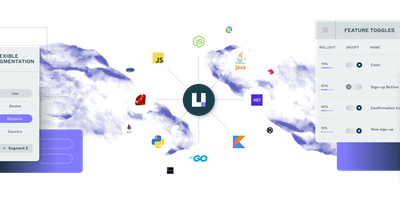
Deployment decoupled from release: Unleash, the most popular open-source feature management platform on GitHub, is a Node.js server backed by PostgreSQL. Ship code dark, then control who sees it through activation strategies: gradual percentage rollouts, targeting by user ID, IP, hostname, or application name, custom constraints against your own context fields, and scheduled or time-limited releases. Strategies stack - a flag activates if any strategy matches - and strategy variants layer A/B versions on top of the on/off decision. Each flag carries per-environment configurations, so a feature can run at 100% in staging while canarying at 5% in production. Backend SDKs (Node.js, Java, Go, Python, Ruby, .NET, PHP, Rust, and more) fetch configuration and evaluate flags locally, so a flag check adds zero network latency to request paths; frontend SDKs for React, Vue, Svelte, iOS, Android, and Flutter evaluate through a proxy layer. Flag hygiene is built in: flags are typed (release, experiment, operational, kill-switch, permission) with expected lifetimes, and Unleash marks overdue flags as potentially stale and surfaces unknown flags your SDKs request but that don't exist. Self-hosting via Docker keeps flag data, targeting rules, and evaluation infrastructure entirely on your side.
Homarr
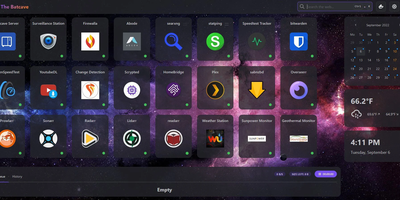
A single pane of glass for every service you run, arranged by drag-and-drop with no YAML or JSON files: Homarr is the modern dashboard for self-hosted infrastructure. Its grid system arranges apps, widgets, and bookmarks on desktop or touch, backed by an icon picker with over 11,000 icons. What separates Homarr from static launchers is 50+ live integrations: Plex, Jellyfin, and Emby media stats, the *arr suite (Sonarr, Radarr) with a unified release calendar, download clients, Pi-hole and AdGuard Home controls, Proxmox, Home Assistant, OPNsense, and Unifi monitoring. Widgets update in real time over WebSockets (tRPC and Redis under the hood), and a built-in search queries thousands of data points across connected services. Custom widgets extend the reach to any HTTP API without code: define endpoint, auth, and refresh interval in the management UI, then render responses as stat grids, tables, progress bars, status indicators, action buttons, or full custom JSX layouts - with an AI-prompt helper for generating templates. Multi-user support is first-class: credentials, OIDC, or LDAP sign-on, groups with granular permissions, and secrets encrypted with AES-256-CBC. A robust background-job system scales it from a Raspberry Pi homelab to deployments serving hundreds of users.
LibreOffice
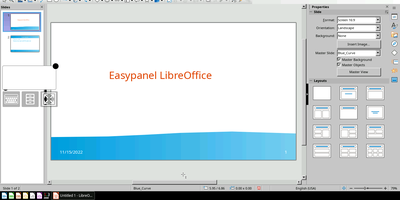
Unleash the might of your creative genius and productivity prowess with LibreOffice, the open-source office suite that's so much more than a mere heir to OpenOffice.org. With a user interface cleaner than a monk's eating habits and a toolbox more feature-stuffed than a Thanksgiving turkey, you'll be crafting documents, spreadsheets, and presentations that dazzle and delight. Glide over to http://yourhost:3000/ or secure your seatbelt for the https journey to https://yourhost:3001/ and experience the digital equivalent of a high-definition, no-pixel-left-behind image streamed right to your web browser at speeds that would make a cheetah envious. And because it's built to play nice with a smorgasbord of architectures, you can fire it up on virtually any device. Host it on RepoCloud, where the cost is as tiny as the footprint of a digital ant, and you've got yourself the Swiss Army knife of office suites for all your document wrangling needs.
It Tools
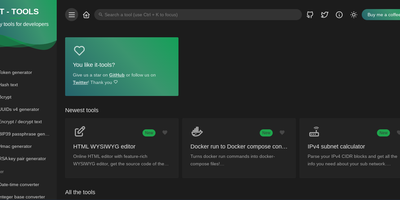
The utilities engineers otherwise scatter across a dozen ad-laden websites - 80+ of them - live together in IT-Tools, one fast, polished web app. Crypto covers JWT decoding, MD5 through SHA-512 hashing, HMAC and bcrypt generation, RSA key pairs, and password strength analysis. Converters handle JSON to CSV, YAML, and TOML, Base64 files, URL encoding, HTML entities, color formats, and Docker run commands to Compose files. Generators produce UUIDv4, ULID, BIP39 mnemonics, QR codes (including Wi-Fi QR), and tokens; text tools include a regex tester, diff viewer, slug and case converters; web utilities parse URLs and user agents, look up HTTP status codes and MIME types, and inspect Open Graph metadata; plus a cron parser, chmod calculator, and more. The privacy argument is the point: JWTs contain user IDs, hashes derive from passwords, JSON dumps hold PII - exactly the inputs you least want a third-party utility site to log. IT-Tools is a frontend-only static bundle (Vue/TypeScript, GPL-3.0, 39k+ GitHub stars) served by Nginx in one container, so everything runs client-side on your infrastructure with nothing transmitted anywhere. New tools ship roughly monthly, and a scaffolding script makes adding custom ones straightforward.
Prowlarr
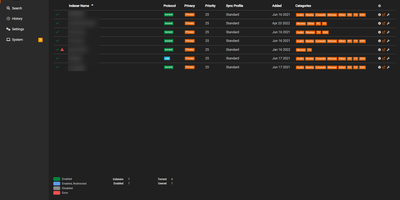
Configure each indexer once, not five times: Prowlarr is the indexer hub of the *arr stack, removing the most tedious duplication in a media automation setup. Instead of configuring the same torrent trackers and Usenet indexers separately in Sonarr, Radarr, Lidarr, Readarr, and Mylar3, you add each one once in Prowlarr and it syncs them to every connected app automatically, complete with category mappings; with Full Sync enabled, adding or removing an indexer propagates everywhere, and a tracker URL change is a one-place fix. Coverage is the deepest available: 500+ torrent trackers with definitions added constantly, 24 native Usenet indexers, generic Newznab and Torznab support for anything else, and custom Cardigann YML definitions with JSON and XML parsing for obscure sources. Built on the same .NET/React base as its siblings, it also earns a place as a search tool in its own right: unified manual search queries every indexer simultaneously at a category level, and you can push multiple releases straight to your download clients without touching Sonarr or Radarr. Health checks and status notifications flag failing indexers, per-indexer statistics track success rates and response times so you can cull unreliable sources, and per-indexer proxy support (SOCKS4/5, HTTP, FlareSolverr) handles trackers behind Cloudflare.

Excalidraw
Half the architecture sketches on the internet trace back to Excalidraw - the MIT-licensed virtual whiteboard whose hand-drawn aesthetic made technical diagramming feel approachable, at roughly 85,000 GitHub stars. The infinite canvas offers rectangles, ellipses, diamonds, arrows with smart binding and labels, free-draw, text, images, and an eraser, with full undo/redo, zoom, dark mode, and keyboard-first ergonomics. Community shape libraries add thousands of pre-built elements - AWS architecture icons, flowchart stencils, UI wireframe kits - and everything exports to PNG, SVG, the clipboard, or the open .excalidraw JSON format that keeps drawings diffable and portable. Live collaboration works on a share-a-link model with live cursors and a laser pointer for presenting, and it is end-to-end encrypted by design: the room key travels in the URL hash, which never reaches the server, so the WebSocket relay only ever sees ciphertext. The architecture is remarkably light - the app is a static bundle served by Nginx, drawings persist locally in the browser, and the stateless excalidraw-room relay handles multiplayer - so a self-hosted deployment gives unlimited boards and collaborators with near-zero resource cost, replacing per-editor whiteboard subscriptions.
Shynet
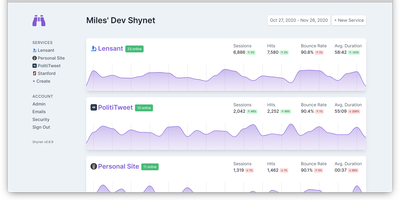
Get ready to send those old-school analytics tools packing, because Shynet is here to revolutionize your data game! This open-source analytics maestro is like a privacy-loving ninja, delivering the lowdown on your website's traffic without creeping on individual users' digital footprints. Shynet's all about the big picture, serving up aggregated insights and trendsetting data that help you get chummy with your website's user dynamics. With features that are hotter than a server room in July, including real-time stats, session recon, and a nifty primary key integration, Shynet's got your back whether you're tracking clicks or counting conversions. And for those of you riding the single-page app wave, fear not! Shynet's got the chops to keep up with your page-hopping users, ensuring your data's as accurate as a Swiss watch. Fancy managing a digital empire? Shynet lets you set up multiple services, each with its own secret agent-style tracking script. Plus, with an API slicker than a greased otter, you can tap into your dashboard's brain from anywhere, anytime. So whether you're a mom-and-pop shop with big dreams, a code whisperer, or a data detective, Shynet's your go-to for making smart, informed website decisions. And hosting it on RepoCloud? That's like having your own digital butler, serving up top-notch hosting without burning a hole in your wallet. So why wait? Give your website the analytics hero it deserves, and let Shynet and RepoCloud be your dynamic duo!
Owncloud
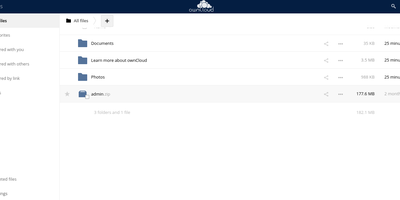
The project that proved organizations could have Dropbox-style convenience with complete data ownership: ownCloud is the original open-source file sync and share platform - the codebase Nextcloud later forked from. This deployment runs the classic ownCloud Server (PHP over PostgreSQL or MariaDB, with Redis caching), the battle-tested edition trusted across enterprises, universities, and public institutions worldwide. The core loop: store files on your server, sync them via desktop clients for Windows, macOS, and Linux plus iOS and Android apps, and access everything through the web interface or standard WebDAV. Sharing is granular - internal users and groups, external recipients via public links with passwords and expiration dates, and federated sharing that connects separate ownCloud instances into one network. Security controls include file firewall rules, multi-factor authentication, encryption, and detailed audit-friendly lifecycle management with versioning and trash-bin recovery. An app marketplace extends the platform, and Web Office integrations bring collaborative document editing through Collabora Online, OnlyOffice, or Microsoft Office Online directly into your files. LDAP and Active Directory integration slots it into existing identity infrastructure. For teams that need a proven, self-hosted alternative to Dropbox or Google Drive - where compliance demands knowing exactly which disk your data sits on - ownCloud remains a foundational choice.

Lychee
Say 'cheese' to Lychee, the open-source photo wrangler that turns your chaotic photo collection into a well-organized gallery of wonders – without costing you a dime! Imagine a world where uploading, renaming, and describing your snapshots is as easy as pie, and you can do it all from the comfort of your web browser. Share your pictorial masterpieces with a single click, or go all 'Mission Impossible' with password protection to keep those nosy parkers at bay. Want to see your memories in all their glory? Full-screen mode and keyboard navigation have got you covered. Flaunt your photos to the public or keep them under wraps – the choice is yours. With Lychee, you're the curator of your own digital museum, complete with batch editing superpowers and the ability to spill the beans on every photo's backstory with EXIF and IPTC Metadata. Import from here, there, and everywhere, tag to your heart's content, and highlight your top shots. All this, wrapped up in a sleek interface that'll make your heart skip a beat. And thanks to RepoCloud's hosting, you can snap away without worrying about storage space or your wallet – it's unlimited, uncompressed, and utterly fabulous. Get ready to give your photos a home they deserve with Lychee!

Corteza
Salesforce's platform model, 100% open-source (Apache 2.0): Corteza is a Go/Vue.js low-code platform developed under a foundation, so there is no open-core bait to grow out of. The heart is Corteza Compose: namespaces contain applications, modules define record structures the way Salesforce objects do, and a drag-and-drop page builder assembles record pages, list pages, dashboards, and charts from configurable blocks. Automation comes from a visual, BPMN-style workflow engine plus JavaScript automation scripts, so cross-application business logic - approval chains, field updates, notifications - is configured rather than programmed. Granular role-based permissions reach down to individual modules, fields, and records, mirroring real organizational hierarchies. Corteza CRM ships as the flagship application built entirely on Compose: leads, accounts, opportunities, campaigns, and cases with a 360-degree customer view, covering most Salesforce standard objects - and because it is just a Compose app, adding or reshaping modules is configuration, not a fork. Everything is reachable over REST APIs, deliberately familiar tooling eases Salesforce admin migration, and a CLI can even generate synthetic records for load-testing what you build.

Barrage
Get ready to unleash a torrent of fun with Barrage, the sleek and chic Deluge WebUI app that's as mobile as you are! This app is like the Swiss Army knife for your torrents, with a design so responsive it'll make your smartphone blush. Whether you're lounging on the beach or commuting on the bus, Barrage lets you add torrents faster than you can say 'magnet link'. Fancy a bit of sorting and filtering action? You got it! Want to play the puppet master with your upload and download speeds? All the power is at your fingertips. And when it comes to prioritizing files or tweaking torrent settings, Barrage is as accommodating as RepoCloud's hosting prices. Deploy it with Docker and watch your torrent troubles sail away into the sunset. It's the smarter, cost-effective way to manage your torrents on the go, courtesy of RepoCloud's hosting magic!
Deluge
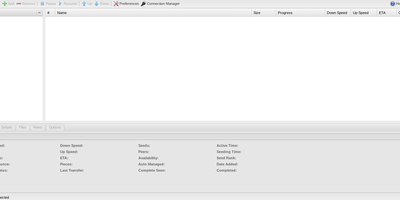
Get ready to ride the BitTorrent wave with Deluge, the all-in-one torrent wrangler that's as versatile as a Swiss Army knife! This nifty app is like the command center for your torrenting missions, operating on a slick daemon/client setup. Choose your adventure with interfaces galore – go old school with Console-UI, click around in GTK-UI, or kick back and torrent from your browser with Web-UI. At the heart of Deluge pumps the mighty libtorrent, a powerhouse for juggling those BitTorrent protocols with finesse. Fire up interfaces and the Deluge daemon with a snap of your fingers (or, you know, a couple of commands). Peek into your torrent kingdom at http://localhost:8112 – just remember, 'deluge' is the magic word (aka the default password). For the torrenting connoisseurs, Deluge dishes out the good stuff – bandwidth customization, VPN compatibility, and reverse proxy setups. And the cherry on top? Hosting it on RepoCloud won't break your piggy bank. So why wait? Dive into the Deluge and let your torrents flow!

Lavalink
Get ready to rock your bot's audio experience with Lavalink, the standalone maestro of melody management! This nifty node is like a backstage pass for your audio, ensuring your shards never get bogged down with the sound. Jam-packed with Lavaplayer and Koe's power chords, Lavalink is the headliner for numerous chart-topping bots. Features? Oh, it's got a setlist that would make any DJ envious: Twitch/YouTube jam sessions, an event system that's more hyped than a concert encore, seek-and-destroy functionality for that perfect audio snippet, volume knobs that go to eleven, and a REST API that's like having your own audio roadie. Plus, it's got stats for when you need to balance the audio load like a pro. Designed to be as light on its feet as a ballet dancer, Lavalink keeps your CPU and memory doing the limbo. Plugin support? Check. Java 17 LTS compatibility? Double-check. And with Semantic Versioning, you'll never miss a beat on updates. Host it on RepoCloud, and you'll be hitting the high notes of performance without the rockstar hosting costs!

EvoBot
Get ready to pump up the jams on Discord with EvoBot, the grooviest music bot on the block! Crafted with the finesse of TypeScript and the smooth moves of discord.js, this bot is like the digital DJ you never knew you needed. With a slick Command Handler straight outta discordjs.guide, EvoBot lets you spin tracks directly from YouTube – just drop a URL or hit it with a search term, and you're ready to rock. Playlist aficionado? No problemo! EvoBot's got your back with YouTube playlist compatibility. But wait, there's more! This bot's not just about hitting play; it's a full-on music maestro. Crank the volume up to eleven, pause for a dramatic effect, resume when the vibe's just right, skip to your heart's content, or shuffle the queue like a deck of cards. And for those karaoke nights, EvoBot dishes out lyrics so you can sing along without missing a beat. Plus, it's a polyglot party-starter, speaking multiple languages to get feet tapping across the globe. Hosted on RepoCloud, you'll be saving your wallet from a cloud-hosting concert ticket price, all while keeping the open-source rhythm alive. So, let's get this musical fiesta started with EvoBot, your go-to bot for tunes on Discord!

PeerTube
The fediverse's answer to YouTube comes from French non-profit Framasoft: PeerTube is a TypeScript/Angular video platform where hundreds of independently operated instances federate over ActivityPub into one network. Videos you publish are discoverable across the whole video fediverse, and viewers can follow your channels from Mastodon or any ActivityPub platform - or plain RSS - without needing an account on your instance. The namesake innovation attacks video hosting's core cost problem: alongside HLS delivery, an optional WebRTC-based P2P layer lets concurrent viewers' browsers share video segments with each other, so a video going viral distributes its own bandwidth demand instead of crushing your server; instance redundancy extends this by letting friendly instances cache each other's videos. Livestreaming is first-class - stream via OBS or any RTMP software, host permanent streams, enable replays, and interact through live chat. Creators get channels, playlists, analytics, built-in video editing (trim, watermark), and an embeddable player for any website. There are no ads, no data mining, and no recommendation algorithm engineered for watch-time - the project's explicit design stance. Admins control federation policy, P2P settings, and theming; a plugin system extends the rest. AGPL-licensed, 300+ contributors, in active development since 2015.

Matomo
Several EU data protection authorities have ruled Google Analytics deployments unlawful; Matomo (formerly Piwik) is the most complete open-source replacement - a full analytics platform with 30+ report types across visitors, actions, referrers, goals, and ecommerce. The self-hosted PHP/MySQL edition is free and keeps every byte of visitor data on your infrastructure, which matters more each year: several EU data protection authorities have ruled Google Analytics deployments unlawful, while Matomo configured for cookieless tracking is approved by France's CNIL for use without a consent banner. All reporting runs on 100% unsampled data - no extrapolation at high traffic volumes. The GDPR Manager handles data subject requests and deletion, with IP anonymization, retention controls, and Do Not Track support built in. A dedicated importer pulls your historical Google Analytics data so years of trends survive the migration. Core analytics cover campaigns, custom variables and dimensions, entry/exit pages, downloads, site search, and full ecommerce tracking with a comprehensive HTTP API for reporting and ingestion. Premium plugins extend the platform into Hotjar-class behavioral tooling - click and scroll heatmaps, session recordings, conversion funnels, form analytics, A/B testing - plus a tag manager and SAML SSO. For teams that need GA-equivalent depth with actual data ownership, Matomo is the realistic drop-in replacement.