Langflow
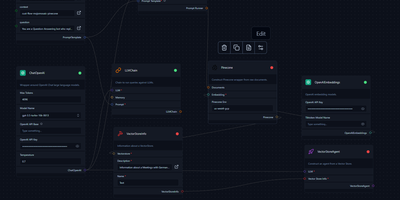
Get ready to unleash your inner language wizard with Langflow, the spellbinding app that turns the complex art of LangChain pipeline creation into a magical drag-and-drop extravaganza! Picture yourself crafting linguistic concoctions with the ease of a seasoned sorcerer, connecting mystical components like LLMs, prompt serializers, agents, and chains with a mere flick of your mouse. Tweak the secret ingredients (a.k.a. prompt parameters), bind together chains and agents in an enchanting dance, and peer into the crystal ball to witness an agent's thought process. When your potion is perfected, abracadabra! Export your masterpiece as a JSON file, ready to charm the socks off LangChain. And for the grand finale, with a wave of your wand (and a single command), you can deploy your creation to Jina AI Cloud faster than you can say 'Presto chango!' Thanks to RepoCloud's hosting, you'll save a dragon's hoard of gold compared to other cloud hosts. Langflow is your trusty sidekick in the quest to build and deploy LangChain pipelines with the ease of a fairy tale ending.
NodeBB
Forum software rebuilt on the modern web stack: NodeBB runs the classic bulletin-board format - categories, threads, local accounts - in real time, on Node.js over MongoDB, Redis, or PostgreSQL. WebSockets stream new posts into open topics as they're written and deliver instant notifications for follows, likes, and subscriptions; built-in chat supports side-by-side private conversations. The headline of recent versions is core ActivityPub federation: your forum can follow, share, and converse with other NodeBB instances, Mastodon, Lemmy, and anything else that speaks the protocol, turning an isolated community into a fediverse node. Everything beyond the common core is a plugin - more than 500 plugins and themes install in one click from the admin panel, covering SSO providers, search backends like Elasticsearch and Solr, galleries, calendars, and more. The theming engine extends base templates with SCSS/CSS on Bootstrap 5, plus a drag-and-drop widget system and custom HTML/CSS/JS injection. Operators get a real-time analytics dashboard, human-readable SEO-friendly URLs with semantic markup, multilingual UI, and full read and write REST APIs for integration. Mobile-first rendering means the same install works everywhere. For communities that outgrew phpBB but don't want Discourse's weight, NodeBB is the natural middle.
Mattermost
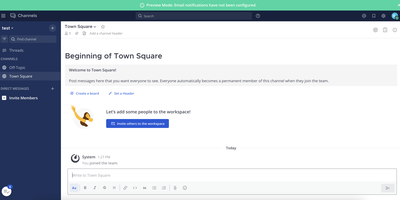
Teams that cannot send messages through someone else's cloud run Mattermost - the open-core, self-hosted alternative to Slack. It provides public and private channels, threaded discussions, unlimited search history, file sharing with previews, one-to-one audio calls, and screen sharing, with desktop clients for Windows, macOS, and Linux plus iOS and Android apps. Messages support full Markdown, which suits engineering conversations with code blocks and logs. Playbooks turn repeatable processes such as incident response and release management into checklist-driven workflows with automated triggers and retrospectives. Integration is a core strength: prebuilt connectors for GitHub, GitLab, Jira, ServiceNow, and PagerDuty, plus webhooks, slash commands, bots, a REST API, and a plugin marketplace with 700+ entries - together making it a working surface for ChatOps rather than just a chat room. Playbooks add keyword and event triggers, task assignment, status broadcasting, and post-incident retrospectives, so operational knowledge is not trapped in individuals' heads. The server is a single Go binary backed by PostgreSQL, with React clients, released monthly under MIT license and deployable fully air-gapped - which is why governments and defense organizations run it inside closed networks, and why the same control applies to any team with confidentiality requirements. The compiled Team Edition is free for unlimited users with no message history cutoff, so costs stay flat as the team grows.
GoToSocial
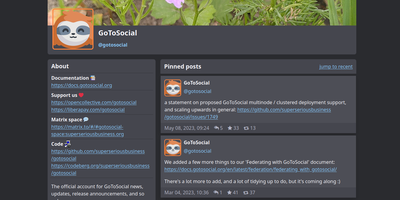
Mastodon serves single-user and small-community instances poorly; GoToSocial, an ActivityPub server written in Go, was built precisely for them. Where Mastodon demands Ruby, PostgreSQL, Redis, and Sidekiq, GoToSocial is one binary using roughly 250-350 MiB of RAM with SQLite as the default database (PostgreSQL optional) - it runs comfortably on a $5 VPS or a repurposed laptop. The deliberate design choice is having no built-in web client: the server exposes profile pages, a settings panel, and a faithful implementation of the Mastodon API, and you post through the client app you already like - Tusky on Android, Feditext on iOS, Pinafore or Phanpy in the browser. Federation is the point: your instance follows, boosts, and replies across Mastodon, Misskey, Pixelfed, and the rest of the Fediverse, with your identity anchored to your own domain. Safety is a stated focus, with granular per-post visibility and interaction controls, content warnings, custom emoji, hashtag following, domain allow/blocklists, and OIDC login support. Built-in Let's Encrypt provisioning simplifies the mandatory TLS. AGPL-3.0 licensed and in active beta, federating cleanly with the ecosystem's major servers.

Ampache
Get ready to amp up your audio experience with Ampache! Imagine a jukebox that never closes, right in your browser. This nifty web-based app is your personal DJ, spinning tracks and videos on demand, wherever you may roam. Picture this: your entire music library, now obediently waiting for your click, ready to serenade you through the simplest of web interfaces. Fancy a bit of musical matchmaking? Ampache's got you covered, syncing up local and remote catalogs to craft a harmonious blend that's music to your ears. And when it comes to streaming, Ampache is like that friend who knows all your favorite songs, streaming them to your chosen player, or even serenading you directly on the web page with a snazzy HTML5 player. This open-source maestro is all about freedom and flexibility, playing nice with almost any device that can hum along to the internet. So, whether you're on your phone, tablet, or kicking back in front of the TV, Ampache is your go-to for a symphony of streaming. And the best part? Hosting it on RepoCloud won't hit a sour note with your wallet. It's like having a backstage pass to your music collection without the VIP price tag!
Paperless-ngx
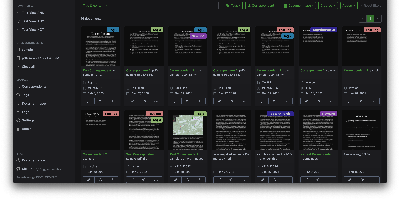
A pile of paper becomes a searchable digital archive under Paperless-ngx, the community-maintained document management system. The pipeline is what makes it work: drop a file into the consumption folder (or let it poll an email inbox), and a worker hashes it for duplicate detection, routes it by type, runs OCRmyPDF with Tesseract (100+ languages) on anything without a text layer, and produces an archivable PDF/A with invisible selectable text embedded - so Ctrl+F works on your scans. Then the smart part: a scikit-learn classifier (TF-IDF plus multi-label prediction) trained on your own tagged documents automatically assigns tags, correspondents, and document types to new arrivals, alongside rule-based exact, keyword, and regex matching for deterministic cases. Full-text search includes relevance ranking, match highlighting, autocomplete, and "more like this" similarity search. Apache Tika integration extends consumption to Word, Excel, PowerPoint, and LibreOffice formats. The Django/Angular app adds custom fields, saved views on a customizable dashboard, bulk editing, workflow automation triggered on upload or matching, shareable public links with expiration, and a robust permissions system with per-document access control. Metadata lives in PostgreSQL with Redis-queued Celery workers processing documents in parallel. Your tax records, invoices, and contracts stay on your server - searchable in seconds, never in someone else's cloud.
Typesense
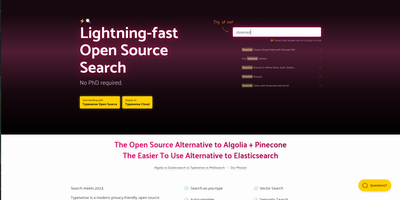
Get ready to turbocharge your search experience with Typesense, the search engine that laughs in the face of typos and serves up results faster than you can say 'instantaneous'! This open-source marvel is the cool cousin of Algolia and the more approachable neighbor of ElasticSearch. With its built-in typo tolerance, Typesense is like that forgiving friend who understands what you mean, even when you text 'tacos' as 'tcoas'. Zipping through queries with the speed of a caffeinated cheetah, it boasts a response time that's quicker than a hiccup (<50ms, to be precise). Tailor your search like a bespoke suit, sort results like a card shark, and refine like a master sommelier with faceting and filtering. It's got more grouping and federating tricks than a magician's convention, and it knows the lay of the land with geo-search capabilities. Plus, with API key generation, it's the perfect wingman for multi-tenant app shindigs. Easy to set up and scale, Typesense is your golden ticket to search nirvana, and with RepoCloud's wallet-friendly hosting, you'll be the toast of the open-source town!
Focalboard
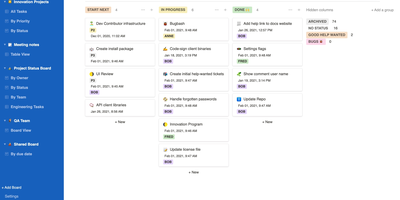
From the Mattermost team comes Focalboard, an open-source, MIT-licensed project board tool - a self-hosted alternative to Trello, Asana, and Notion databases, written in Go with a React frontend. Every board renders the same card data four ways: Kanban with drag-and-drop columns, a spreadsheet-style table, an image-forward gallery, and a calendar. Cards carry unlimited custom properties - dates, dropdowns, checkboxes, people, URLs - and boards can be grouped, filtered, and sorted by any property combination, with unlimited saved filtered views for quick access. Built-in templates cover the common workflows (meeting agendas, content calendars, project tasks, roadmaps, sprint planning), or you can build fully custom boards from scratch. Collaboration is real: card comments with @mentions, per-board permissions for teams or individuals, file attachments stored on your own infrastructure, and archiving with backup snapshots. Migration tooling imports existing boards from Trello (JSON export), Asana, and Notion, so switching does not mean starting over. It ships in 20+ languages and runs as a lightweight multi-user personal server. Worth knowing before deploying: Mattermost has shifted primary development to the integrated Mattermost Boards plugin, so the standalone edition is community-maintained - stable and functional, but evolving slowly. For teams wanting a free, private Trello without per-user fees, it remains a solid pick.
Shiori
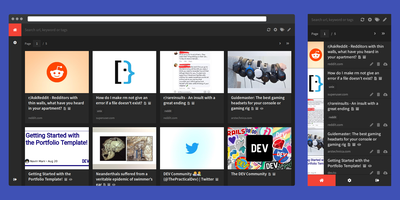
Most web links eventually break - the sobering statistic Shiori, a bookmark manager with archiving by default, is built on. Its answer is archiving by default - where possible, every bookmark you save gets a clean, readable offline copy parsed from the page, ads and navigation stripped, so the article survives even after the original URL dies. Conceived as a simple Pocket clone and written in Go, the entire server is a single binary using roughly 25-30 MB of RAM with SQLite out of the box (Postgres and MySQL supported) - genuinely the lightest archiving bookmark manager you can run. Saving is one click through the Firefox and Chrome extensions, and finding things again is where Shiori quietly outperforms its size: full-text search covers the archived page content, not just titles and tags, so you can find that article by a phrase you remember from paragraph six. Reader mode presents the cleaned text; archive mode shows the preserved page. It's dual-interface by design - a pretty web UI (installable as a PWA on mobile) and a complete CLI for terminal devotees - plus a REST API for scripting. Pocket imports work natively, and Netscape HTML handles browser imports and exports. Multi-user support included. MIT-licensed.
Drone
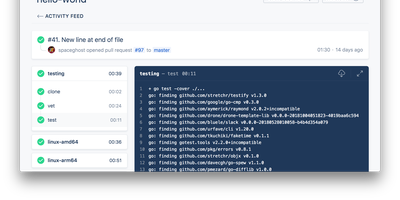
Get ready to turbocharge your code with Drone.io, the CI butler for the coding aristocracy! Picture this: your software builds and tests are as automated as your morning coffee maker, thanks to Drone.io's slick automation magic. Configuring it is a piece of cake with a nifty file that cozies up in your git repo like a cat in a sunbeam. And when it's go-time, each pipeline step struts its stuff in its own Docker container fashion show, downloaded on-the-fly. Fancy a dance with GitHub or a tango with GitLab? Drone.io's got smooth moves with a bunch of source code management sweethearts. It's the polyglot of platforms, speaking every language from Python to PHP, and it's as comfortable with databases and services as a nerd in a comic book store. Share your secret sauce with plugins, or go full mad scientist with custom controls, secret spells, and yaml incantations. Plus, with Drone.io's commitment to solitary build confinement, your code's personal space is always respected. And when it's time to grow, Drone.io scales up like it's been hit with a growth ray. Host it on RepoCloud, and you'll save enough to make your wallet do a happy dance, all while keeping the open-source spirit alive and kicking!
AdGuard Home
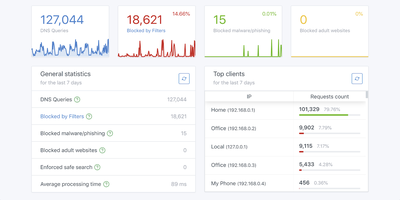
Say goodbye to the digital equivalent of pesky flies—ads! AdGuard Ad Blocker is your online knight in shining armor, banishing every last banner, pop-up, and pre-roll video ad from your kingdom of browsers. It's like having a personal bouncer for your web experience, keeping the riff-raff out while making sure your favorite sites still look fabulous. But wait, there's more! AdGuard is like a privacy ninja, stealthily protecting your data from the prying eyes of web analytics and tracker ninjas. And for those digital boogeymen lurking in the shadows? AdGuard's got your back, shielding you from phishing and malware-infested waters. Got kiddos? Activate the parental controls and create a web playground as safe as a cushioned room. It's not just about blocking ads; it's about supercharging your browsing speed and saving your precious data from being devoured by ad monsters. With AdGuard hosted on RepoCloud, you'll enjoy all these perks without breaking the bank. It's the ultimate tool for a smoother, safer, and more enjoyable online adventure!
Change Detection
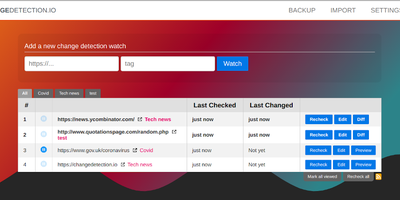
Price drops, restocks, job postings, government announcements, competitor edits - changedetection.io watches web pages and alerts you the moment anything changes, down to PDF text and checksums. Point it at a URL, set a check interval, and precise filters decide what counts as a change: a Visual Selector targets page elements by pointing and clicking, CSS selectors and XPath narrow scope, trigger-text and ignore-text rules (with regex support) cut noise, and JSONPath or jq handles API responses. A dedicated re-stock and price detection mode extracts product metadata and fires on thresholds - alert only when the price drops below your target or the percentage change exceeds a limit. JavaScript-heavy sites render through a real Chrome browser via Playwright, with the ability to execute JS steps first (log in, click, scroll) before extracting text. Notifications reach 85+ services through Apprise - Discord, Slack, Telegram, email, webhooks - optionally with a screenshot of the changed page, and AI-powered summaries (any OpenAI-compatible endpoint, including local Ollama) describe what changed. Per-watch proxies, custom headers, and POST/GET control cover hostile targets. Apache-2.0 licensed with local file-based storage: the URLs you monitor and why stay entirely your business.
Flarum
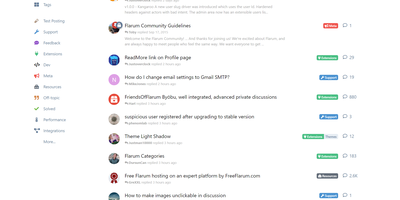
Dive into the future of chit-chat with our snazzy forum app! It's not just easy on the eyes with its chic UI, but it's also a breeze to customize and as light as a feather, making sure your thumb-swiping game is strong on any gadget. We've got the security tighter than a drum, so you can gab away without a worry. And talk about a babel fish – this baby speaks 41 flavors of human, so it's like the United Nations of forums. Whether you're a telecom titan, a globe-trotting storyteller, or the maestro of memes, our app is your soapbox. Host it on RepoCloud, where the price is as tiny as the footprint, and join the forum frenzy that's sweeping the netizens off their feet!
Languagetool
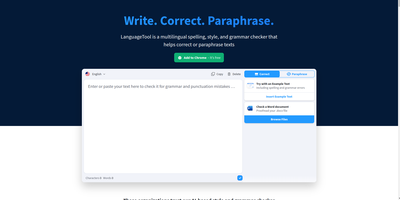
Grammar, punctuation, and style errors a dictionary lookup can't see: LanguageTool is open-source proofreading powered by a Java rule engine covering English, German, Spanish, French, Portuguese, Dutch, and 25+ other languages. Self-hosting the HTTP server is how you get Grammarly-class checking without sending every sentence you write to a third party - a real concern when the text being proofread is confidential email, legal drafts, or unreleased documentation. Your instance exposes the standard /v2/check API, so the official ecosystem plugs straight in: browser extensions for Chrome and Firefox accept a custom server URL, and integrations exist for VS Code, LibreOffice, Obsidian, Vim, Emacs, and many editors. Notably, self-hosting restores free browser-extension checking that the hosted service moved behind a premium subscription - your server, no character limits, no paywall. Detection quality is tunable: optional n-gram datasets (multi-gigabyte language models for en, de, es, fr, nl) teach the engine word-order and confusion-pair errors like there/their and brakes/breaks, and a fastText model improves automatic language identification. Everything runs offline once models are downloaded. The core is LGPL, the API is documented with Swagger, and rules are community- maintained and constantly expanding.
HedgeDoc
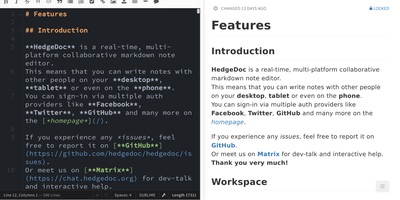
Real-time collaborative Markdown behind your own firewall: HedgeDoc (formerly CodiMD, descended from HackMD's open-source edition) keeps team notes on team infrastructure. Share a note's URL and collaborators are editing together instantly - live cursors, changes appearing keystroke by keystroke - in a three-mode interface that toggles between raw Markdown, rendered preview, and side-by-side split. The Markdown dialect is extended where engineers need it: Mermaid, Graphviz, and Vega-Lite diagrams, MathJax for equations, syntax-highlighted code blocks, embedded content, and a presentation mode that turns a note into reveal.js slides with a single YAML header. A dropdown permission system controls each note - freely editable, limited to signed-in users, or locked read-only - and published notes become clean read-only pages for wider distribution. Revisions track every change with the ability to revert to any earlier version. The AGPL-3.0 codebase is light enough to run on a Raspberry Pi and deploys via Docker with PostgreSQL, MySQL, or SQLite. Authentication covers LDAP, SAML, OAuth2, and email. It deliberately stays a focused document editor - no page trees or kanban - and does that one job with excellent keyboard-first ergonomics for meeting notes, RFCs, runbooks, and shared scratchpads.

OpenSpeedTest
Meet OpenSpeedTest, the Usain Bolt of online bandwidth testers! This nifty tool doesn't need the old-school Flash or Java to flex its muscles. It's like a digital speedometer for your internet, ready to clock your connection from the slow-motion 1 Kbps crawl all the way to the warp-speed 1 Gbps+ sprint. OpenSpeedTest is a tech-savvy fortune teller; it magically predicts your stable download and upload speeds using the latest wizardry in web tech. And it's not just about numbers; it dishes out pro tips to turbocharge your internet experience. Fancy being a speed test maestro? You can whip up your own network speed showdown without any pesky plugins. Embed it into your website or app, and voila! Your users can test their net velocity without ever bidding adieu to your page. Perfect for the home office or the corporate empire, OpenSpeedTest is the go-to for DIY or large-scale, self-hosted network speed tests. And with RepoCloud hosting, you'll be saving more coins than a video game plumber, all while enjoying the open-source camaraderie!
Supertokens Core
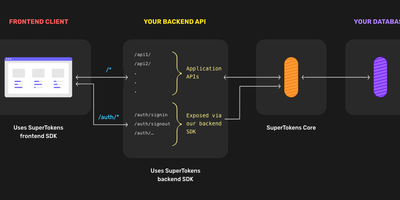
Authentication that lives inside your application rather than behind a redirect to an external identity provider - SuperTokens takes a fundamentally different architecture from Auth0 and AWS Cognito. Three tiers make that work - frontend SDKs (React, Angular, Vue, vanilla JS, React Native) render overridable login UI and manage tokens; backend SDKs (Node.js, Python, Go) expose auth endpoints on your own API domain; and SuperTokens Core, the piece you host here, is the stateless HTTP service handling core auth logic, password hashing, token signing, and database operations against PostgreSQL. The recipe system keeps features decoupled: use email/password, social login, passwordless (magic links, OTP), phone-password, multi-factor authentication (TOTP, WebAuthn), user roles, and microservice auth - individually or combined; you can even use SuperTokens purely for session management alongside another login provider. Sessions are where it shines: rotating refresh tokens with theft detection, automatic access-token refresh, CSRF protection, and secure cookie handling out of the box - the details that become vulnerabilities when hand-rolled. Verification happens locally in your backend via cached JWT signing keys, so the Core stays off the hot path. Self-hosted means no user limits, free forever, with all user data in your database. Apache-licensed.
Rocket.Chat
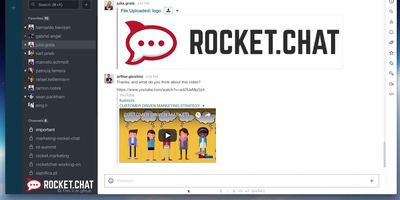
Blast off into productivity space with Rocket.Chat SIX, the ultimate team collaboration cosmos! Imagine a world where your data isn't just your own, it's your best-kept secret. With customization that's as vast as the universe and integration that's as seamless as a black hole, you're in for a stellar ride. This platform is like the Swiss Army knife for your messages, projects, and tasks, all orbiting harmoniously in one digital galaxy. But wait, there's more! It's not just about team efficiency; it's about making customer connections that are out of this world. Rocket.Chat SIX is your mission control for omnichannel customer service, creating conversations that sparkle like constellations. And for those who like their chats with a side of excitement, the in-built chat engine is like adding a turbo boost to your app or website's user engagement. Built for the control freaks in spacesuits, this platform offers end-to-end encryption and compliance with intergalactic data protection laws. Plus, with deployment options more flexible than a yoga instructor in zero gravity, your security needs are covered. So why settle for a cloud when you can have the whole cosmos with RepoCloud hosting? Get ready to take your team's productivity to infinity and beyond!