MailCrab
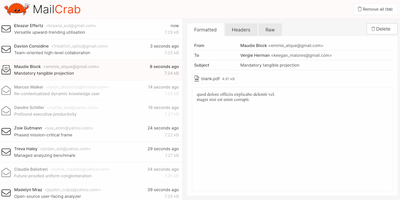
Introducing MailCrab, the crustacean of the email testing world that's ready to snap up all your development emails in its claws! This nifty accept-all SMTP server isn't just another pretty shell; it comes with a web interface that lets you spy on your emails like a secret agent. Peek at formatted emails, snatch attachments, scrutinize headers, or dive into the raw email abyss. It's a dockerized delight that scuttles across both amd64 and arm64 platforms with ease. Crafted in the robust and speedy Rust language, MailCrab's backend is like a treasure chest that hoards your emails in memory's locker, while the frontend is your trusty periscope to the sea of messages. It's smart enough to fetch all your email metadata with a single call and then keeps an eye out for new messages with its websocket tentacles. Want to read a message? Just poke the endpoint, and voilà! Plus, with a few secret commands, you can mark messages as read, make them walk the plank one by one, or unleash a kraken to wipe them all out. Host it on RepoCloud, where the costs are as tiny as plankton compared to other cloud hosts, and you'll be sailing the high seas of email testing with a grin as wide as a whale's!
Filezilla Client
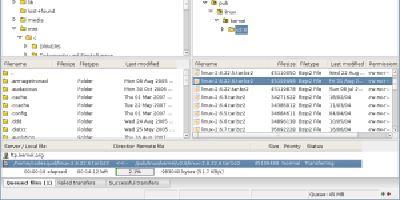
Zip through the digital skies with FileZilla Client, the speed-demon of file transfer programs! This nifty app plays nice with FTP, FTPS, and SFTP, and doesn't discriminate against your platform of choice. It's like having a Swiss Army knife for your files, complete with a user-friendly graphical interface that even your grandma could love. Imagine sending pictures so crisp and fast, your web browser won't know what hit it. FileZilla Client is a master of disguise, supporting multiple architectures and whispering sweet nothings to the internet via HTTP or HTTPS. Tired of playing the 'who's got the permissions?' game? Set your user PUID and group PGID to keep the peace between your host OS and the container. And for the control freaks in the room, you can even tweak the umask settings to tell your services how to behave inside their container homes. Host it on RepoCloud, and you'll be the file-transferring hero you always knew you could be, without burning a hole in your wallet!
Oxigen
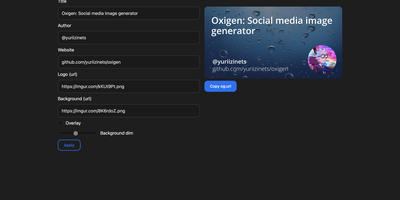
The social preview cards shown when links hit Twitter, LinkedIn, Slack, or Discord, generated on the fly: Oxigen is a small Go service for dynamic Open Graph images, no designer required per page. Instead of exporting static images per page, you compose a card once and drive it with parameters: title, author, website, logo, background image, and background dimming all arrive as URL query arguments, so your og:image meta tag simply points at the Oxigen endpoint with the page's own values substituted in. Every blog post, product page, and doc gets a branded, correctly sized preview generated on the fly. A built-in web UI covers interactive composition - tweak the text and imagery, watch the preview update, copy the resulting URL - while the same rendering path serves programmatic API use from static site generators, CMS templates, or build pipelines. Rendering is pure Go using the gg 2D graphics library, freetype fonts, and the imaging package, built on the kyoto framework by that project's author. Deployment is one stateless container on port 80 with no database and no external dependencies, so instances scale and restart freely.
Docker Registry
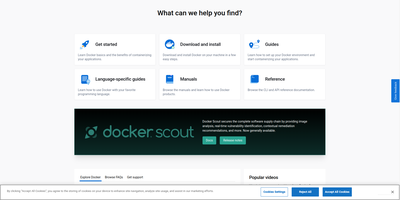
Ahoy, container enthusiasts! Set sail with Docker Registry 2.0, the swashbuckling storage sidekick for your Docker images. This app isn't just an implementation of the Docker Registry HTTP API V2; it's a compatibility wizard, joining forces with Docker versions 1.6 and up. Looking to hoist your registry solution to new heights or just want a cozy spot for your private collection? Docker Registry 2.0 has got your back, offering a fortress of security and a playground of scalability. It's the unsung hero behind the curtain of the Docker Hub, GitHub Container Registry, GitLab Container Registry, and DigitalOcean Container Registry, not to mention its star role in the CNCF Harbor Project and VMware Harbor Registry. Get ready to manage your digital treasures like a pro, with a content distribution system that's more extensible than a pirate's telescope. And with RepoCloud hosting, you'll be saving more doubloons than you can count, all while keeping the open-source spirit alive and kicking!
Whiteboard
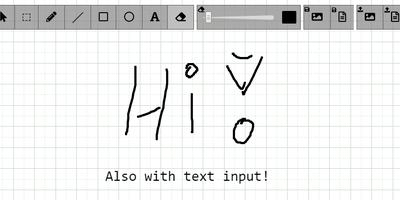
The drawing surface inside WebRTC conference tools like Meetzi and the LAMS online-learning platform is Whiteboard (by cracker0dks) - a lightweight Node.js collaborative sketchboard built to be embedded and customized, which also slots into Nextcloud via the External Sites app. Everyone opening the same whiteboardid URL parameter draws on the same board, with remote user cursors visible live, per-user undo/redo, and an indicator showing the smallest participating screen so nobody draws outside a colleague's view. Content handling goes beyond pen strokes: drag-and-drop or paste images and PDFs from any PC or browser, then resize, rotate, and draw over them on canvas or background; add text and sticky notes; hold Shift for angle-snapped lines and perfect squares. Every function has a keybinding - deliberately friendly to pen displays like Wacom and XP-Pen whose hardware buttons map to shortcuts. Boards save to image or JSON (with reload), export directly to Nextcloud via WebDAV, and persist across restarts with the file-database option. A REST API with bundled interactive docs allows full programmatic control, an optional access token locks down uploads, and YAML configuration tunes behavior and performance. MIT-licensed and reverse-proxy friendly.
Qdrant
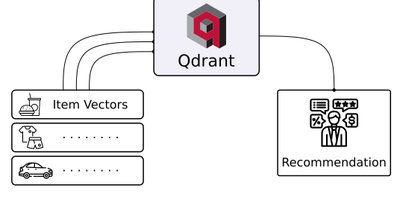
Embark on a quest with Qdrant, the Herculean vector database that's flexing its muscles to revolutionize AI apps. Imagine a digital genie that grants you the power to sift through high-dimensional space with the ease of a cosmic search engine. It's not just an API service; it's your ticket to transforming brainy embeddings into superstar applications that can match, search, and recommend like a boss. Qdrant is like the Swiss Army knife for data types, handling everything from witty string banter to numerical ninja ranges, and even geo-locations with a sense of wanderlust. It's cloud-native, so it grows with your ambitions, scaling horizontally like it's training for the digital Olympics, all while being as resource-efficient as a monk. Host it on RepoCloud, and you'll be building semantic neural search castles in the sky in no time, understanding user antics as they unfold, and spotting similar images or duplicate doppelgängers with the sharpness of an eagle. It's the open-source powerhouse that makes your data dance to the tune of innovation, all at a cost that keeps your wallet as happy as a clam at high tide!
Countly
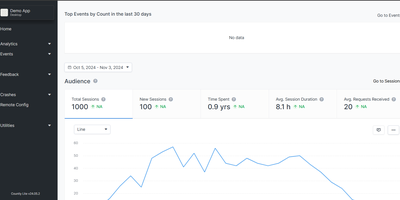
Mixpanel, OneSignal, and Crashlytics in one self-hosted stack - Countly is an all-in-one product analytics and engagement platform where every byte of first-party data stays on your server. A Node.js application over MongoDB, it collects through ten battle-tested SDKs spanning iOS, Android, web JavaScript, React Native, Flutter, Unity, and desktop (plus a data write API for anything else), and has powered tens of thousands of mobile, web, and desktop apps since 2012. The analytics core covers sessions, custom events, views, user profiles, and real-time dashboards, with exploration tools built for product managers as much as analysts. What separates Countly from pure analytics tools is acting on the data without third parties: built-in push notifications send automated, transactional, and personalized messages to iOS (APNs), Android (Firebase), and Huawei devices, with the SDK handling token retrieval and permission flows automatically; crash reporting captures symbolicated native crashes on iOS and Android plus JavaScript errors, correlated with the same user and session data. Email reports keep stakeholders updated, and the plugin-based architecture means features load as modules. For GDPR-sensitive products, engagement without piping user data to advertising companies is the entire point. AGPL-licensed server, installable in minutes.
Corteza
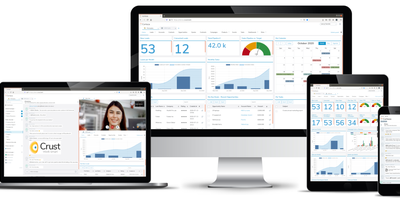
Salesforce's platform model, 100% open-source (Apache 2.0): Corteza is a Go/Vue.js low-code platform developed under a foundation, so there is no open-core bait to grow out of. The heart is Corteza Compose: namespaces contain applications, modules define record structures the way Salesforce objects do, and a drag-and-drop page builder assembles record pages, list pages, dashboards, and charts from configurable blocks. Automation comes from a visual, BPMN-style workflow engine plus JavaScript automation scripts, so cross-application business logic - approval chains, field updates, notifications - is configured rather than programmed. Granular role-based permissions reach down to individual modules, fields, and records, mirroring real organizational hierarchies. Corteza CRM ships as the flagship application built entirely on Compose: leads, accounts, opportunities, campaigns, and cases with a 360-degree customer view, covering most Salesforce standard objects - and because it is just a Compose app, adding or reshaping modules is configuration, not a fork. Everything is reachable over REST APIs, deliberately familiar tooling eases Salesforce admin migration, and a CLI can even generate synthetic records for load-testing what you build.
Bazarr
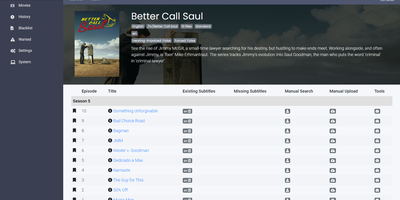
Subtitles are the one chore Sonarr and Radarr leave behind - Bazarr finishes the *arr media stack by automating them. It connects to both via their APIs and mirrors their libraries - it doesn't scan disk itself, it manages exactly what your *arr apps index. For every monitored episode and movie it checks existing internal and external subtitles against your language profiles, then hunts missing ones across dozens of providers - OpenSubtitles.com, Podnapisi, Addic7ed, Subscene, and many regional sources - covering 184 subtitle languages including forced/foreign-dialogue tracks. Matching is smarter than filename guessing: releases are compared by release group and source, some providers support exact file-hash matching, and every downloaded subtitle gets a percentage score. Set a minimum score per Sonarr/Radarr connection and Bazarr rejects weak matches; enable upgrades and it replaces previously downloaded subtitles when better ones surface. Out-of-sync files get fixed too - automatic subtitle synchronization realigns timing after download, triggered only below a configurable score threshold so good subs aren't touched. Per-show and per-movie language configuration, download history, manual on-demand search, and adaptive searching that throttles provider API calls round it out, all behind a clean Sonarr-style web UI written in Python. If your library serves multilingual viewers, this removes the last manual step.
AutoGen Studio
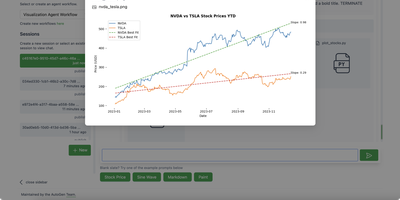
Prototype multi-agent AI systems without writing orchestration code: AutoGen Studio is Microsoft's low-code interface over the AutoGen AgentChat framework. You compose teams of LLM-powered agents in a visual Team Builder, either by drag-and-drop from a component library or by editing the declarative JSON specification directly. Each agent gets a model, a prompt, tools (Python functions), and the team gets termination conditions and an orchestration pattern, sequential or LLM-driven. The Playground runs teams interactively with live message streaming between agents, a visual control-transition graph, tool-call and code-execution tracking, and pause/stop controls, which makes it a practical debugger for agent behavior. Finished teams export as JSON for use in any Python application via the TeamManager class, or serve as an API endpoint. Any OpenAI-compatible model endpoint works, including local servers like Ollama or vLLM. Microsoft labels it a research prototype: use it for prototyping and evaluation, and build production systems on the underlying AutoGen framework.
GroqNotes
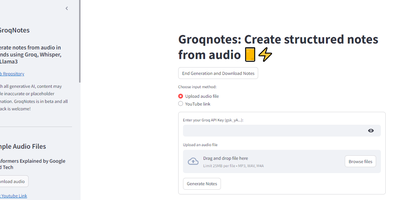
Introducing Groqnotes, the app that takes your audio lectures and transforms them into organized notes faster than you can say 'I should have paid more attention in class!' With the power of Groq's Whisper API, this Streamlit marvel listens to your lectures and then channels its inner librarian to create structured notes that even your future self will thank you for. It’s like having a personal assistant who never sleeps, fueled by a mix of Llama3-8b and Llama3-70b—because why settle for one when you can have two brainy llamas working for you? The larger model crafts the grand architecture of your notes, while the speedy one fills in the juicy details, ensuring you get the best of both worlds. So, whether you’re cramming for finals or just trying to make sense of your professor's 3-hour monologue on quantum physics, Groqnotes has got your back. Say goodbye to chaotic scribbles and hello to notes that are as organized as your sock drawer (or at least, we hope so)! Get ready to impress your classmates and maybe even your professors with notes that look like they were crafted by a team of caffeinated scholars. Groqnotes: because who needs sleep when you have structured notes?
Teable
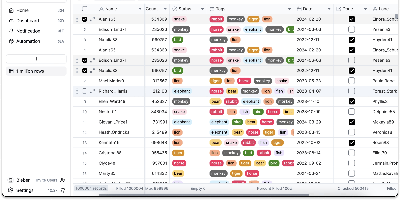
An Airtable-style spreadsheet interface directly on PostgreSQL: Teable is an open-source no-code database where every table is a real Postgres table. Unlike tools that store records in a metadata abstraction layer, every Teable table is a real Postgres table with standard column types, so filtering, sorting, and grouping run at database speed, million-row tables answer complex filters in roughly 200 milliseconds without index tuning, and any PostgreSQL-compatible tool - psql, BI dashboards, ETL pipelines - can query the same data directly. The interface offers Grid, Kanban, Gallery, Calendar, and Form views as non-destructive overlays with their own filters and hidden fields, plus 20+ field types, formulas, comments, attachments, batch editing, undo/redo, and edit history. Collaboration is real-time with live cursors and instant sync across views, backed by Redis, and a REST API is auto-generated per table, largely compatible with Airtable API clients - alongside native SQL access for BI tools, analytics pipelines, and your own applications to JOIN and query directly, with no exports, API rate limits, or sync jobs. Global search spans all records, chart plugins handle quick visualization, and CSV and Excel import/export cover migrations. Where Airtable caps paid plans at 100K-500K rows and charges roughly $20 per user per month, a self-hosted Teable instance has neither limit: the Postgres database itself is the export if you ever leave. Built in TypeScript with NestJS, deployed via Docker with PostgreSQL and Redis, and licensed AGPL-3.0.
Perplexica3
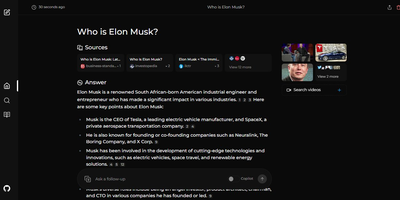
Meet Perplexica, your new AI-driven search engine sidekick that doesn't just search the web—it practically reads your mind! Harnessing the power of advanced machine learning, Perplexica dives deep into the ocean of the internet to fetch not just any answers, but the most relevant, crystal-clear responses, all while keeping your privacy under lock and key. Built on the robust SearxNG framework, it's like having a super-smart librarian who also respects your personal space. Hosted on RepoCloud, it's not just smart—it's also a wallet-friendly genius!
Screenshot To Code
description_humorous
Documize
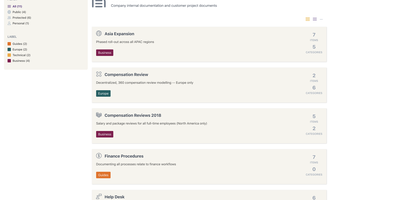
Enterprise documentation discipline without enterprise infrastructure: Documize Community is the Confluence alternative built on exactly that trade. The entire platform - Go backend, Ember.js frontend - compiles to a single executable binary for Linux, Windows, and macOS with zero runtime dependencies: no Elasticsearch, no Redis, no JVM. Point it at PostgreSQL, MySQL, MariaDB, Percona, or Microsoft SQL Server (rare in open source, decisive in Microsoft shops), and schema migrations run on launch with native full-text search on whichever engine you chose. Content organization rejects nested-folder sprawl for Spaces, categories, and labels, and the section-based composable editor mixes rich text, Markdown, code blocks, PDFs, diagrams, and embedded Jira or Trello content in one document, with reusable blocks and templates so teams start from standards rather than blank pages. It deliberately unifies internal team docs and customer-facing documentation in one system with granular space-, document-, and action-level permissions deciding who sees what. Where wikis stop, Documize continues: content approval workflows (draft, review, approve, publish), version management, lifecycle control, feedback capture, PDF export, analytics showing what gets read and ignored, activity streams, and audit logs. Keycloak, LDAP, and SSO integrate for enterprise auth. AGPL-licensed.
Emby
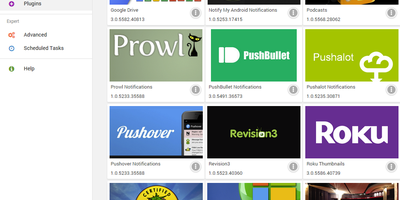
Point Emby at your movie, music, and photo libraries and it becomes a private streaming service: metadata and artwork arrive from TMDB and TVDB, everything lands in a polished browsable interface, and media transcodes on the fly whenever a client can't play the original format. The client reach is the selling point: native apps span Android TV, Apple TV, Google TV, Fire TV, Roku, LG and Samsung smart TVs, iOS, Android, Apple CarPlay, Android Auto, plus web browsers and desktop apps for Windows, macOS, and Linux, and DLNA devices are auto-detected for casting and remote control. Multi-user support gives each household member their own account, watch history, favorites, and recommendations, with genuinely capable parental controls: content restrictions, access schedules, time limits, and live monitoring with remote control of kids' sessions. Live TV works with hardware tuners like HDHomeRun or M3U playlists, with free guide data in the US, Canada, and UK. The server and core features are free; an optional Premiere key adds hardware-accelerated transcoding, DVR recording, offline sync, and Cinema Mode intros.
Matomo
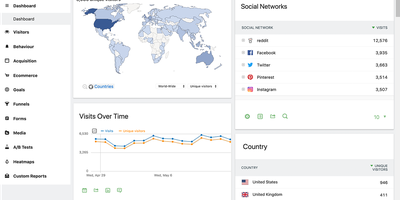
Several EU data protection authorities have ruled Google Analytics deployments unlawful; Matomo (formerly Piwik) is the most complete open-source replacement - a full analytics platform with 30+ report types across visitors, actions, referrers, goals, and ecommerce. The self-hosted PHP/MySQL edition is free and keeps every byte of visitor data on your infrastructure, which matters more each year: several EU data protection authorities have ruled Google Analytics deployments unlawful, while Matomo configured for cookieless tracking is approved by France's CNIL for use without a consent banner. All reporting runs on 100% unsampled data - no extrapolation at high traffic volumes. The GDPR Manager handles data subject requests and deletion, with IP anonymization, retention controls, and Do Not Track support built in. A dedicated importer pulls your historical Google Analytics data so years of trends survive the migration. Core analytics cover campaigns, custom variables and dimensions, entry/exit pages, downloads, site search, and full ecommerce tracking with a comprehensive HTTP API for reporting and ingestion. Premium plugins extend the platform into Hotjar-class behavioral tooling - click and scroll heatmaps, session recordings, conversion funnels, form analytics, A/B testing - plus a tag manager and SAML SSO. For teams that need GA-equivalent depth with actual data ownership, Matomo is the realistic drop-in replacement.
Excalidraw
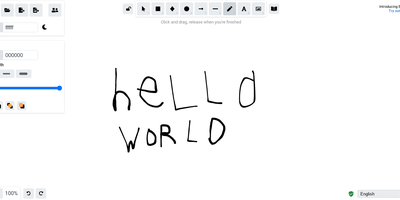
Half the architecture sketches on the internet trace back to Excalidraw - the MIT-licensed virtual whiteboard whose hand-drawn aesthetic made technical diagramming feel approachable, at roughly 85,000 GitHub stars. The infinite canvas offers rectangles, ellipses, diamonds, arrows with smart binding and labels, free-draw, text, images, and an eraser, with full undo/redo, zoom, dark mode, and keyboard-first ergonomics. Community shape libraries add thousands of pre-built elements - AWS architecture icons, flowchart stencils, UI wireframe kits - and everything exports to PNG, SVG, the clipboard, or the open .excalidraw JSON format that keeps drawings diffable and portable. Live collaboration works on a share-a-link model with live cursors and a laser pointer for presenting, and it is end-to-end encrypted by design: the room key travels in the URL hash, which never reaches the server, so the WebSocket relay only ever sees ciphertext. The architecture is remarkably light - the app is a static bundle served by Nginx, drawings persist locally in the browser, and the stateless excalidraw-room relay handles multiplayer - so a self-hosted deployment gives unlimited boards and collaborators with near-zero resource cost, replacing per-editor whiteboard subscriptions.