Appsmith
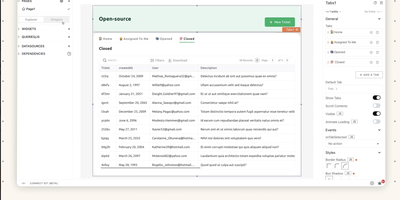
Admin panels, database GUIs, dashboards, approval flows, customer support consoles - Appsmith builds the internal tools your team keeps postponing, on an open-source low-code platform. The UI assembles from 45+ drag-and-drop widgets - tables with server-side pagination and inline editing, charts, forms, lists, buttons - which bind to data through {{ }} JavaScript expressions anywhere in the editor. Datasources cover PostgreSQL, MySQL, MongoDB, MS SQL, Redis, Snowflake, and more, plus any REST or GraphQL API, with SaaS integrations and AI query support for prompt-based steps inside apps. When the widget library falls short, custom widgets are plain JavaScript, HTML, and CSS, and external JS libraries can be imported, which keeps the platform extensible where pure no-code tools hit walls. Git-based version control enables branch-based collaboration, review, and rollback of app definitions. Queries and JS objects hold the business logic layer between datasources and UI. Self-hosted via Docker or Kubernetes, with role-based access control for published apps.
Windmill
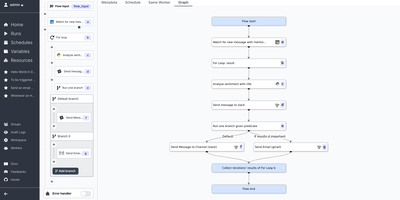
Get ready to harness the power of the almighty Windmill Cloud, the digital sorcerer that turns your humble scripts into mighty workflows and snazzy user interfaces quicker than you can say 'abracadabra'! Imagine crafting internal apps and Herculean workflows with just a sprinkle of code here and there. Windmill Cloud is your trusty sidekick, transforming your scripts into production-grade marvels. Unleash your inner developer wizard with a spellbook of languages like Python, Typescript, Go, Bash, and Sql. Conjure up scripts into workflows with a flick of low-code magic, and share your creations with an auto-magical UI or craft one with minimal toil and trouble. Whether you're running your digital empire on your own mystical lands or ours, Windmill Cloud stands vigilant with permissioning shields and monitoring spells included. It's the open-source Merlin to the proprietary kingdoms of Airplane, Superblocks & Retool, and it's a breeze to deploy across realms, be they quaint hamlets or sprawling metropolises. Command long-running background giants, weave scripts with intricate dependencies, conjure high-speed endpoints, or summon simple one-off tasks—all without breaking a sweat. Trigger these incantations from a webhook or the enchanted UI and keep a watchful eye with ease. Craft intricate flows from the simplest of scripts, plucked from your own enchanted workspace or the grand Hub. Assemble supercharged apps with a wave of your wand using drag-and-drop components, bind them to your data, and launch your app into the stratosphere in mere minutes. With Windmill Cloud's performance potions, your app will soar, unfazed by the weight of even the most complex spells. All this, hosted on RepoCloud, where the cost of casting these digital spells is but a fraction of the cloud giants' hoards. So, what are you waiting for? Let Windmill Cloud be the wind beneath your tech wings!
Budibase
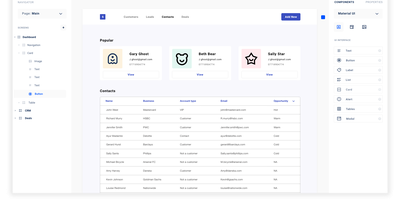
Unleash the power of Budibase, the open-source superhero that transforms mere mortals into tool-creating wizards! Wave goodbye to the dark ages of time-consuming tool development and say hello to lightning-fast app conjuring. With Budibase, you don't need a spellbook (or coding experience) to whip up custom internal tools and forms faster than you can say 'Abracadabra!' Connect with your existing database, charm data from a Rest API, enchant a CSV into submission, or craft from the ether with Budibase's own mystical database. Drag, drop, click, and—voilà!—automated workflows and dazzling designs appear out of thin air. Join the league of over 75,000 teams who've harnessed Budibase to accelerate their business operations to warp speed. Need to secure your data treasures, automate the mundane, or streamline your kingdom's processes? Budibase has got your cape. Plus, hosting on RepoCloud means you'll save a treasure chest of gold compared to those other cloud giants!
Nocobase
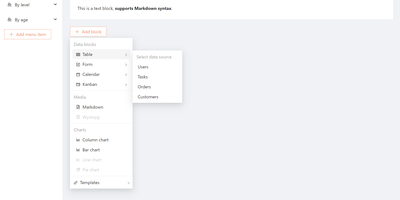
CRMs, project trackers, inventory tools - NocoBase is an open-source no-code/low-code platform for building business systems like these. Its architecture is data-model driven: you define collections and relationships first, then compose any number of interface blocks (tables, forms, kanban, charts) on top of the same model, so data structure is never coupled to a particular view. The core is a microkernel where every feature is a plugin, WordPress-style; you enable official plugins, install marketplace ones, or write your own as npm packages with server and client parts. Data sources include the main PostgreSQL or MySQL database, external databases, and third-party APIs - so you can build admin panels over existing production data instead of migrating it. Built-in infrastructure covers role-based permissions down to collection, record, and field level, workflow automation with approval steps and scheduled triggers, and audit logs; a one-click switch flips between usage and configuration modes. Because custom features live in isolated plugins with a documented lifecycle, core upgrades do not overwrite your customizations, and swapping UIs never requires data migrations since interfaces sit on independent models. Written in TypeScript on Node.js, Koa, and React under the AGPL license, it is light enough for one person to run and extend - and where no-code SaaS platforms charge per seat and per app, a self-hosted instance runs unlimited applications for unlimited users at hosting cost alone.
NocoDB
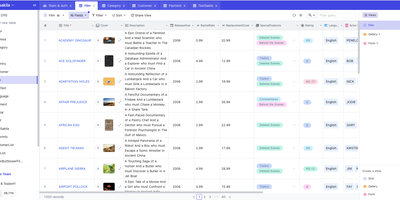
Any existing relational database becomes a collaborative, Airtable-style smart spreadsheet under NocoDB. It connects to PostgreSQL, MySQL, MariaDB, SQL Server, or SQLite, introspects the schema - tables, relationships, indexes - and renders it as interactive Grid, Gallery, Kanban, Calendar, and Form views without migrating a single row. Your business data stays in your database; NocoDB keeps only its own metadata (view configs, permissions, webhooks) in a separate store. Every connected table automatically gets REST APIs with Swagger documentation, effectively turning legacy databases into modern backends. The spreadsheet layer adds 20+ field types including formulas, lookups, rollups, links, attachments, and currency, plus sorting, filtering, grouping, and multi-field editing. Views can be locked or shared publicly with password protection, role-based access control scopes permissions per user, and webhooks plus CSV, Excel, and Airtable import round out integration. An ERD view visualizes the schema. Built with Node.js and Vue, deployed via Docker, handling millions of rows.
ToolJet
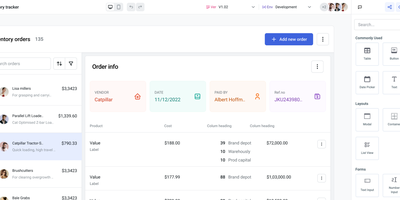
Retool's job, self-hosted: ToolJet is an open-source low-code platform for building internal tools, dashboards, and admin panels. Apps are assembled in a drag-and-drop visual builder with 60+ responsive components, including tables, charts, forms, and lists, and connected to 80+ data sources: PostgreSQL, MySQL, MongoDB, REST and GraphQL APIs, cloud storage, and common SaaS tools. When visual configuration is not enough, you can run JavaScript or Python inline for queries and transformations. A built-in no-code database (ToolJet Database) covers apps that need their own tables without provisioning an external database, Workflows add node-based automation for background jobs with dedicated worker containers and a Redis-backed queue, and multi-page apps with multiplayer editing, inline comments, and mentions support team development. Security is designed for internal data: credentials are AES-256-GCM encrypted, data flows proxy-only through your server so database contents never reach a third-party cloud, and granular per-app access control plus SSO gate each tool. Where Retool-style platforms bill per builder and sometimes per end user, the self-hosted Community Edition serves unlimited builders and users at hosting cost, and full source availability means the platform itself can be forked, audited, and extended. The stack is Node.js and React on PostgreSQL, deployed via Docker.