
imgproxy
Say goodbye to the digital weight gain of your website with imgproxy, the image-shrinking superhero! This app is like a personal trainer for your pixels, ensuring your site stays nimble and quick on its virtual feet. By dynamically resizing and processing images as they're requested, imgproxy is the Marie Kondo of the digital image world, tidying up your storage space and slashing those hefty SaaS fees. Fancy a little nip and tuck for your photos? imgproxy has a tool belt brimming with features like cropping, contrast adjustments, and even pixelization for that retro gamer vibe. It's like having a Swiss Army knife for your images! And for the security-conscious, imgproxy is your loyal guard dog, keeping those pesky image processing attack vectors at bay. Whether you're cloud-bound or cluster-hugging, just whisper sweet parameters into your request URL and voilà – imgproxy fetches your images faster than you can say 'libvips'. And for the power users, imgproxy Pro plans are like VIP backstage passes, giving you more features, more capacity, and an entourage of support. All this, hosted on RepoCloud, where the cost is as tiny as your newly optimized images. Get ready to serve up svelte, speedy visuals without breaking the bank!

Thumbor
Born at Brazilian media giant Globo.com, Thumbor answers imaging CDNs like Imgix and Cloudinary with an HTTP service where every image variant is just a URL. Ask for /300x200/smart/your-image.jpg and Thumbor fetches the original, crops and resizes on demand, and caches the result - one source file, unlimited renditions, no batch pre-generation pipeline. The "smart" in the URL is the signature feature: OpenCV-based face detection finds people in the frame and crops around them (no more thumbnails with severed heads), and when no faces exist, feature detection finds visually important corners and computes a weighted center of mass as the focal point. Beyond cropping, a chainable filter pipeline handles brightness, contrast, grayscale, blur, red-eye removal, rounded corners, rotation, watermarks, and format conversion with quality control - applied in order via URL segments. All common image formats work out of the box, and every layer is pluggable: loaders (HTTP, local, S3), storages and result storages (local, S3, Ceph, and community backends), engines, optimizers, filters, and even custom detectors, with the awesome-thumbor list cataloging the ecosystem. URL signing prevents abuse of your processing capacity. Integrations exist for Django, Rails, Node, WordPress, and most frameworks. MIT-licensed, battle- tested for over a decade.
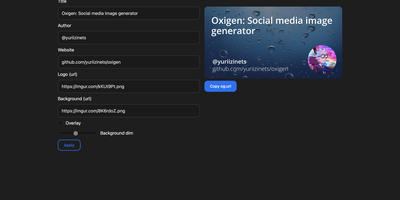
Oxigen
The social preview cards shown when links hit Twitter, LinkedIn, Slack, or Discord, generated on the fly: Oxigen is a small Go service for dynamic Open Graph images, no designer required per page. Instead of exporting static images per page, you compose a card once and drive it with parameters: title, author, website, logo, background image, and background dimming all arrive as URL query arguments, so your og:image meta tag simply points at the Oxigen endpoint with the page's own values substituted in. Every blog post, product page, and doc gets a branded, correctly sized preview generated on the fly. A built-in web UI covers interactive composition - tweak the text and imagery, watch the preview update, copy the resulting URL - while the same rendering path serves programmatic API use from static site generators, CMS templates, or build pipelines. Rendering is pure Go using the gg 2D graphics library, freetype fonts, and the imaging package, built on the kyoto framework by that project's author. Deployment is one stateless container on port 80 with no database and no external dependencies, so instances scale and restart freely.