
Ubuntu VPS
A minimal Ubuntu 24.04 LTS virtual private server — no pre-installed applications, no opinionated configuration, just the operating system and root access. Start from a clean slate and install exactly what you need: web servers, databases, development toolchains, CI runners, monitoring stacks, VPN endpoints, game servers, or anything else that runs on Linux. The server ships with apt package management, systemd service supervision, and standard networking configured out of the box, giving you access to over 36,000 packages in the Universe repository alone. Connect via SSH with the key you select during deployment; a dedicated IPv4 address is included with every server at no extra charge. A browser-based serial console in the RepoCloud dashboard provides emergency access without an SSH client. Snapshots let you capture the server state before risky changes and roll back with one click. Resize CPU and RAM on demand without reinstalling. Canonical's standard security maintenance covers this LTS release through May 2029 — five years of patches for the Main repository. Ubuntu Pro extends that to ten years with additional Universe coverage, kernel livepatching, and compliance tooling, available free for up to five machines.
Mstream
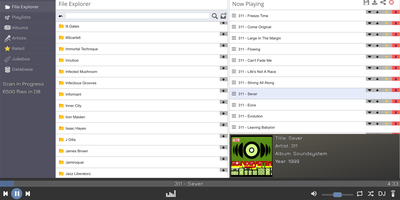
"The easiest music streaming server available" is mStream's own billing, and the claim holds up: a lightweight Node.js app that turns a folder of audio files into a private streaming service in minutes, no external database required. Its filesystem-based design is the clever part - the API mirrors your folder structure, so you can browse and play music immediately, before any library scan finishes, and your organization on disk is your organization in the app. It streams flac, mp3, wav, ogg, opus, aac, and m4a, which matters to the audiophile crowd: FLAC plays uncompressed, bit-perfect, with gapless playback for live albums and continuous mixes. The web player runs anywhere a browser does and packs personality - a Milkdrop-style visualizer (Butterchurn), playlist sharing via links, and drag-and-drop uploads straight through the file explorer. Native iOS and Android apps add the feature streaming subscriptions can't match: sync your collection to your phone for true offline playback of music you own. Multi-user support assigns separate directories and permissions per account. Resource usage is famously light - mStream is tested on multi-terabyte libraries and runs happily on a Raspberry Pi, so a small RepoCloud instance serves a lifetime's collection. GPL-licensed, with zero listening-habit telemetry.
Trigger.dev
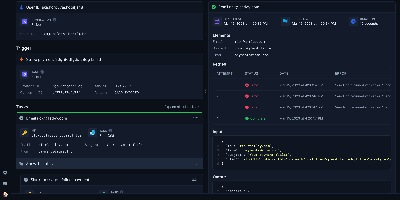
Welcome to the world of background jobs, where your code can finally take a nap while it works! Imagine a magical realm where your long-running tasks can be scheduled like your favorite Netflix binge, complete with API integrations and webhooks that make your code feel like it's throwing a party while you’re away. No more worrying about whether your job will finish before your coffee gets cold; with our open source background jobs platform, you can delay tasks like a pro procrastinator! It's like having a personal assistant for your code, but without the awkward small talk or the need to share your lunch. So sit back, relax, and let your code do the heavy lifting while you focus on more important things, like debating whether pineapple belongs on pizza. Deploy it with a single click and watch your productivity soar, all for half the price of those other cloud hosts that think they're too cool for school!
Tautuilli
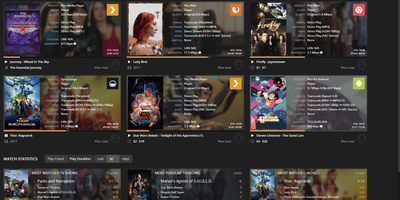
Get ready to transform your Plex Media Server into a surveillance powerhouse with Tautulli! This nifty web app is like a personal assistant for your server, keeping tabs on all the who's, what's, when's, and how's of your media consumption. It's a statistics ninja, slicing and dicing data into digestible graphs and tables that even your grandma could understand. Want to know if your friends are binge-watching your movie collection while you're at work? Tautulli's got your back. It logs every giggle, gasp, and groan from your users, and even lets you send out snazzy newsletters to brag about your ever-growing media empire. And for those on the move, there's an official app to keep you in the loop. Best of all, hosting it on RepoCloud won't break the bank, leaving you with more cash to spend on popcorn. So, why wait? Give your Plex server a brain boost with Tautulli, and watch it on any python-friendly system!

Minecraft Server
Get ready to craft, mine, and host like a pro with the itzg/minecraft-server app! This digital wizardry ensures your Minecraft escapades are never behind the times by magically summoning the latest stable version of the Minecraft server at launch. Want to be a version virtuoso? No problemo! You can pick your potion, be it a specific release or the freshest snapshot, and wield the power to tailor your pixelated playground. Console knights, mobile adventurers, and Windows warriors, rejoice! There's a Bedrock Server with your name on it for that buttery-smooth blocky bliss. And because we're not about that 'complicated' life, the classic port 25565 is ready to roll out the red carpet directly to your host machine. Host your blocky realms on RepoCloud, where the cost is as tiny as a block of dirt, but the fun is as big as a mountain biome!
MailCrab
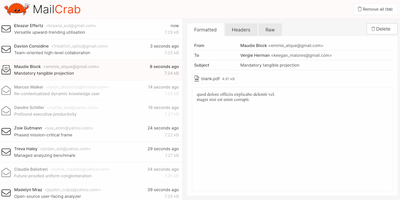
Introducing MailCrab, the crustacean of the email testing world that's ready to snap up all your development emails in its claws! This nifty accept-all SMTP server isn't just another pretty shell; it comes with a web interface that lets you spy on your emails like a secret agent. Peek at formatted emails, snatch attachments, scrutinize headers, or dive into the raw email abyss. It's a dockerized delight that scuttles across both amd64 and arm64 platforms with ease. Crafted in the robust and speedy Rust language, MailCrab's backend is like a treasure chest that hoards your emails in memory's locker, while the frontend is your trusty periscope to the sea of messages. It's smart enough to fetch all your email metadata with a single call and then keeps an eye out for new messages with its websocket tentacles. Want to read a message? Just poke the endpoint, and voilà! Plus, with a few secret commands, you can mark messages as read, make them walk the plank one by one, or unleash a kraken to wipe them all out. Host it on RepoCloud, where the costs are as tiny as plankton compared to other cloud hosts, and you'll be sailing the high seas of email testing with a grin as wide as a whale's!
Radarr
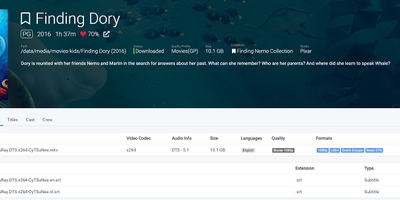
The movie half of the *arr stack: Radarr is a .NET collection manager that automates acquiring films for Usenet and BitTorrent users the way Sonarr does for TV. Add a movie once and Radarr handles the rest: it monitors indexers and RSS feeds, grabs a matching release the moment one appears, sends it to SABnzbd, NZBGet, qBittorrent, Deluge, Transmission, rTorrent, or another connected download client, then imports, sorts, and renames the file into your library structure. Quality profiles are the control surface - define allowed resolutions and a cutoff, and Radarr keeps upgrading files automatically, replacing a DVD rip when a Blu-ray release lands. Custom formats go further, scoring releases by codec, HDR metadata, release group, streaming source, or arbitrary regex so the copy you want always wins the pick. Failed downloads retry with another release automatically; a manual search shows every candidate and explains why one was skipped. Release parsing recognizes director's cuts, special editions, AKA titles, and hardcoded subs. Plex and Kodi integration handles notifications, library refreshes, and metadata like posters, trailers, and subtitles, and a calendar view tracks upcoming releases. It pairs naturally with Jellyseerr for request management and shares its API conventions with the whole *arr ecosystem.
Jellyfin
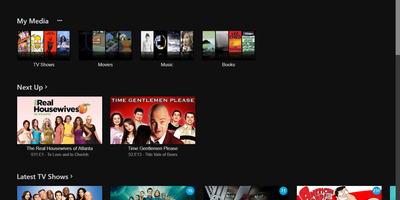
Unleash the kraken of your media collection with Jellyfin! This open-source maestro of media turns your server into a personal streaming powerhouse. Picture this: your entire cinematic universe, TV binges, concert halls, and even your digital bookshelf, all at the tips of your fingers, ready to beam to any gadget you own. Jellyfin is like a Swiss Army knife for your media – it slices, dices, and serves up live TV and DVR, so you can catch the latest episode or save it for a rainy day. And with SyncPlay, you can synchronize your watch parties across the globe, because who doesn't love a good movie with friends? Available on all the cool kid platforms, Jellyfin ensures you're never more than a click away from your media munchies. Plus, with a GNU GPL license, it's more free than a bird – modify, remix, and share to your heart's content. And the cherry on top? Jellyfin is a privacy ninja, dodging trackers and keeping your data out of the clutches of the digital overlords. Host it on RepoCloud, and you'll be saving coins faster than a video game plumber, all while enjoying the open-source camaraderie!
ZNC
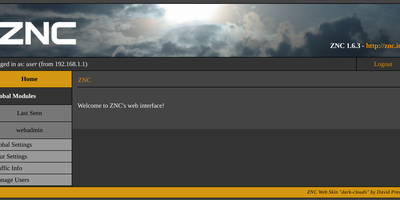
Ever wish you could be the omnipresent deity of your favorite IRC channels, never missing a single cat meme or heated debate about tabs vs. spaces? Meet ZNC, the IRC bouncer that ensures you’re always in the loop, even when you're off pretending to be productive. Think of it as your personal 24/7 nightclub bouncer, but instead of keeping people out, it keeps you perpetually in! With ZNC, you can finally achieve that elusive dream of being everywhere and nowhere at the same time. So go ahead, take a nap, walk the dog, or binge-watch that series—ZNC’s got your back, ensuring you never miss a beat in the endless symphony of IRC chatter. Who needs sleep when you have ZNC?
Navidrome
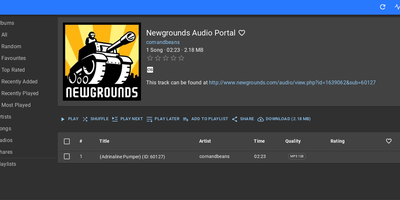
Spotify economics without the subscription or catalog gaps: Navidrome, the reference self-hosted music server, streams your own FLAC, MP3, and ALAC collection from a single Go binary with a React/Material UI web player. Its Subsonic/OpenSubsonic API compatibility is the superpower: 50+ existing clients work out of the box, from Symfonium and DSub on Android to Feishin and Sonixd on desktop, plus Android Auto, CarPlay, and Android TV apps. Transcoding is server-managed and FFmpeg-backed - FLAC direct-plays at home and downsamples to MP3, AAC, or Opus over mobile bandwidth, with the OpenSubsonic transcoding extension letting clients declare capabilities and receive per-track direct-play or transcode decisions automatically. Multi-user support gives every account its own play counts, favorites, ratings, and playlists, and multi-library support scopes different collections to different users. The feature list covers serious listening: Last.fm and ListenBrainz scrobbling, artist bios and images, embedded and external lyrics, audiobook bookmarks, saved play queues that resume on another device, internet radio, jukebox mode, and M3U playlist auto-import kept in sync with your folder. Resource usage is famously low - it runs happily on a Raspberry Pi and scales to six-figure track counts.
Audiobookshelf
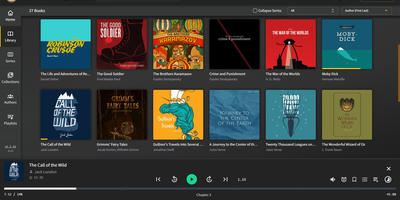
Get ready to transform your digital bookshelf with Audiobookshelf, the self-hosted maestro of audiobooks and podcasts! Imagine a world where your audio tales and talk shows are not just thrown into a digital pile, but are sorted with the finesse of a librarian who's had one too many espressos. Audiobookshelf thrives on a neat directory diet, feasting on the juicy details of folder names to serve up author bios, series sagas, tantalizing titles, publication dates, and more, right to your ears. It's like having a personal DJ for your books, spinning metadata tags into a symphony of organized bliss. And for the tech-savvy, it's as customizable as your grandma's secret cookie recipe, with all the Docker container spices you love. Hosted on RepoCloud, where your wallet can take a breather from those high-flying cloud hosting fees, Audiobookshelf is the VIP lounge for your audiobooks and podcasts, all on your own server with the sleek Easypanel as your bouncer. Queue up, tune in, and get lost in your perfectly curated audio universe with Audiobookshelf!
Kavita
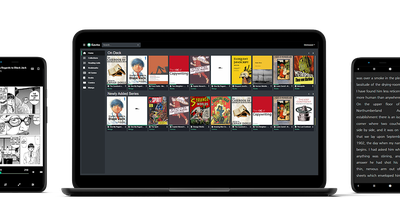
Manga, comics, ebooks, and light novels get a streaming-service-style home in Kavita - a fast, cross-platform reading server for the DRM-free collection you share with family and friends. It natively serves CBZ, CBR, CB7, ZIP/RAR/7z archives, raw images, EPUB, and PDF, with hand-crafted web readers per format: webtoon scrolling, single and dual-page spreads with advanced caching for the comic reader, and a book reader with adjustable fonts, spacing, margins, color themes, and column modes. Reading progress tracks per user, so everyone resumes exactly where they stopped on any device. Metadata parses from filenames, ComicInfo.xml, and EPUB fields, feeding index-backed search, smart filters, collections, reading lists with CBL import, and Want to Read queues. Role-based user management covers age restrictions, per-library access, and OIDC authentication. An OPDS feed connects third-party clients - Panels on iOS, Librera on Android, KOReader on e-ink devices - and a comprehensive REST API supports custom integrations. EPUB annotation and highlight support, custom theming, and full localization round it out. Built with .NET and Angular, it handles 50,000+ file libraries without strain; optional Kavita+ adds AniList scrobbling, recommendations, and external metadata.
Emby
Point Emby at your movie, music, and photo libraries and it becomes a private streaming service: metadata and artwork arrive from TMDB and TVDB, everything lands in a polished browsable interface, and media transcodes on the fly whenever a client can't play the original format. The client reach is the selling point: native apps span Android TV, Apple TV, Google TV, Fire TV, Roku, LG and Samsung smart TVs, iOS, Android, Apple CarPlay, Android Auto, plus web browsers and desktop apps for Windows, macOS, and Linux, and DLNA devices are auto-detected for casting and remote control. Multi-user support gives each household member their own account, watch history, favorites, and recommendations, with genuinely capable parental controls: content restrictions, access schedules, time limits, and live monitoring with remote control of kids' sessions. Live TV works with hardware tuners like HDHomeRun or M3U playlists, with free guide data in the US, Canada, and UK. The server and core features are free; an optional Premiere key adds hardware-accelerated transcoding, DVR recording, offline sync, and Cinema Mode intros.
Fireshare
The moment after ShadowPlay saves a great clip is what Fireshare was built for: your friends see it now, not after a YouTube upload, processing queue, and platform terms review. Drop videos into a watched folder and this Flask/React application generates a unique shareable URL for each one, complete with Open Graph metadata - so pasting the link into Discord, Twitter, or Slack produces a proper embed with title, description, and video thumbnail instead of a raw URL. Viewers need no account and no app. Visibility is per-file: public (browseable on your feed), private (unlisted, reachable only by direct link), or password protected. For game clips specifically, Fireshare organizes automatically - clips sort by game with cover art pulled from SteamGridDB, no manual tagging - while tags and full-library search cover everything else. Optional transcoding (CPU or GPU) creates lower-quality renditions so viewers on weak connections get automatic quality adaptation, and video cropping trims clips in place. The extras round out a genuinely finished tool: view counters, timestamped share links, a shuffle button, restrictable uploads, Discord notifications for new videos, an RSS feed of the public feed, mobile support, and LDAP for multi-user setups. No storage limits, no watermarks, no platform deciding what stays up. GPL-licensed.
Komga
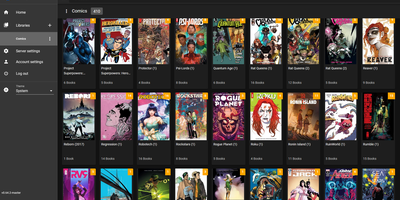
What Jellyfin is for video, Komga is for comics, manga, BDs, magazines, and eBooks: point it at folders of CBZ, CBR, CBT, PDF, and EPUB files and it becomes a proper library with cover art, embedded metadata import, and per-user reading progress. The responsive web reader handles multiple reading modes - left-to-right for western comics, right-to-left for manga, webtoon scrolling - while collections and read lists organize crossovers and story arcs, with ComicRack .cbl read list import for existing curation. Its openness is the real differentiator: OPDS v1.2 and v2.0 feeds serve virtually every reader app (Panels, Moon+ Reader, Mihon/Tachiyomi, KyBook), with OpenSearch and page-streaming extensions so mobile apps fetch pages on demand instead of whole archives. E-ink support is built in, not bolted on - Kobo devices sync directly against Komga instead of Kobo's servers, with two-way read progress, on-the-fly KEPUB conversion via Kepubify, and optional proxying so official Kobo purchases still work; KOReader sync covers everything else. Multi-user management brings per-library access control, age restrictions, and label restrictions for family setups. Housekeeping tools detect duplicate files and duplicate pages, and a REST API feeds a healthy ecosystem of community scripts. Runs from a single Docker container with embedded SQLite.
Prowlarr
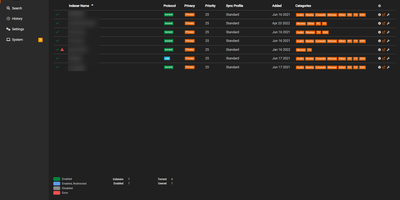
Configure each indexer once, not five times: Prowlarr is the indexer hub of the *arr stack, removing the most tedious duplication in a media automation setup. Instead of configuring the same torrent trackers and Usenet indexers separately in Sonarr, Radarr, Lidarr, Readarr, and Mylar3, you add each one once in Prowlarr and it syncs them to every connected app automatically, complete with category mappings; with Full Sync enabled, adding or removing an indexer propagates everywhere, and a tracker URL change is a one-place fix. Coverage is the deepest available: 500+ torrent trackers with definitions added constantly, 24 native Usenet indexers, generic Newznab and Torznab support for anything else, and custom Cardigann YML definitions with JSON and XML parsing for obscure sources. Built on the same .NET/React base as its siblings, it also earns a place as a search tool in its own right: unified manual search queries every indexer simultaneously at a category level, and you can push multiple releases straight to your download clients without touching Sonarr or Radarr. Health checks and status notifications flag failing indexers, per-indexer statistics track success rates and response times so you can cull unreliable sources, and per-indexer proxy support (SOCKS4/5, HTTP, FlareSolverr) handles trackers behind Cloudflare.
Sonarr
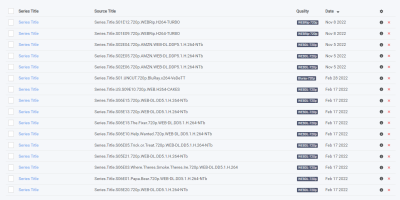
Add a series once, set a quality profile, and everything downstream is automated: Sonarr is the smart PVR for Usenet and BitTorrent users. It monitors RSS feeds from your indexers, detects new episodes the moment they release, sends matching grabs to SABnzbd, NZBGet, qBittorrent, Deluge, or another download client, then renames files with fully configurable templates, sorts them into consistent folder structures, and notifies Plex, Kodi, or Jellyfin to update the library. Quality profiles define what's acceptable (HDTV, WEB-DL, Blu-ray, up to 4K) and an upgrade cutoff - when a better release appears, Sonarr replaces the existing file automatically, stepping from HDTV to WEB-DL to Blu-ray until the cutoff is met. Custom formats add weighted scoring for finer-grained release selection, with community-maintained TRaSH Guides presets as the widely accepted defaults. Failed downloads are handled without intervention: Sonarr retries with another release, and manual search shows every candidate with the reasons any was rejected. It scans existing libraries for missing episodes, fully supports specials, multi-episode files, and daily and anime series types, and a calendar view shows upcoming episodes across every tracked show. Runs on Linux, Windows, macOS, and Raspberry Pi, and pairs naturally with Prowlarr for centralized indexer management.
Substreamer
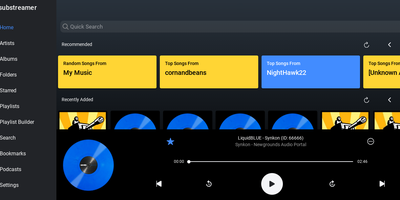
A free, polished web client for Subsonic-compatible music servers: Substreamer is the browser-based frontend you point at your existing streaming backend to play your own library from anywhere. It speaks the Subsonic API (v1.13 and higher), which makes it compatible with the whole ecosystem that has grown around that protocol: the original Subsonic server, its forks Airsonic and Madsonic, and modern implementations like Navidrome and Ampache. That decoupling is the point - your music files, transcoding, and library indexing live on whichever server you prefer, while Substreamer provides the listening experience: browse by artist, album, and genre, build and manage playlists, search your collection, and stream on demand. This RepoCloud deployment runs the containerized web edition, so the same interface is available from any browser without installing a native app, and it pairs with the Substreamer mobile apps that made the client popular. For anyone assembling a self-hosted Spotify replacement - typically Navidrome for the backend plus a good client - Substreamer fills the client half with a clean, familiar player UI. Because it is a stateless client, the container is lightweight and low-maintenance: connect it to your server's URL and credentials, and your entire collection is streaming in minutes, with no subscription and no catalog that can disappear.