Morphic
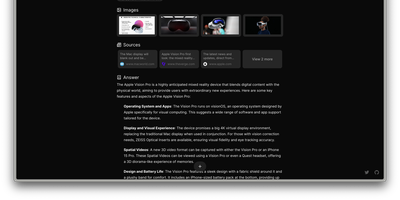
Perplexity's answer-engine experience, self-hostable and open-source: Morphic searches the web and writes cited answers. Instead of returning a list of links, it searches the web, reads the sources, and generates a complete answer with inline numbered citations. The generative UI streams rich components, source cards with thumbnails, image grids, syntax-highlighted code, and LaTeX math, rather than plain markdown. Quick mode answers fast; Adaptive mode runs deeper multi-step research. Search backends are pluggable: the Docker Compose bundle ships with a private SearXNG instance so no search API key is required, and Tavily, Brave, and Exa are supported alternatives. LLM providers include OpenAI, Anthropic, Google, Ollama, and any OpenAI-compatible endpoint, with per-mode model mapping - fast, cheap models for quick searches, stronger models for adaptive research, tuning the cost-quality trade-off per query type. An inspector panel exposes tool execution during multi-step research, and AI-suggested follow-up questions keep an investigation moving. Chat history persists in PostgreSQL, results are shareable by URL, file uploads feed context into queries, and optional Supabase authentication adds multi-user or guest access. Because the default search path is your private SearXNG instance, research topics never hit a commercial search API - and with local Ollama models the marginal cost of a query approaches zero. Built with Next.js, TypeScript, and the Vercel AI SDK under Apache 2.0.

Meilisearch
Get ready to turbocharge your digital haystack with Meilisearch Cloud, the open-source search engine that's more electrifying than a double espresso shot for your search bar! Imagine a world where your users can find the needle in the haystack before you can say 'Meili-whoa!' – that's the sub-50-millisecond promise of this search sorcerer. Wave goodbye to the days of head-scratching configurations; Meilisearch is like that friend who just gets you, offering smart, zero-config search setups. It's the Swiss Army knife of full-text search engines, slicing through every use case with the precision of a gourmet chef. Whether your users are typing in English, Esperanto, or Elvish, Meilisearch is the polyglot pal you never knew you needed, automatically tuning into any language. Fancy yourself a bit of a search maestro? Go ahead, orchestrate your own ranking symphony with custom relevancy rules. And because we're all about keeping secrets, Meilisearch comes with API keys and tenant tokens to keep your searches as secure as a vault. Want to go the extra mile? Unleash the power of geo searches and let your users find treasures nearby. With Meilisearch Cloud hosted on RepoCloud, you're not just saving coins compared to those spendy cloud hosts; you're also joining a band of open-source rockstars. So, strap in and prepare to deliver a search experience that's as customizable as a build-a-bear workshop, all with just a few lines of code!

PhotoPrism
Get ready to give your photo collection a dose of AI smarts with PhotoPrism, the snazzy, decentralized dazzler of the image world! This app is like a ninja in the night, silently tagging and sorting your snapshots without so much as a hiccup in your day-to-day. Whether you're a homebody with a penchant for privacy or a cloud-surfing digital nomad, PhotoPrism's got your back. Wave goodbye to the headache of RAW files, the clones of duplicate images, and the babel of video formats. With its slick search sorcery, you can pinpoint that one photo of Aunt Mabel's surprise birthday party in a snap. Plus, with glossy world maps, you can take a stroll down memory lane, but with GPS precision. Fancy a bit of magic? Just hover over those Live Photos and watch them... well, live! And let's not forget the facial recognition – it's like having a butler who knows your guests by sight, only it's your photos. PhotoPrism is the Fort Knox of photo apps, guarding your precious memories with an ironclad promise of privacy. Host it on RepoCloud, and you'll be saving more than just memories; you'll be saving some serious coin, too!
Typesense
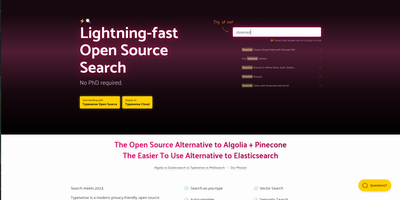
Get ready to turbocharge your search experience with Typesense, the search engine that laughs in the face of typos and serves up results faster than you can say 'instantaneous'! This open-source marvel is the cool cousin of Algolia and the more approachable neighbor of ElasticSearch. With its built-in typo tolerance, Typesense is like that forgiving friend who understands what you mean, even when you text 'tacos' as 'tcoas'. Zipping through queries with the speed of a caffeinated cheetah, it boasts a response time that's quicker than a hiccup (<50ms, to be precise). Tailor your search like a bespoke suit, sort results like a card shark, and refine like a master sommelier with faceting and filtering. It's got more grouping and federating tricks than a magician's convention, and it knows the lay of the land with geo-search capabilities. Plus, with API key generation, it's the perfect wingman for multi-tenant app shindigs. Easy to set up and scale, Typesense is your golden ticket to search nirvana, and with RepoCloud's wallet-friendly hosting, you'll be the toast of the open-source town!

Ghost File Sharing
Get ready to turbocharge your coding escapades with our app that's like a GPS for GitHub! Navigate the bustling streets of code, projects, and fellow code-connoisseurs with ease. It's like having a productivity potion at your fingertips. Subscribe to our newsletter and be the cool kid on the block with the latest product scoops and corporate chronicles. Plus, our app is Fort Knox for your code, ensuring your digital masterpieces are safe as houses. Ideal for the solo programming ninja or the enterprise brigade, our app is your golden ticket to the open-source wonderland, all while saving your coins with RepoCloud's wallet-friendly hosting!

Perplexica
Meet Perplexica, the brainy, open-source search engine that doesn't just search the web—it practically reads your mind! Powered by the wizardry of AI, Perplexica digs through the digital universe to fetch not just any answers, but the ones you actually need. Thanks to its advanced machine learning chops, it's like having a personal research assistant who's always on the ball. Built on the robust SearxNG framework, it not only keeps you in the loop with the latest info but also guards your privacy like a digital fortress. Host it on RepoCloud, and you'll wonder how you ever browsed the net without it!

AnythingLLM
Chat with your own documents: AnythingLLM, from Mintplex Labs, wraps retrieval-augmented generation (RAG) in an open-source application anyone can run. You organize content into workspaces, each an isolated namespace with its own documents, vector embeddings, chat history, and settings, so one instance can hold several separate knowledge bases. Upload PDFs, DOCX, TXT, and other formats, or scrape web pages; the built-in collector parses and chunks them into a vector database (LanceDB by default, with Pinecone, Chroma, Qdrant, and others supported). Answers cite their source documents. It works with both cloud LLMs (OpenAI, Anthropic, Gemini) and local ones via Ollama or LM Studio, and the embedding model is separately configurable. Beyond RAG chat, it includes AI agents that can browse the web and run tools, an embeddable chat widget for your website, a developer API, and multi-user mode with admin, manager, and default roles plus per-workspace access control. Context assembly is smarter than naive RAG: pinned documents, attached files, vector search hits, and recent chat history are combined under a token budget so the model's context window is filled efficiently, and each workspace supports multiple independent conversation threads against the same knowledge base. Because the embedding model, vector store, and chat LLM are all independently swappable, you can move between providers without re-ingesting a single document. The stack is Node.js with a React frontend, MIT-licensed.

Farfalle
Live web search plus an LLM of your choice: Farfalle is an open-source, self-hosted answer engine in the Perplexity mold. Queries route through one of several search providers - self-hosted SearXNG for a fully independent stack, or Tavily, Serper, and Bing APIs - and the model composes a cited answer from the retrieved results. Model flexibility is the core design: run llama3, mistral, gemma, or phi3 locally through Ollama for zero per-query cost and full privacy, use cloud models like GPT-4o or Groq-hosted Llama 3 for speed, or route to any provider via LiteLLM. An Expert Search mode uses an agent that plans a multi-step search strategy and executes it for harder questions, and chat history keeps prior research sessions available. The stack is a Next.js and shadcn/ui frontend over a FastAPI backend with Redis rate limiting, shipped as a pre-built Docker image. A browser search-engine entry pointing at your instance makes it the default search from the address bar. Paired with SearXNG and Ollama, the whole pipeline runs with no external API at all.
Khoj
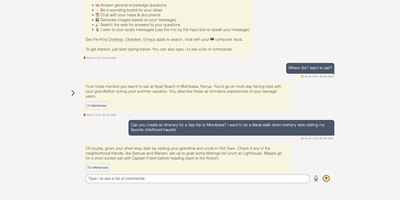
A self-hosted "second brain": Khoj indexes your own files and answers questions from them, parsing Markdown (whole Obsidian vaults included), org-mode, PDF, Word, plain text, Notion pages, GitHub repositories, and images described by a vision model, then embedding everything with sentence-transformers into a vector index for semantic search and RAG with cited sources. Any LLM backend works: local models like Llama, Qwen, or Mistral via Ollama, or cloud models like GPT, Claude, and Gemini. You can build custom agents, each with its own persona, scoped knowledge base, chat model, and tools such as web search and code execution. Scheduled automations run recurring research and deliver newsletters or notifications to your inbox, and research mode performs multi-hop web searches with inline citations. Access it from a browser, the Obsidian plugin, Emacs, desktop, or WhatsApp - all clients connect to the same self-hosted instance, making Khoj one of the few AI assistants Emacs users can point at decades of org files. Semantic search means recall works without exact keywords: "that paper about forecasting with transformers" surfaces the right PDF even when you cannot remember its title. Switching LLM backends never requires re-indexing your documents, and with a local model via Ollama, even inference stays on hardware you control - journals, research, and private notes are never sent anywhere. Python/FastAPI stack, AGPL-licensed, with PostgreSQL storage.

SearXNG
Up to 280 search services - Google, Bing, DuckDuckGo, Brave, Qwant, Startpage - aggregated without tracking or profiling: SearXNG is a privacy-respecting metasearch engine (AGPL-3.0, successor to Searx). Your instance queries the upstream engines on your behalf: your IP address, cookies, and search history never reach them, tracker parameters are stripped from result URLs, and an optional image proxy fetches thumbnails server-side so result pages leak nothing. It can even route outbound queries through Tor for full anonymity. Search is organized into categories - general, images, videos, news, maps, music, IT, science, files - with bang shortcuts for targeting specific engines, and every source can be enabled, disabled, or weighted per category in settings.yml. A plugin system adds calculators, hash tools, tracker removal, and unit conversions inline, and preferences (themes, safe search, languages, engine selection) persist in cookies rather than server-side accounts. The real argument for running your own instance rather than trusting a public one is control: you decide the logging policy (none), the engine mix, rate limiting, and who gets access - making it the default search backend for browsers, families, and teams that want Google-quality results without the profile.

Whoogle
Google's search results without Google's surveillance: Whoogle is a self-hosted proxy that strips the tracking and keeps the results. Your query goes from browser to your Whoogle instance, which fetches results from Google with a randomly generated User Agent and strips everything hostile before returning them: no ads or sponsored content, no third-party JavaScript or cookies, no AMP links, no URL tracking tags like utm_source, no referrer header - and Google sees your server's IP, never yours. Unlike metasearch engines that blend sources, Whoogle proxies Google exclusively, so result quality is exactly what you'd get logged out and incognito, minus the noise. A lightweight Flask app configured entirely through environment variables, it supports DuckDuckGo-style bang shortcuts, autocomplete suggestions, safe search, per-country and per-language filtering, site blocklists, and automatic rewriting of social links to privacy front-ends like Nitter and Invidious. Privacy hardening goes further: built-in Tor routing makes Google see an exit node instead of your server, HTTP/SOCKS proxy support covers other setups, and POST-based queries keep search terms out of logs. Light, dark, and fully custom CSS themes plus browser search-engine registration make it a drop-in default on desktop and mobile. Stateless, tiny, and trivial to run.
Perplexica3
Meet Perplexica, your new AI-driven search engine sidekick that doesn't just search the web—it practically reads your mind! Harnessing the power of advanced machine learning, Perplexica dives deep into the ocean of the internet to fetch not just any answers, but the most relevant, crystal-clear responses, all while keeping your privacy under lock and key. Built on the robust SearxNG framework, it's like having a super-smart librarian who also respects your personal space. Hosted on RepoCloud, it's not just smart—it's also a wallet-friendly genius!
Qdrant
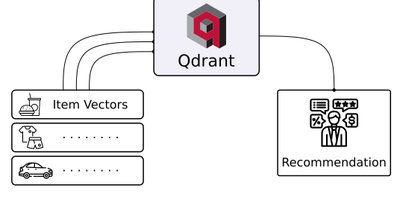
Embark on a quest with Qdrant, the Herculean vector database that's flexing its muscles to revolutionize AI apps. Imagine a digital genie that grants you the power to sift through high-dimensional space with the ease of a cosmic search engine. It's not just an API service; it's your ticket to transforming brainy embeddings into superstar applications that can match, search, and recommend like a boss. Qdrant is like the Swiss Army knife for data types, handling everything from witty string banter to numerical ninja ranges, and even geo-locations with a sense of wanderlust. It's cloud-native, so it grows with your ambitions, scaling horizontally like it's training for the digital Olympics, all while being as resource-efficient as a monk. Host it on RepoCloud, and you'll be building semantic neural search castles in the sky in no time, understanding user antics as they unfold, and spotting similar images or duplicate doppelgängers with the sharpness of an eagle. It's the open-source powerhouse that makes your data dance to the tune of innovation, all at a cost that keeps your wallet as happy as a clam at high tide!
Weaviate
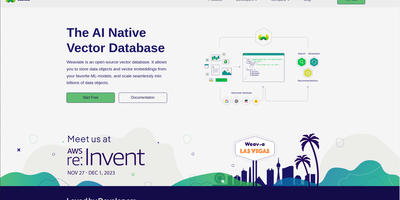
Embark on a semantic adventure with Weaviate, the open-source vector database that's like a GPS for your data! Imagine a world where your data points are like stars in the cosmos, and Weaviate is your trusty telescope, helping you navigate the galaxy of information based on the 'semantic vibes' they emit. With the ability to stand alone or play nice with a smorgasbord of vectorizing modules, this database is your ticket to a lightning-fast vector similarity search that zips through raw vectors or data objects with the speed of a comet, even when you throw in a few filters. It's like having a search party that combines the Sherlock Holmes of keyword sleuthing with the psychic predictions of vector search techniques for mind-blowingly accurate results. Want to play quiz master with your data? Pair it with any generative model and host a Q&A session right in your dataset! Hosting Weaviate on RepoCloud is like getting first-class seats for your apps on a spaceship, at economy prices. Buckle up for a next-gen vector database experience that will power your apps to infinity and beyond!