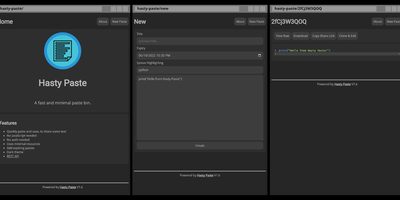
Hasty Paste
Paste some text, hit save, share the link - Hasty Paste is a fast, minimal pastebin written in Python on the async Quart framework, named, by its author's own admission, "because you use it so fast without a care in the world." No accounts, no authentication, no friction - built for the everyday case of handing a debug log, config snippet, or stack trace to someone in tech support or a chat channel. Pastes get randomly generated IDs, with an optional "long" ID mode that makes brute-force URL guessing impractical, and expiry times ensure throwaway content actually gets thrown away. Optional Pygments syntax highlighting makes code readable, a dark theme spares your eyes, and the whole interface works without JavaScript - it renders in terminal browsers and under the strictest script blockers. Storage is a custom flat-file system (no database), caching runs internally or through Redis for busier instances, and a REST API plus the companion "Hastily Paste It" CLI script enable piping command output straight into a paste from the terminal. The Alpine-based Docker image is tiny, resource usage is minimal, and the license is AGPL.
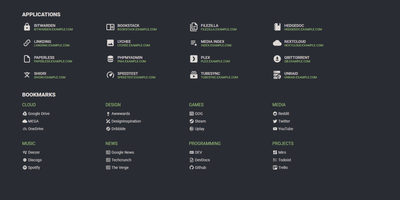
Flame
A server full of scattered services becomes one clean application hub under Flame - a self-hosted startpage where every bit of configuration happens in built-in GUI editors, never a config file. Applications and bookmarks are created, edited, and organized into categories directly in the browser, and favorites pin to the homescreen for one-click access. The integrated search bar filters your apps and bookmarks locally as you type, and prefix shortcuts (like /g for Google) route queries to any of 11 web search providers or custom ones you define, making Flame a genuine browser homepage rather than a static link wall. Docker integration is the standout for homelabs: mount the Docker socket, add flame.type, flame.name, and flame.url labels to containers, and new services appear on the dashboard automatically - Kubernetes Ingress annotations work the same way. A weather widget shows temperature, cloud coverage, and animated conditions for your coordinates, and password authentication protects settings and items. Appearance is deeply customizable with 15 built-in color themes, a custom theme builder, and full custom CSS support. The stack is Node.js with SQLite behind a React frontend - light, fast, and inspired by the minimalist SUI design.
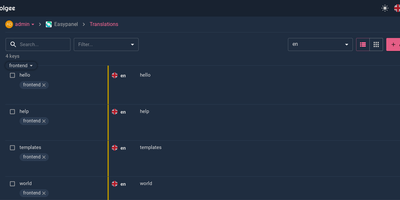
Tolgee
Hold Alt/Option, click any string in your running app, and edit the translation in place: Tolgee is an open-source localization platform built the way developers wish translation worked - changes save straight to the platform with no hunting through JSON or PO files. In-context editing works even in production via the Tolgee Tools browser extension, which injects credentials without touching source code, so a client or colleague with zero coding skills can translate the product inside the product. The SDKs (React, Angular, Vue, Svelte, plus iOS and Android) extract context from each UI element and capture one-click screenshots, giving both human translators and machines the surrounding meaning that raw string files lose. Autonomous translation uses that context: new keys are instantly filled from translation memory or machine translation (DeepL, Google Translate, AWS Translate), with optional human review afterward - shipping no longer waits on a translation agency. A CLI handles import/export, a REST API covers automation, a Figma plugin bridges design, and an MCP server lets AI coding assistants search keys, create translations, and trigger machine translation without leaving the editor. Self-hosting this Crowdin/Phrase/Lokalise alternative keeps every string, screenshot, and API key on your infrastructure.
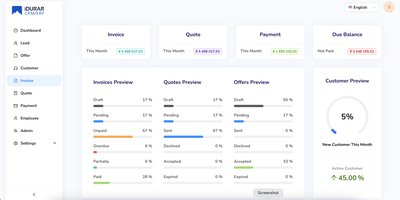
iDURAR
Quote to cash in one web application - create quotes, convert them to invoices, record payments, track customers: iDURAR is an open-source ERP and CRM platform for small and medium-sized businesses. Built on the MERN stack (MongoDB, Express, React, Node.js) with Ant Design components and Redux state management, it presents a clean SaaS-style interface that needs little onboarding. Core modules cover invoice management with PDF generation and email delivery, payment recording against invoices, quote and proforma handling, customer records, and accounting views over the resulting data. Multi-currency support and localization make it usable for internationally operating teams. Because the whole stack is JavaScript with an API-first backend, extending it - custom fields, new modules, integrations - is approachable for any Node/React developer rather than requiring a specialist ERP skill set. Deployment is straightforward via Docker with a MongoDB instance. Licensed under AGPL-3.0 with free commercial use; a hosted enterprise version exists but the self-hosted edition is fully functional.
Codel
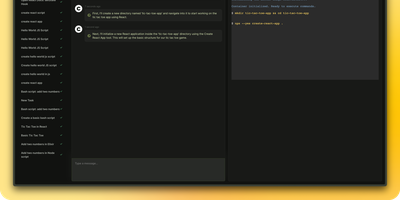
Meet your new digital sidekick, a fully autonomous AI Agent ready to tackle complex tasks and projects across terminals, browsers, and editors. It's like having a super-smart assistant who never needs coffee breaks!
Shaarli
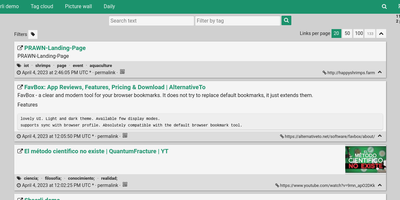
Personal, minimalist, database-free bookmarking - Shaarli is a philosophy as much as an app. Everything lives in a single compressed datastore file inside data/: no MySQL, no PostgreSQL, backup by copying one directory. That write-once/read-many file is usually served straight from OS disk caches, which is why a decade-old Shaarli instance with tens of thousands of links still responds instantly. Designed deliberately single-user, it saves URL, title, unlimited-length description, and tags (with autocomplete, renaming, and merging), marks entries public or private, and automatically strips utm_source and fb tracking parameters from saved URLs. That description field is why the community uses Shaarli as far more than bookmarks: a microblog, read-it-later queue, code-snippet base, pastebin, and shared clipboard between machines. Sharing is one click via bookmarklet or Android apps; consumption is per-tag RSS/Atom feeds plus a daily digest feed; search is full-text with tag filtering. A REST API opens it to any client, a plugin and theme system extends the PHP core (Markdown rendering, thumbnails), and import/export uses browser-standard Netscape HTML - your data enters and leaves freely. LDAP login is supported, no telemetry is sent anywhere, and the UI degrades gracefully without JavaScript. The anti-cloud Delicious.
BulkTestZola
Tired of waiting for your static site generator to finish building while you age gracefully? Zola is the Rust-powered speed demon that compiles your entire site before your coffee gets cold. One binary, zero dependencies, infinite smugness when you tell Jekyll users about your build times. Deploy on RepoCloud and watch your sites materialize at the speed of light!
Lynx
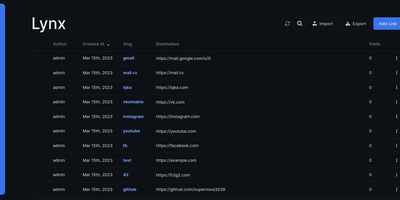
Get ready to shrink those lengthy links into snappy, bite-sized URLs with Lynx! This MEVN stack marvel is like a magic wand for your web addresses, turning them from unwieldy beasts into sleek, manageable kittens. Wave goodbye to the days of typing out endless characters; Lynx's user-friendly dashboard lets you tame the chaos with a few clicks. Fancy a custom root path? No problemo! Lynx lets you strut your stuff with personalized redirects. And for the control enthusiasts, there's an admin interface that puts you in the captain's chair of your URL fleet. With features like multi-user support, ShareX integration, and two-factor authentication, Lynx isn't just a URL shortener—it's your digital Swiss Army knife. Host it on RepoCloud, and you'll be the link wizard without the wizardly hosting costs. Abracadabra, your web life just got a whole lot simpler!
Appsmith
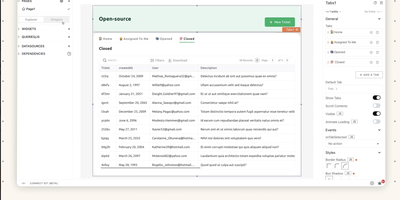
Admin panels, database GUIs, dashboards, approval flows, customer support consoles - Appsmith builds the internal tools your team keeps postponing, on an open-source low-code platform. The UI assembles from 45+ drag-and-drop widgets - tables with server-side pagination and inline editing, charts, forms, lists, buttons - which bind to data through {{ }} JavaScript expressions anywhere in the editor. Datasources cover PostgreSQL, MySQL, MongoDB, MS SQL, Redis, Snowflake, and more, plus any REST or GraphQL API, with SaaS integrations and AI query support for prompt-based steps inside apps. When the widget library falls short, custom widgets are plain JavaScript, HTML, and CSS, and external JS libraries can be imported, which keeps the platform extensible where pure no-code tools hit walls. Git-based version control enables branch-based collaboration, review, and rollback of app definitions. Queries and JS objects hold the business logic layer between datasources and UI. Self-hosted via Docker or Kubernetes, with role-based access control for published apps.
Actual Budget
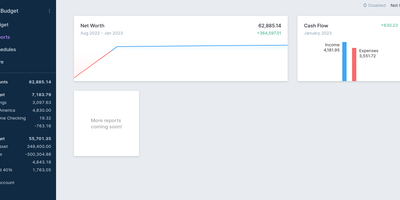
Every unit of income gets a job in Actual Budget - a local-first personal finance app built on envelope (zero-sum) budgeting, where you can only budget cash you actually have, which keeps the plan honest by construction. The data model is a SQLite file that lives on your device and works fully offline; the self-hosted Node.js sync server adds background multi-device synchronization using CRDT-based distributed-systems machinery, browser and mobile access as an installable web app, and automated backups. Optional end-to-end encryption makes the synced data unreadable even to the server hosting it. Transactions enter three ways: manual entry, file import (CSV, QIF, OFX, QFX, CAMT.053), or automatic bank syncing through GoCardless for EU/UK banks and SimpleFIN for US/Canada. Built-in YNAB4 and nYNAB importers migrate complete budget histories, and reports, schedules for recurring transactions, and rule-based transaction cleanup handle the day-to-day. A fully featured local API lets developers script custom importers and automation against their own data. 100% free, open source, and 26k stars strong.
SimpleTorrent
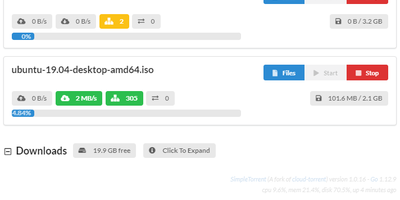
Get ready to turbocharge your torrenting experience with SimpleTorrent, the self-hosted torrent maestro that lets you kick back while your torrents do the hustle. Crafted with the magic of Go (golang), this nifty app transforms your server into a torrent-fetching powerhouse, snagging files and lining them up for your streaming pleasure or HTTP retrieval. Fancy a bit of control? You got it! Pick and choose individual files, command an external app to celebrate task completion, and enforce a seeding etiquette to say 'stop' when you've shared enough. But wait, there's more! Throttle those speeds to avoid hogging the bandwidth and dive into the nitty-gritty of transfer stats with a web UI that's slicker than a greased otter. Real-time updates? Check. Mobile-friendly? You bet. A content server that's faster than a caffeinated cheetah? Absolutely. And with IPv6 readiness, a fresh torrent engine from anacrolix/torrent, and extra goodies like a torrent watcher, K8s/docker health-checks, bonus trackers, and a magnet protocol handler, SimpleTorrent hosted on RepoCloud is like having your very own torrent butler – all at a price that won't plunder your coin purse!

AFFiNE
Gaining over 71,000 GitHub stars as one of the fastest-rising knowledge management platforms, AFFiNE merges the document editing capabilities of Notion, the infinite canvas of Miro, and the structured data of Airtable into a single cohesive workspace. The block-based editor built on the custom BlockSuite framework supports rich text, code blocks, embeds, tables, kanban boards, and database views with drag-and-drop composition. The whiteboard mode provides an infinite canvas where users can freely mix documents, sticky notes, shapes, connectors, and hand-drawn elements, enabling visual thinking alongside structured note-taking. Real-time collaboration allows multiple users to edit documents and whiteboards simultaneously with cursor presence, comment threads, and version history. The local-first architecture stores all data on your device by default using CRDT-based synchronization, ensuring offline access and data sovereignty, with optional cloud sync for cross-device availability. Workspaces organize content into hierarchical page trees with full-text search, favorites, tags, and trash management. The platform supports Markdown import and export, PDF export, and HTML export for interoperability. AI features powered by configurable LLM providers enable writing assistance, summarization, translation, and content generation directly within documents. The theming system supports light and dark modes with customizable accent colors. Running on a dedicated VPS on RepoCloud with guaranteed CPU, RAM, and SSD, full root SSH access, and a browser serial console. Licensed under MIT with an open-source self-hosted edition.
Cryptpad
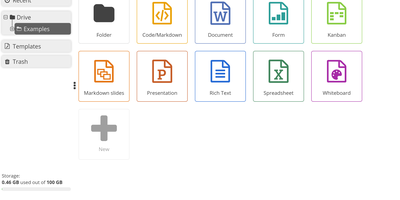
Get ready to collaborate like a super-spy with CryptPad, the open-source office suite that's as secure as a vault in Fort Knox! Wave goodbye to prying eyes because with end-to-end encryption, your secrets are safer than a squirrel's nut stash. Dive into a smorgasbord of applications and cook up projects with your pals or professional partners in real-time. Planning an epic adventure or plotting world domination in a client meeting? CryptPad's got you covered. And the best part? You can jump straight into the action without the hassle of sign-ups or downloads. It's not just an editor; it's your encrypted command center for all things teamwork. Host it on RepoCloud, and you'll be saving more than just your data – you'll be saving dough, too!
Wekan
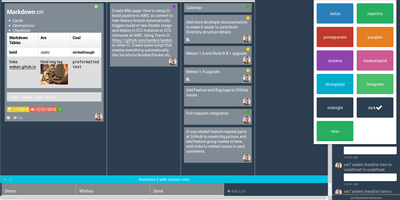
Embark on a task-taming adventure with WeKan, the open-source superhero of Kanban apps! Picture this: a digital playground where your projects transform into vibrant boards, each a realm of 'To Do', 'Doing', and 'Done' columns. Populate these realms with task cards—mighty little champions complete with titles, epic descriptions, and countdowns to their due dates. WeKan's lists are like the stages of a quest, guiding you through the workflow with the ease of a wizard's spell. Customize your quest log with a kaleidoscope of colors and fields to capture the lore of each task. Each card is a quest in itself, a scroll of information that moves with you from one stage to the next. And fear not, for WeKan is a fortress of privacy, with self-hosting shields, access control spells, and an open-source code grimoire for the ultimate security enchantment. Hosted on RepoCloud, your data stays as safe as treasure in a dragon's lair, but without the fiery breath and at a cost that would make even a dwarf smile. So why wait? Let WeKan be your guide in the quest for peak productivity!
Trilium Notes
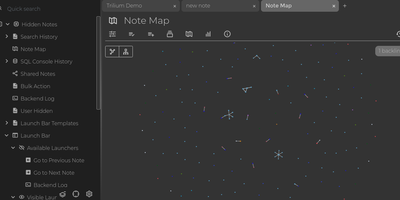
For people whose notes number in the tens of thousands, Trilium Notes is the hierarchical note-taking application built specifically for large personal knowledge bases - actively maintained as TriliumNext. Notes arrange into arbitrarily deep trees where every note is both content and container, and cloning lets a single note live in multiple places at once - bash notes belong under both Linux and Scripting, and Trilium refuses to make you choose. A WYSIWYG editor handles rich text, tables, math, and syntax-highlighted code blocks with Markdown-style shortcuts, while dedicated note types cover Excalidraw sketches, mind maps, geo maps with GPX tracks, relation maps that visualize connections between notes, and tables with typed columns. The attribute system is the power layer: labels attach queryable metadata (#year=1999, #author), relations create named links between notes, and both inherit down the tree - feeding full-text search, saved queries, and scripting. Scripting is Trilium's deepest differentiator: JavaScript code notes run on events like note changes or hourly schedules, build custom widgets, and add server-side logic, turning the knowledge base into a programmable platform. Protected notes encrypt sensitive content, note hoisting focuses on subtrees, and the self-hosted server syncs desktop clients across devices.
Filebrowser
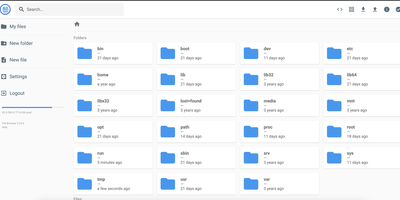
Embark on a digital safari with File Browser, the Swiss Army knife of file management! This nifty app transforms your directory into a command center where files quiver in anticipation of your next move. Ready to upload, obliterate, peek, rename, or tweak your digital darlings? File Browser is your trusty sidekick. It's like having a team of mini-me's, each with their own digital playground, perfect for juggling files in a bustling multi-user circus. Customize your digital escapade with a smorgasbord of options: switch up user check-ins, command your server with pre/post event shell spells, or slap on your brand's superhero cape. Flying solo or in a squadron, File Browser is your go-to for a file-taming fiesta, all while saving your coins with RepoCloud's wallet-friendly hosting. Who knew file management could be this exhilarating?
WPS Office
description_humorous
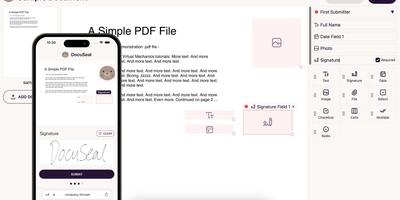
DocuSeal
Contracts signed on your own server: DocuSeal is the most feature-complete open-source, self-hosted alternative to DocuSign. A WYSIWYG builder turns any PDF into a fillable form with 14 field types: signature, initials, date, file upload, checkbox, dropdown, radio, stamp, and more. Documents route to multiple submitters in sequence or parallel, with automated SMTP email notifications, reminders, and a mobile-optimized signing experience that works on any device without an account. Every completed document carries an automatic PDF eSignature with verification and an audit trail. Templates are reusable and can also be generated programmatically - from HTML via API or from PDFs and DOCX files with embedded field tags - and the REST API plus webhooks drive full workflow automation, with embedded signing forms and form builders for React, Vue, Angular, and plain JavaScript. Files store on disk or in S3, Google Cloud Storage, or Azure. The UI ships in 7 languages with signing in 14. Runs on SQLite, PostgreSQL, or MySQL; AGPL-3.0 licensed with unlimited documents and no per-signature fees.