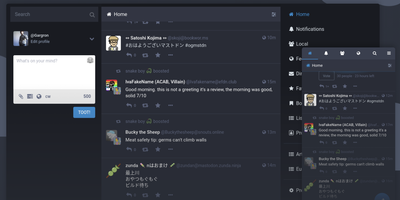
Mastodon
Embark on a social media odyssey with Mastodon, where you're the captain of your own digital destiny! Wave goodbye to pesky algorithms and intrusive ads, and say hello to a home feed that's as personalized as your coffee order. Whether you're sharing the latest earworm, your cinematic masterpiece, a gallery of your cat's antics, or stirring the pot with a spicy poll, Mastodon lets your creativity run wild. This decentralized, open-source gem is like a social media potluck – each server brings its own flavor, but together, they create a feast of global connections. Mastodon champions your digital autonomy, shunning ad overlords and profile pimps. It's built on the sturdy foundations of open web protocols, so it plays nice with any other platform that speaks ActivityPub. With Mastodon hosted on RepoCloud, you're not just building a social network; you're crafting a social sanctuary that mirrors your unique vibe, all while saving your wallet from the cloud hosting giants. Get ready to moderate, curate, and celebrate your online world with Mastodon on RepoCloud!
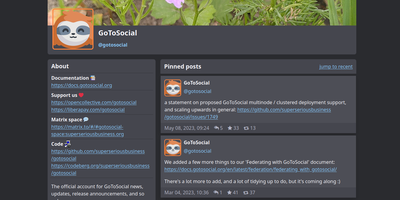
GoToSocial
Mastodon serves single-user and small-community instances poorly; GoToSocial, an ActivityPub server written in Go, was built precisely for them. Where Mastodon demands Ruby, PostgreSQL, Redis, and Sidekiq, GoToSocial is one binary using roughly 250-350 MiB of RAM with SQLite as the default database (PostgreSQL optional) - it runs comfortably on a $5 VPS or a repurposed laptop. The deliberate design choice is having no built-in web client: the server exposes profile pages, a settings panel, and a faithful implementation of the Mastodon API, and you post through the client app you already like - Tusky on Android, Feditext on iOS, Pinafore or Phanpy in the browser. Federation is the point: your instance follows, boosts, and replies across Mastodon, Misskey, Pixelfed, and the rest of the Fediverse, with your identity anchored to your own domain. Safety is a stated focus, with granular per-post visibility and interaction controls, content warnings, custom emoji, hashtag following, domain allow/blocklists, and OIDC login support. Built-in Let's Encrypt provisioning simplifies the mandatory TLS. AGPL-3.0 licensed and in active beta, federating cleanly with the ecosystem's major servers.
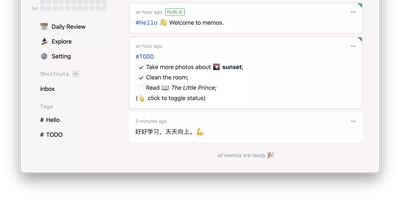
Memos
Open the page, write a Markdown note, move on - Memos is a lightweight, self-hosted service built for quick capture. Instead of folders, notebooks, and titles, it presents a timeline: open the page, write a Markdown note, and move on. Notes support headings, code blocks with syntax highlighting, task lists, tables, and file attachments, with tags auto-extracted from #hashtags in the text. Each memo carries a visibility level, private, protected (logged-in users), or public, so one instance works as a personal log, a small team wiki, or a lightweight microblog. The backend is a single Go binary with a React frontend, around 50 MB of memory at runtime and a ~20 MB Docker image, so it fits comfortably on the smallest instance size with near-zero maintenance. SQLite is the default store, with MySQL and PostgreSQL supported for multi-user deployments needing more concurrency, and full REST and gRPC APIs - Connect RPC for browsers, gRPC-Gateway for external tools - make capture scriptable from CLIs, bots, and automation platforms. Fast full-text search spans all memos, pinned notes keep references handy, and a masonry view suits visual browsing. MIT-licensed with zero telemetry; content is stored as plain Markdown in a database you control, so notes remain readable, exportable, and free of proprietary formats.