Joplin
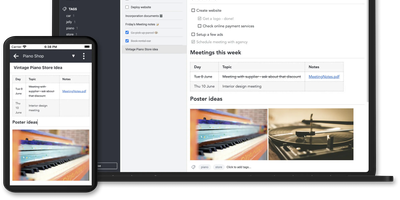
Notes on Windows, macOS, Linux, Android, iOS, and the terminal, synced through your own server: Joplin pairs its open-source clients with Joplin Server, the official self-hosted backend that replaces Dropbox, OneDrive, or Nextcloud as the synchronization target. Notes are Markdown with inline attachments (images, PDFs, audio), organized into hierarchical notebooks and sub-notebooks with cross-cutting tags, alongside to-do lists with reminders and alarms. End-to-end encryption is the headline feature: enabled in the clients, it encrypts sync payloads on-device before upload, so the server stores blobs it cannot read - genuine protection even if the host is compromised. The desktop app offers both Rich Text and Markdown editors, extended by a plugin ecosystem, custom themes, and an Extension API for writing your own scripts; a Web Clipper for Chrome and Firefox captures full pages or screenshots straight into notebooks. Joplin Server ships as a Docker image with SQLite for evaluation and PostgreSQL for production, offers a filesystem storage driver for large content, and includes multi-user support and note sharing - all free under AGPL-3.0 when self-hosted. Notes stay in an open format, so the exit path always exists.
Commento
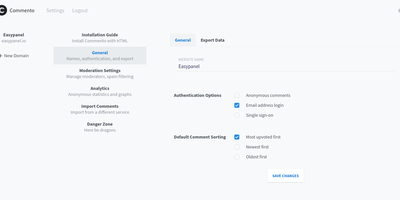
Unleash the chatterbox in your website with Commento, the widget that turns monologues into dialogues faster than you can say 'engagement'! Picture this: a symphony of upvotes for the wisdom droppers and a gentle nudge of downvotes for the not-so-enlightened. It's like having a bouncer for your blog's comment section, but with markdown muscle that lets your audience flex their formatting finesse—bold, italic, and everything typographically tasty. And for the maestros of moderation? You've got the power to freeze fiery threads, banish the blabber, and put the timeout corner to good use. Wave goodbye to spam-a-lot invaders with a detection system that's more alert than a caffeinated meerkat. Plus, with nested replies, your comment section will be more organized than a librarian's bookshelf. No sign-up hoopla means more gab for everyone, and customization options that let you dress up your widget to match your website's snazzy suit. Host it on RepoCloud, and you'll be saving coins while your community thrives. Now, isn't that comment-worthy?
Fider
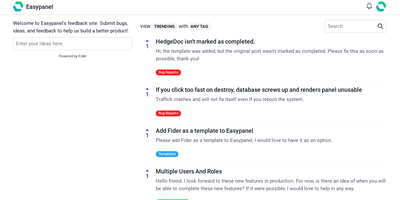
Get ready to tap into the pulse of your customer base with Fider, the idea wrangler extraordinaire! This app is like a digital town hall where your users can shout out their brilliant ideas, give a thumbs-up to their favorites, and engage in riveting discussions about their most-wanted features. Fider is the ultimate feedback funnel, keeping you in the know with the who's who of suggestions – whether they're hot off the press, in the works, or given the polite 'thanks, but no thanks.' With a sign-in faster than a superhero's costume change, your visitors can jump right into the action. Dress Fider up to match your brand's snazzy style, or go incognito with a private site for your eyes only. Speaking the language of the people (multiple languages, to be exact), Fider breaks down barriers like a linguistic ninja. Tagging? Check. Markdown flair? Double-check. A public API that plays nice with other systems? You betcha. And for the tech-savvy, there's even a Webhook handshake for seamless integrations. Hosted on RepoCloud, where the cost is as friendly as your neighborhood barista, Fider turns feedback chaos into a harmonious chorus of actionable insights. So why wait? Let Fider and RepoCloud be the dynamic duo your audience has been waiting for!
Groqnotes
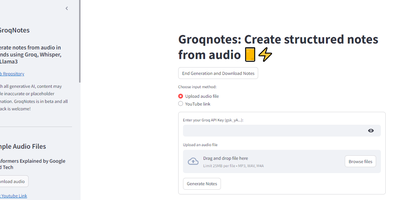
Ever wished your lecture notes could magically organize themselves while you daydream about your next coding project? Enter Groqnotes, the Streamlit app that turns your audio ramblings into structured, coherent notes faster than you can say 'Whisper API.' Using Groq's Whisper to transcribe your audio and a tag team of Llama3-8b and Llama3-70b models, this app is like having a personal assistant who never misses a detail. The larger Llama3-70b handles the heavy lifting of creating a solid note structure, while the nimble Llama3-8b fills in the content with the grace of a caffeinated coder. Say goodbye to messy notebooks and hello to organized brilliance, all without lifting a finger. Just click, speak, and let Groqnotes do the rest. It's like magic, but with more llamas.
HedgeDoc
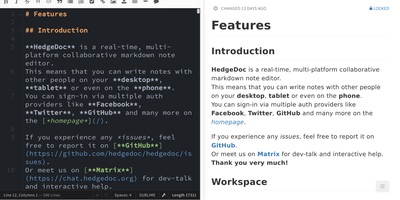
Real-time collaborative Markdown behind your own firewall: HedgeDoc (formerly CodiMD, descended from HackMD's open-source edition) keeps team notes on team infrastructure. Share a note's URL and collaborators are editing together instantly - live cursors, changes appearing keystroke by keystroke - in a three-mode interface that toggles between raw Markdown, rendered preview, and side-by-side split. The Markdown dialect is extended where engineers need it: Mermaid, Graphviz, and Vega-Lite diagrams, MathJax for equations, syntax-highlighted code blocks, embedded content, and a presentation mode that turns a note into reveal.js slides with a single YAML header. A dropdown permission system controls each note - freely editable, limited to signed-in users, or locked read-only - and published notes become clean read-only pages for wider distribution. Revisions track every change with the ability to revert to any earlier version. The AGPL-3.0 codebase is light enough to run on a Raspberry Pi and deploys via Docker with PostgreSQL, MySQL, or SQLite. Authentication covers LDAP, SAML, OAuth2, and email. It deliberately stays a focused document editor - no page trees or kanban - and does that one job with excellent keyboard-first ergonomics for meeting notes, RFCs, runbooks, and shared scratchpads.
Memos
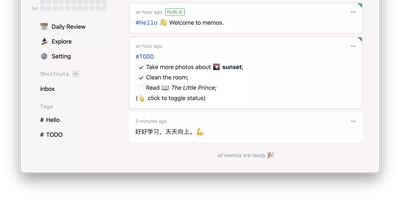
Open the page, write a Markdown note, move on - Memos is a lightweight, self-hosted service built for quick capture. Instead of folders, notebooks, and titles, it presents a timeline: open the page, write a Markdown note, and move on. Notes support headings, code blocks with syntax highlighting, task lists, tables, and file attachments, with tags auto-extracted from #hashtags in the text. Each memo carries a visibility level, private, protected (logged-in users), or public, so one instance works as a personal log, a small team wiki, or a lightweight microblog. The backend is a single Go binary with a React frontend, around 50 MB of memory at runtime and a ~20 MB Docker image, so it fits comfortably on the smallest instance size with near-zero maintenance. SQLite is the default store, with MySQL and PostgreSQL supported for multi-user deployments needing more concurrency, and full REST and gRPC APIs - Connect RPC for browsers, gRPC-Gateway for external tools - make capture scriptable from CLIs, bots, and automation platforms. Fast full-text search spans all memos, pinned notes keep references handy, and a masonry view suits visual browsing. MIT-licensed with zero telemetry; content is stored as plain Markdown in a database you control, so notes remain readable, exportable, and free of proprietary formats.
GroqNotes
Introducing Groqnotes, the app that takes your audio lectures and transforms them into organized notes faster than you can say 'I should have paid more attention in class!' With the power of Groq's Whisper API, this Streamlit marvel listens to your lectures and then channels its inner librarian to create structured notes that even your future self will thank you for. It’s like having a personal assistant who never sleeps, fueled by a mix of Llama3-8b and Llama3-70b—because why settle for one when you can have two brainy llamas working for you? The larger model crafts the grand architecture of your notes, while the speedy one fills in the juicy details, ensuring you get the best of both worlds. So, whether you’re cramming for finals or just trying to make sense of your professor's 3-hour monologue on quantum physics, Groqnotes has got your back. Say goodbye to chaotic scribbles and hello to notes that are as organized as your sock drawer (or at least, we hope so)! Get ready to impress your classmates and maybe even your professors with notes that look like they were crafted by a team of caffeinated scholars. Groqnotes: because who needs sleep when you have structured notes?
Outline Wiki
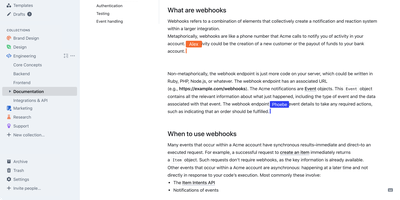
Get ready to turbocharge your team's brainpower with Outline! Imagine a digital treehouse where all your team's knowledge is not just thrown in haphazardly, but organized with the finesse of a library catalog. With Outline, you'll be crafting documents like a pro, thanks to its slick markdown support, nifty slash commands, and the ability to embed pretty much anything. Wave goodbye to the chaos of collaboration; real-time editing, threaded conversations, and comments mean you'll be in sync faster than you can say 'knowledge is power!' And for those who live in Slack, Outline's like the cool neighbor that never makes you leave your chat to search or share docs. Want to show off your brand's swagger? Go public with your docs, decked out in your brand's colors and logo, right on your own domain. It's like having a custom-tailored suit for your content. Speedy, secure, and simpler than a Sunday morning - Outline is the multilingual maestro of your team's symphony, playing well with Figma, Loom, and a whole orchestra of tools. And hosting it on RepoCloud? That's like getting first-class seats for your data at a budget airline price!
NextChat (ChatGPT Next Web)
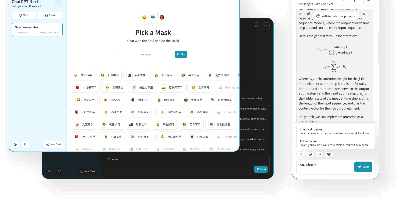
Ever dreamed of having your own AI chatbot that can rival the likes of Tony Stark's JARVIS but without the billionaire budget? Well, dream no more! With our one-click, cross-platform ChatGPT web UI, you can now harness the power of GPT3, GPT4, and even Gemini Pro faster than you can say 'open sesame!' Imagine impressing your friends, colleagues, and that one skeptical relative with a chatbot that not only understands them but also cracks jokes better than your dad. And the best part? You don't need to sell a kidney to afford it! So, why settle for mundane when you can have a digital assistant that's practically a stand-up comedian, philosopher, and trivia master rolled into one? Click, deploy, and let the AI magic begin!