Lenpaste
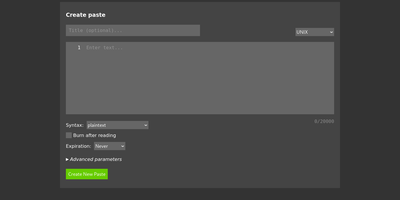
Share code snippets, logs, configs, and notes without registration, tracking, or ads: Lenpaste is a minimal, self-hosted, anonymous alternative to pastebin.com. It is deliberately spartan in the right ways: no accounts, no JavaScript required (the entire site works in text browsers and hardened setups), and cookies used solely to store display preferences. Pastes support syntax highlighting across a long list of languages (from ApacheConf and Arduino to mainstream stacks), configurable expiration from minutes to unlimited, one-use "burn after reading" pastes that self-delete on first view, optional author attribution, and iframe embedding for dropping pastes into other pages. The form-encoded HTTP API covers everything the UI does - create pastes with title, syntax, expiration, and line-ending normalization, fetch them by ID, and query server capabilities - making it trivial to pipe command output to your paste server from shell scripts. Server operators control maximum title and body lengths, maximum paste lifetime, rate limits for viewing and creation, search-engine indexing policy, and can lock private instances behind HTTP Basic authentication. It deploys as a single lightweight Docker container, giving your team a snippet-sharing endpoint where the content never touches a third-party service.
OpenUI
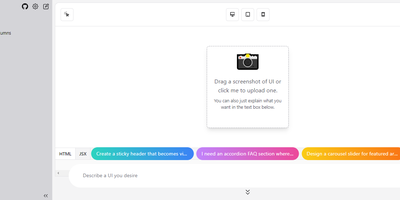
Describe a component in natural language and watch it render: OpenUI, from Weights & Biases, is an open alternative to Vercel's v0. Type a prompt like "a dark-themed dashboard with a sidebar and charts" and the LLM renders working HTML with Tailwind styling live in the browser. You then iterate conversationally, asking for changes until the design is right, and convert the result to React, Svelte, or Web Components for use in a real project. The backend is Python with LiteLLM routing, so it works with OpenAI, Anthropic, Gemini, Groq, and Mistral API keys, or fully offline against local Ollama models, including vision models like LLaVA that can generate UI from screenshot input - feed a screenshot and the model reproduces or riffs on an existing interface. Generated markup is inspectable at any point, with light and dark mode toggles, theme selection, and responsive previews across device sizes. The practical effect is compressing the mockup-review-revise loop from hours to minutes: a described layout renders in seconds and iterates through follow-up prompts, and because output converts to real framework code, prototypes feed directly into production codebases instead of staying trapped in a design tool. Self-hosting keeps unreleased product interfaces and prompts on your own server, and LiteLLM routing lets you pick the model per task - a cheap fast model for rough drafts, a stronger one for final passes, or free local models for unlimited experimentation.
Octobox
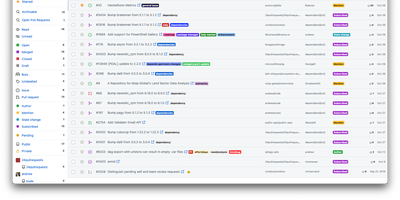
What Gmail did for email, Octobox does for GitHub notifications: an ephemeral, unmanageable stream becomes an inbox you can actually triage. GitHub marks notifications read the moment you glance at them and lets old ones vanish days later; heavy maintainers end up building elaborate Gmail filter systems just to cope. Octobox - a Ruby on Rails app over PostgreSQL - syncs your notifications into a persistent inbox with an explicit archived state: mark a thread done, and if the issue or PR sees new activity, it pops back automatically, so nothing silently falls through. Triage is keyboard-driven with Gmail-style shortcuts (j/k to navigate, e to archive, m to mute, s to star), and multi-select clears noisy repositories in bulk. Filtering is where it earns its keep: slice by repository, organization, type, action, state, reason, CI status, labels, author, assignee, or bot origin, combine prefix search filters, and pin favorite searches to the sidebar. The optional GitHub App enriches entries with live PR/CI status and labels so you can decide without clicking through. Auto-archive rules clear merged PRs and closed issues; muting and snoozing silence the rest. A REST API supports integrations. Self-hosting keeps your notification metadata - a map of everything you work on - on your own server.

Thumbor
Born at Brazilian media giant Globo.com, Thumbor answers imaging CDNs like Imgix and Cloudinary with an HTTP service where every image variant is just a URL. Ask for /300x200/smart/your-image.jpg and Thumbor fetches the original, crops and resizes on demand, and caches the result - one source file, unlimited renditions, no batch pre-generation pipeline. The "smart" in the URL is the signature feature: OpenCV-based face detection finds people in the frame and crops around them (no more thumbnails with severed heads), and when no faces exist, feature detection finds visually important corners and computes a weighted center of mass as the focal point. Beyond cropping, a chainable filter pipeline handles brightness, contrast, grayscale, blur, red-eye removal, rounded corners, rotation, watermarks, and format conversion with quality control - applied in order via URL segments. All common image formats work out of the box, and every layer is pluggable: loaders (HTTP, local, S3), storages and result storages (local, S3, Ceph, and community backends), engines, optimizers, filters, and even custom detectors, with the awesome-thumbor list cataloging the ecosystem. URL signing prevents abuse of your processing capacity. Integrations exist for Django, Rails, Node, WordPress, and most frameworks. MIT-licensed, battle- tested for over a decade.

ToolJet
Retool's job, self-hosted: ToolJet is an open-source low-code platform for building internal tools, dashboards, and admin panels. Apps are assembled in a drag-and-drop visual builder with 60+ responsive components, including tables, charts, forms, and lists, and connected to 80+ data sources: PostgreSQL, MySQL, MongoDB, REST and GraphQL APIs, cloud storage, and common SaaS tools. When visual configuration is not enough, you can run JavaScript or Python inline for queries and transformations. A built-in no-code database (ToolJet Database) covers apps that need their own tables without provisioning an external database, Workflows add node-based automation for background jobs with dedicated worker containers and a Redis-backed queue, and multi-page apps with multiplayer editing, inline comments, and mentions support team development. Security is designed for internal data: credentials are AES-256-GCM encrypted, data flows proxy-only through your server so database contents never reach a third-party cloud, and granular per-app access control plus SSO gate each tool. Where Retool-style platforms bill per builder and sometimes per end user, the self-hosted Community Edition serves unlimited builders and users at hosting cost, and full source availability means the platform itself can be forked, audited, and extended. The stack is Node.js and React on PostgreSQL, deployed via Docker.
Verdaccio
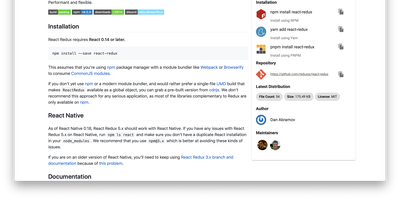
Private npm packages without shipping code to the public registry or paying for npm Enterprise: Verdaccio is the standard lightweight, zero-config private registry and caching proxy. It runs as a single Node.js process with its own tiny embedded database; no external database is required to start. Point npm, yarn, or pnpm at it and everything behaves as expected: install, publish, unpublish, dist-tags, and deprecation all work against the standard npm endpoints. The uplink system is where it earns its keep: packages not found locally are fetched from configured upstreams (npmjs.org, yarn, JFrog, Nexus, or another Verdaccio), cached as tarballs, and served locally thereafter - cutting CI latency and surviving registry outages. Multiple uplinks chain for failover, and per-package glob patterns in config.yaml route scopes to specific upstreams while controlling access, publish, and unpublish rights per group. You can even override a public package by publishing a patched version under the same name locally. A plugin architecture swaps in auth backends (htpasswd default, LDAP and others available), storage drivers (S3, Google Cloud Storage), middleware routes, and metadata filters. With official Docker images and a Kubernetes Helm chart, it slots into any pipeline in minutes.
Weblate
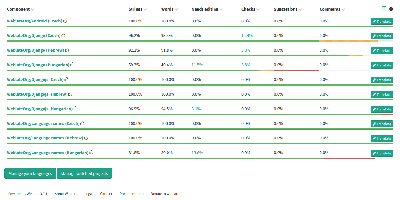
Over 2,500 open-source projects and companies in more than 165 countries localize with Weblate - the libre continuous localization platform and the standard self-hosted answer to Crowdin and Lokalise. Its defining trait is that translations live in the same version control as your code: Weblate talks directly to Git and Mercurial, pulls new source strings automatically via webhooks, and pushes finished translations back either as direct commits or as pull/merge requests on GitHub, GitLab, Gitea, Bitbucket, Azure DevOps, Gerrit, or Pagure. Every translator is properly credited in the commit history. For translators, it is a full computer-aided translation tool: translation memory, glossaries, customizable quality checks that catch placeholder and formatting mistakes, propagation of identical strings across components, and automatic suggestions from machine translation services - DeepL, Amazon Translate, LibreTranslate, and others, with per-service priorities and support for custom Python engines. It handles the format zoo (gettext PO, JSON, YAML, Android XML, iOS strings, and dozens more) and supports crowdsourced workflows with granular access control, workspaces, two-factor authentication, and reviewer approval steps. A REST API, CLI client, and add-on system automate everything else. Built on Python/Django, GPL-licensed, with no per-string or per-seat pricing when self-hosted.
Hastebin
"Throw it on a haste and send the link" entered developer vocabulary because of Hastebin (haste-server), the minimalist open-source pastebin. Written in Node.js with three stated design goals - be really pretty, be really simple, be easy to set up - it does one job precisely: paste code, logs, stack traces, or config snippets, press save (or Ctrl+N for a new one), and get a short random-key URL to share. Syntax highlighting renders pastes readably across common languages, a raw view serves plain text for curl and scripts, and duplicate-and-edit makes iterating on a shared snippet trivial. The killer workflow is the terminal: with the haste-client utility or a one-line shell function, `cat error.log | haste` prints a shareable URL straight from stdout - the fastest route from a broken build to a colleague's eyeballs. Storage is pluggable through a simple adapter interface: filesystem by default, Redis with optional key expiration for pastes that should age out, and configurable key length, maximum paste size, and static documents. Self-hosting matters here because pastes often contain internal logs and stack traces that should never sit on a public pastebin - your instance keeps them inside your network, under your retention rules.
Chromium
Surf's up on the web with the Chromium browser, now in a swanky Docker container! This isn't your grandma's browser; it's a sleek, secure, and speedier way to ride the digital waves. With support for the brawniest of processors (x86-64 and arm64), you can deploy this bad boy on RepoCloud and watch it fly faster than a seagull after a french fry. Fancy a secure connection? HTTP and HTTPS are both on the menu. Tweak the sails with environment variables and run configurations to make your browsing as smooth as a sea breeze. And for the power users, hoist your flags high with Chromium CLI options that'll make your containerized browser salute you. Whether you're looking to accelerate with GPU or nestle into a Docker in Docker setup, this Chromium is ready to set sail on the vast ocean of modern websites, all while keeping your wallet as full as a pirate's treasure chest thanks to RepoCloud's lower hosting costs. Ahoy, mateys, let's browse!
Sshwifty
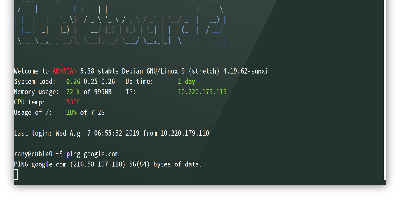
Get ready to teleport your terminal experience straight into your browser with Sshwifty, the web-based wizard that conjures up SSH and Telnet connections with just a click! Wave goodbye to clunky clients and say hello to smooth access from any web-savvy device. Park this magical creature on your own digital lawn (a.k.a. your computer or server) and watch it transform into the Gandalf of gateways, offering a customizable portal to your digital dominions. With Sshwifty, you can summon a fleet of servers, craft presets for your favorite digital destinations, and even cast a security spell to limit travel to known realms only. Plus, with TLS enchantments and Socks5 proxy pathways, your connections are not just swift, they're Fort Knox-secure. Whether you're diving into distant data centers or just hopping over to your home hub, Sshwifty is your trusty sidekick in the quest for seamless, sorcery-level server management. And with RepoCloud's wallet-friendly hosting, you'll have more gold in your pouch for other quests. Abracadabra, your terminal is now omnipresent!
phpMyAdmin
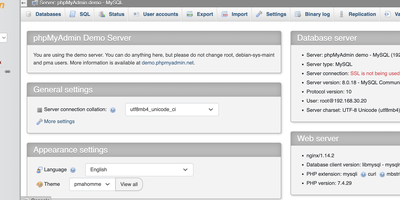
Since 1998, phpMyAdmin has been the standard web interface for MySQL and MariaDB - the tool millions of developers, DBAs, and hosting companies reach for when a database needs inspecting, fixing, or migrating. Written in PHP, it covers effectively the entire administration surface: create, browse, alter, and drop databases, tables, views, columns, and indexes; insert and edit rows through a tabular editor; manage user accounts and granular privileges; and maintain stored procedures, triggers, and events - all without touching a command line. The SQL editor executes arbitrary queries with syntax highlighting, autocompletion, history, and bookmarkable statements, including batch queries. Import/export is a migration workhorse: read SQL, CSV, XML, and OpenDocument spreadsheets in; write out to SQL dumps, CSV, JSON, XML, PDF, Word, LaTeX, and more - the fastest path for moving a WordPress database or handing a schema to a colleague. The Designer view renders your schema as an interactive ER diagram with drag-and-drop relationship editing, and data transformations display BLOBs as images or download links inline. Server maintenance views surface configuration suggestions. Multi-server support, dark mode, and translations into 72 languages round out a tool that earns its ubiquity. GPL-licensed.
Langflow
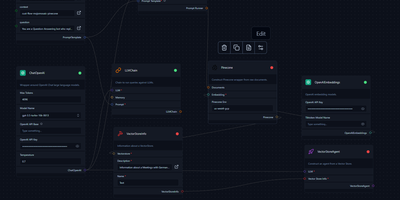
Get ready to unleash your inner language wizard with Langflow, the spellbinding app that turns the complex art of LangChain pipeline creation into a magical drag-and-drop extravaganza! Picture yourself crafting linguistic concoctions with the ease of a seasoned sorcerer, connecting mystical components like LLMs, prompt serializers, agents, and chains with a mere flick of your mouse. Tweak the secret ingredients (a.k.a. prompt parameters), bind together chains and agents in an enchanting dance, and peer into the crystal ball to witness an agent's thought process. When your potion is perfected, abracadabra! Export your masterpiece as a JSON file, ready to charm the socks off LangChain. And for the grand finale, with a wave of your wand (and a single command), you can deploy your creation to Jina AI Cloud faster than you can say 'Presto chango!' Thanks to RepoCloud's hosting, you'll save a dragon's hoard of gold compared to other cloud hosts. Langflow is your trusty sidekick in the quest to build and deploy LangChain pipelines with the ease of a fairy tale ending.
Coolify
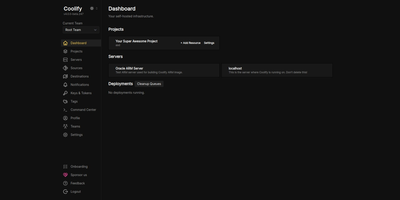
Any SSH-accessible Linux box - VPS, bare metal, Raspberry Pi, EC2 - becomes a Heroku-like deployment environment under Coolify, an open-source, self-hostable platform-as-a-service. Connect a GitHub, GitLab, Bitbucket, or Gitea repository and every push builds and deploys automatically via Nixpacks, a Dockerfile, or Docker Compose, with Traefik reverse proxying, automatic Let's Encrypt certificates, and per-branch preview deployments with their own URLs. Databases - PostgreSQL, MySQL, MariaDB, MongoDB, Redis - provision in a few clicks, and a catalog of 280+ one-click service templates covers WordPress, n8n, Grafana, MinIO, Plausible, and more, replacing an afternoon of Compose YAML with a two-minute operation. One dashboard manages multiple servers, with Docker Swarm available for clustering. Backups go to any S3-compatible storage with one-click restore, a browser terminal gives real-time server access, and a full API supports CI/CD integration. All configuration lives on your own servers, so resources keep running even without Coolify. Apache 2.0 licensed.
PocketBase
An entire backend in a single Go executable: PocketBase embeds SQLite with realtime subscriptions, authentication and user management, file storage, and an admin dashboard, all behind a REST-ish API. SQLite runs in WAL mode, which outperforms client-server databases for the read-heavy workloads typical of small and mid-sized apps. Authentication supports email/password, one-time passwords, and 15+ OAuth2 providers including Google, Apple, and GitHub, with stateless tokens. Clients subscribe to record changes over server-sent events, and official JavaScript and Dart SDKs cover web, mobile, and Flutter frontends. Collections, rules, and API access permissions are managed visually in the admin UI. When you need custom logic, extend it with JavaScript hooks running in the embedded JS VM of the prebuilt binary, or import PocketBase as a Go library and compile custom business logic into your own single-file backend. File storage attaches uploads to records with thumbnail generation for images and optional S3-compatible external storage. All state lives in one pb_data directory, so backup is a directory copy and upgrade is replacing a binary - one of the lowest-maintenance backends you can run. The contrast with Firebase is the point: where usage-based pricing scales with reads, writes, and bandwidth, PocketBase runs the entire backend at flat hosting cost, and the data is a plain SQLite file you can copy anywhere. MIT-licensed.
LibreTranslate
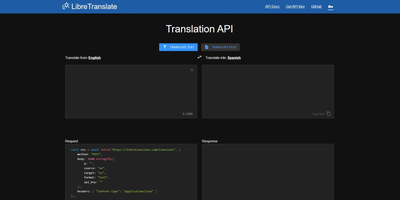
Machine translation with no Google, no Azure, no per-character billing, and no text leaving your infrastructure: LibreTranslate is a free, open-source translation API that runs entirely on your own server. The engine underneath is Argos Translate, which runs OpenNMT neural models with SentencePiece tokenization and Stanza sentence-boundary detection, all offline. Models install as portable .argosmodel packages covering dozens of languages - English, Spanish, French, German, Chinese, Japanese, Russian, Arabic, Hindi, Portuguese, and many more - and Argos handles automatic pivoting: with es-to-en and en-to-fr installed, it chains them to translate es-to-fr without a direct model. The API is a straightforward HTTP POST to /translate with source and target language codes, returning JSON - simple enough that the ecosystem has clients in every major language and integrations across tools like Weblate and Mastodon. Beyond plain text it translates HTML while preserving markup and handles whole file uploads (documents in, translated documents out), plus automatic language detection when the source is unknown. A clean bundled web UI serves interactive translation for end users, and optional API keys with rate limits control access. AGPL-licensed and trainable with custom models, it is the standard answer when translation must be private, unmetered, and self-contained - GDPR-sensitive text never touches a third party.
Nango
The integrations your SaaS product offers its own users - that is what Nango, an open-source product-integrations platform, exists to build. It solves the repetitive infrastructure work behind every third-party API connection: OAuth flows, API key handling, token refresh, encrypted credential storage, rate-limit backoff, retries, and multi-tenant connection management. It ships pre-built auth configurations for 800+ APIs. Your users connect their accounts through an embeddable, white-label Connect UI, and your backend then reads or writes data through Nango's proxy, SDKs, or REST API without ever touching raw credentials. Integration logic is written as TypeScript functions covering actions, scheduled data syncs, and webhook processing - all running on one runtime with retries, checkpointing, and per-connection logs built in. Syncs pull records incrementally on a schedule, one-way or two-way, which suits RAG pipelines, search indexing, and keeping local copies of external data current. Selected actions can also be exposed as tool schemas or through a built-in MCP server, so AI agents operate on user-connected accounts without ever handling provider credentials. Auth support spans OAuth 2.0, OAuth 1.0a, API keys, basic auth, and JWT, and observability - logs, metrics, failure detection, and a reconnect flow for expired credentials - is scoped per customer connection for easier support debugging. Works with any backend language. Self-hosting on RepoCloud keeps all customer credentials and synced data on infrastructure you control, which matters for data residency and compliance requirements.