Gitea
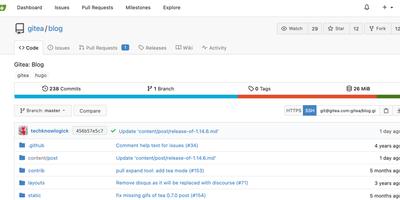
Get ready to turbocharge your code capers with Gitea, the DevOps dynamo that's lighter than a feather and slicker than a greased byte! This nifty platform is your one-stop shop for herding those pesky code commits from the wild plains of planning all the way to the bustling metropolis of production. Fancy a stroll through the annals of commit history? Gitea's got you covered. Need to merge like a pro? Check. And for the Git gurus, we're talking tags, cherry-picking fiestas, and hooks that would make Captain Hook jealous. But wait, there's more! Unleash the power of Gitea Actions, the CI/CD sidekick that plays nice with GitHub Actions, ensuring your deployment dance is as smooth as a robot doing the moonwalk. Juggle issues, labels, and kanban boards like a coding circus star, and manage over 20 flavors of package management – because variety is the spice of source code. Hosted on RepoCloud, where the cost is as tiny as a bug in a nano-simulator, Gitea is the open-source hero that's all about flexing to fit your workflow, while keeping things tighter than a duck's waterproof feathers when it comes to security. So why settle for less when you can customize, collaborate, and create with the best, all while saving your coins? Gitea and RepoCloud: where code dreams come true, without the nightmare bills!
Weaviate
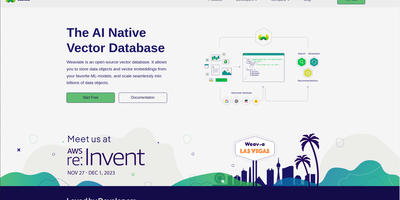
Embark on a semantic adventure with Weaviate, the open-source vector database that's like a GPS for your data! Imagine a world where your data points are like stars in the cosmos, and Weaviate is your trusty telescope, helping you navigate the galaxy of information based on the 'semantic vibes' they emit. With the ability to stand alone or play nice with a smorgasbord of vectorizing modules, this database is your ticket to a lightning-fast vector similarity search that zips through raw vectors or data objects with the speed of a comet, even when you throw in a few filters. It's like having a search party that combines the Sherlock Holmes of keyword sleuthing with the psychic predictions of vector search techniques for mind-blowingly accurate results. Want to play quiz master with your data? Pair it with any generative model and host a Q&A session right in your dataset! Hosting Weaviate on RepoCloud is like getting first-class seats for your apps on a spaceship, at economy prices. Buckle up for a next-gen vector database experience that will power your apps to infinity and beyond!
Unleash
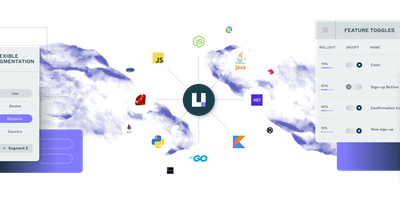
Deployment decoupled from release: Unleash, the most popular open-source feature management platform on GitHub, is a Node.js server backed by PostgreSQL. Ship code dark, then control who sees it through activation strategies: gradual percentage rollouts, targeting by user ID, IP, hostname, or application name, custom constraints against your own context fields, and scheduled or time-limited releases. Strategies stack - a flag activates if any strategy matches - and strategy variants layer A/B versions on top of the on/off decision. Each flag carries per-environment configurations, so a feature can run at 100% in staging while canarying at 5% in production. Backend SDKs (Node.js, Java, Go, Python, Ruby, .NET, PHP, Rust, and more) fetch configuration and evaluate flags locally, so a flag check adds zero network latency to request paths; frontend SDKs for React, Vue, Svelte, iOS, Android, and Flutter evaluate through a proxy layer. Flag hygiene is built in: flags are typed (release, experiment, operational, kill-switch, permission) with expected lifetimes, and Unleash marks overdue flags as potentially stale and surfaces unknown flags your SDKs request but that don't exist. Self-hosting via Docker keeps flag data, targeting rules, and evaluation infrastructure entirely on your side.
Typesense
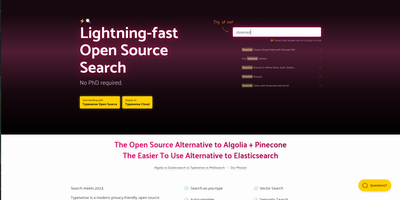
Get ready to turbocharge your search experience with Typesense, the search engine that laughs in the face of typos and serves up results faster than you can say 'instantaneous'! This open-source marvel is the cool cousin of Algolia and the more approachable neighbor of ElasticSearch. With its built-in typo tolerance, Typesense is like that forgiving friend who understands what you mean, even when you text 'tacos' as 'tcoas'. Zipping through queries with the speed of a caffeinated cheetah, it boasts a response time that's quicker than a hiccup (<50ms, to be precise). Tailor your search like a bespoke suit, sort results like a card shark, and refine like a master sommelier with faceting and filtering. It's got more grouping and federating tricks than a magician's convention, and it knows the lay of the land with geo-search capabilities. Plus, with API key generation, it's the perfect wingman for multi-tenant app shindigs. Easy to set up and scale, Typesense is your golden ticket to search nirvana, and with RepoCloud's wallet-friendly hosting, you'll be the toast of the open-source town!
n8n
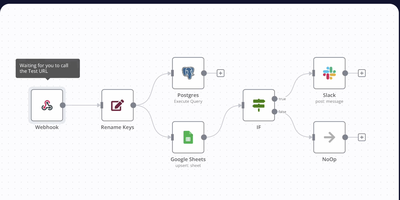
Webhooks, cron schedules, and app events trigger chains of nodes that fetch, transform, and route data: n8n is a workflow automation platform built around a visual, node-based editor. It ships with 400+ built-in integrations covering databases like Postgres, SaaS tools like Slack and HubSpot, and every major AI provider. When a pre-built node does not exist, the HTTP Request node calls any REST API, and the Code node runs JavaScript or Python inline, so you are never blocked by a missing connector. Workflows execute as directed graphs with branching, loops, error handling, and sub-workflows, and every run is logged for inspection and replay during debugging. It also includes LangChain-based nodes for building AI agents with tool calling and memory. Self-hosting on RepoCloud gives you unlimited workflow executions with no per-task pricing, and all data stays on your instance. Runs on Node.js with SQLite by default; add Postgres and Redis queue mode when you need to scale workers horizontally.

Kutt
Built for self-hosting from the ground up, Kutt is a modern, MIT-licensed URL shortener: zero-configuration setup, no build step, and SQLite, PostgreSQL, or MySQL with optional Redis caching. Links carry real management features - custom slugs from a configurable alphabet (confusable characters like 0/O and l/1 omitted by default), password protection, descriptions, expiration times, and the ability to edit a destination URL without changing the short link already in circulation. Custom domains make branded short links first-class: add as many as you like and serve each under your own name instead of a third-party's. Private, per-link statistics track clicks, browsers, operating systems, and countries without logging visitor IPs or sensitive data. An admin page manages users and links instance-wide, and two environment flags (DISALLOW_REGISTRATION, DISALLOW_ANONYMOUS_LINKS) lock the instance down for private use; OpenID Connect login integrates with an existing identity provider. Automation runs through a documented REST API - create, list, delete, and pull stats - plus Chrome and Firefox extensions and ShareX compatibility for shortening from anywhere. Built with Node.js and React, deployed in one Docker container, it replaces Bitly with something you own: your domain, your analytics, and links that never die with a vendor.
Directus
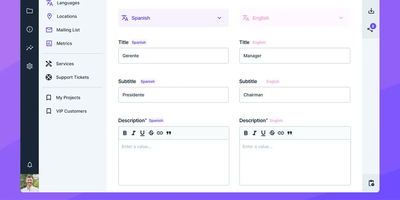
Say hello to Directus, the open-source genie that magically turns any SQL database into a snazzy API and a slick no-code playground. It's like a Swiss Army knife for your data, playing nice with any SQL database you throw at it, so you can keep your precious data right where it is—no moving vans required. With Directus, you get a REST and GraphQL API superhighway built atop your database, making your data dance at your fingertips. And the Directus App? It's like a VIP lounge for your team, where they can schmooze with data in style, managing and visualizing it without breaking a sweat. Whether you're crafting a Backend-as-a-Service masterpiece, spinning up a Headless CMS, building the ultimate internal toolset, or diving into Data Management & Analytics, Directus is your go-to wingman. Plus, with RepoCloud hosting, you'll be saving more coins than a video game plumber, all while enjoying the freedom of open-source camaraderie. Get ready to connect, design, and control like a data wizard, because with Directus and RepoCloud, the digital world is your oyster!
Supertokens Core
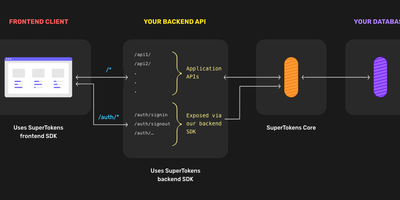
Authentication that lives inside your application rather than behind a redirect to an external identity provider - SuperTokens takes a fundamentally different architecture from Auth0 and AWS Cognito. Three tiers make that work - frontend SDKs (React, Angular, Vue, vanilla JS, React Native) render overridable login UI and manage tokens; backend SDKs (Node.js, Python, Go) expose auth endpoints on your own API domain; and SuperTokens Core, the piece you host here, is the stateless HTTP service handling core auth logic, password hashing, token signing, and database operations against PostgreSQL. The recipe system keeps features decoupled: use email/password, social login, passwordless (magic links, OTP), phone-password, multi-factor authentication (TOTP, WebAuthn), user roles, and microservice auth - individually or combined; you can even use SuperTokens purely for session management alongside another login provider. Sessions are where it shines: rotating refresh tokens with theft detection, automatic access-token refresh, CSRF protection, and secure cookie handling out of the box - the details that become vulnerabilities when hand-rolled. Verification happens locally in your backend via cached JWT signing keys, so the Core stays off the hot path. Self-hosted means no user limits, free forever, with all user data in your database. Apache-licensed.

Barrage
Get ready to unleash a torrent of fun with Barrage, the sleek and chic Deluge WebUI app that's as mobile as you are! This app is like the Swiss Army knife for your torrents, with a design so responsive it'll make your smartphone blush. Whether you're lounging on the beach or commuting on the bus, Barrage lets you add torrents faster than you can say 'magnet link'. Fancy a bit of sorting and filtering action? You got it! Want to play the puppet master with your upload and download speeds? All the power is at your fingertips. And when it comes to prioritizing files or tweaking torrent settings, Barrage is as accommodating as RepoCloud's hosting prices. Deploy it with Docker and watch your torrent troubles sail away into the sunset. It's the smarter, cost-effective way to manage your torrents on the go, courtesy of RepoCloud's hosting magic!
Adminer
description_humorous

Drone Runner
description_humorous
RabbitMQ
description_humorous
EverShop
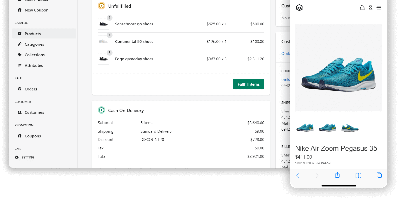
Magento's extensibility without PHP, Shopify's polish without the platform tax: EverShop is the TypeScript-first e-commerce platform built on that promise. Architected as a modular monolith on Node.js, it organizes every piece of business logic - catalog, checkout, customers, your custom extensions - into modules that plug in without touching core code, extended through a disciplined set of mechanisms: registry processors for transforming data across modules, hooks that wrap function calls, async event subscribers (product created, order placed), and route middleware. The storefront and the fully-featured admin panel are both React with server-side rendering and hydration, giving fast first paint and SEO-friendly pages, while a typed GraphQL API (plus REST endpoints) serves exactly the data each view needs - the same API that powers headless and PWA builds. Standard commerce is covered: product management with variants and attributes, category navigation, cart and checkout, order and customer management, coupons, and a theme system built on React components and Tailwind for deep storefront customization. PostgreSQL is the default database, deployment is Docker-friendly with near-zero configuration, and the GPL-3.0 license means the entire stack - types, resolvers, and checkout flow included - is yours to read and modify.
ICEcoder
description_humorous
Aptabase
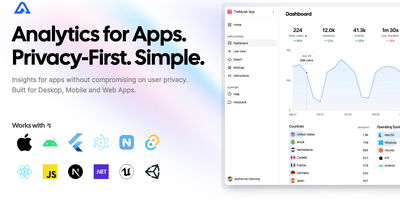
Web analytics tools ignore native mobile, desktop, and game apps; Aptabase was built for exactly those. If Firebase Analytics would force a privacy-policy footnote you don't want to write, this is the alternative - session-based metrics with no cookies, no IDFA or GAID, no device fingerprinting, and a daily-rotated salt that makes cross-day re-identification mathematically impossible. That design means GDPR, CCPA, and PECR compliance out of the box and "Data Not Collected" App Store privacy labels without ATT prompts. The SDK coverage is the widest in its category: eleven first-party libraries spanning Swift, Kotlin, Flutter, React Native, Tauri, Electron, .NET MAUI, NativeScript, Unity, Unreal Engine, and JavaScript for web - each MIT-licensed, following platform conventions, and accepting a custom host parameter that points at your instance. Integration is minutes: initialize with an app key, call trackEvent with optional properties, and the dashboard shows sessions, events, app versions, OS breakdowns, and country-level geography. The self-hosted stack is a .NET server over PostgreSQL for metadata and ClickHouse for high-volume event ingestion, giving cloud-parity features under an AGPL license. For indie iOS/Android apps, Electron and Tauri tools, and Unity or Unreal games, it replaces Firebase without the Google entanglement.
Visual Studio Code Server
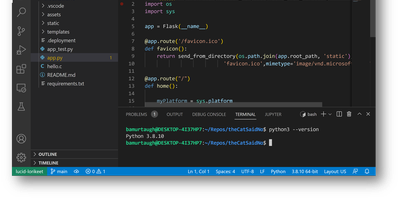
Unleash the coder in you from anywhere, on anything that can browse the web, with the docker-code-server, brought to you by the LinuxServer.io squad! Imagine tapping away at your code on a tablet while lounging on the beach or debugging that pesky script on your Chromebook at your favorite coffee shop. With this nifty tool, you can maintain a single, slick development environment across all your gadgets. And for those who juggle between Windows or Mac and Linux, it's like having a secret passage directly to Linux-land. Plus, let's talk turbocharging - big cloud servers mean your tests and builds are faster than a caffeinated squirrel. All this, while your laptop's battery breathes a sigh of relief, because the heavy lifting is done elsewhere. Say goodbye to a bazillion Chrome tabs eating up your resources, and hello to coding freedom with RepoCloud's wallet-friendly hosting!

Countly
Mixpanel, OneSignal, and Crashlytics in one self-hosted stack - Countly is an all-in-one product analytics and engagement platform where every byte of first-party data stays on your server. A Node.js application over MongoDB, it collects through ten battle-tested SDKs spanning iOS, Android, web JavaScript, React Native, Flutter, Unity, and desktop (plus a data write API for anything else), and has powered tens of thousands of mobile, web, and desktop apps since 2012. The analytics core covers sessions, custom events, views, user profiles, and real-time dashboards, with exploration tools built for product managers as much as analysts. What separates Countly from pure analytics tools is acting on the data without third parties: built-in push notifications send automated, transactional, and personalized messages to iOS (APNs), Android (Firebase), and Huawei devices, with the SDK handling token retrieval and permission flows automatically; crash reporting captures symbolicated native crashes on iOS and Android plus JavaScript errors, correlated with the same user and session data. Email reports keep stakeholders updated, and the plugin-based architecture means features load as modules. For GDPR-sensitive products, engagement without piping user data to advertising companies is the entire point. AGPL-licensed server, installable in minutes.
Qdrant
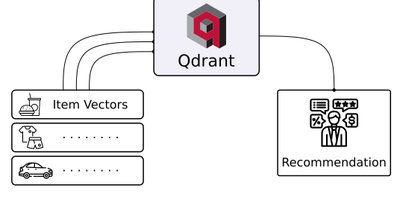
Embark on a quest with Qdrant, the Herculean vector database that's flexing its muscles to revolutionize AI apps. Imagine a digital genie that grants you the power to sift through high-dimensional space with the ease of a cosmic search engine. It's not just an API service; it's your ticket to transforming brainy embeddings into superstar applications that can match, search, and recommend like a boss. Qdrant is like the Swiss Army knife for data types, handling everything from witty string banter to numerical ninja ranges, and even geo-locations with a sense of wanderlust. It's cloud-native, so it grows with your ambitions, scaling horizontally like it's training for the digital Olympics, all while being as resource-efficient as a monk. Host it on RepoCloud, and you'll be building semantic neural search castles in the sky in no time, understanding user antics as they unfold, and spotting similar images or duplicate doppelgängers with the sharpness of an eagle. It's the open-source powerhouse that makes your data dance to the tune of innovation, all at a cost that keeps your wallet as happy as a clam at high tide!