Kopia
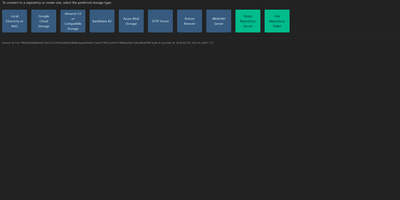
Engineers who have outgrown Duplicati or rsync scripts tend to appreciate Kopia's design: encrypted, compressed, content-deduplicated snapshots in Go, stored in a repository on any storage you control - S3, Google Cloud Storage, Azure Blob, Backblaze B2, SFTP, WebDAV, or a plain filesystem. Encryption is mandatory and end-to-end: every block is encrypted client-side with AES-256-GCM or ChaCha20-Poly1305 using keys derived from your repository password, and even file names never leave the machine in plaintext. Blocks are packed into 20-40 MB blobs with random names, so the storage provider learns nothing about content or structure. Deduplication is automatic and content-based - identical data across files, snapshots, and even multiple machines backing up to the same repository is stored once. Policies govern everything per-directory: compression choice, retention (hourly through annual), scheduling, and ignore rules. Incremental snapshots are point-in-time records you can mount and browse like a filesystem. This deployment runs the Kopia repository server with its web UI, centralizing backups from multiple client machines over an authenticated API - each client connects with the server URL and certificate fingerprint, and users only see their own snapshots. Error correction, high-latency-tolerant caching, and both CLI and GUI round it out.
Drone
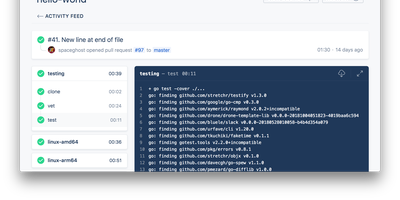
Get ready to turbocharge your code with Drone.io, the CI butler for the coding aristocracy! Picture this: your software builds and tests are as automated as your morning coffee maker, thanks to Drone.io's slick automation magic. Configuring it is a piece of cake with a nifty file that cozies up in your git repo like a cat in a sunbeam. And when it's go-time, each pipeline step struts its stuff in its own Docker container fashion show, downloaded on-the-fly. Fancy a dance with GitHub or a tango with GitLab? Drone.io's got smooth moves with a bunch of source code management sweethearts. It's the polyglot of platforms, speaking every language from Python to PHP, and it's as comfortable with databases and services as a nerd in a comic book store. Share your secret sauce with plugins, or go full mad scientist with custom controls, secret spells, and yaml incantations. Plus, with Drone.io's commitment to solitary build confinement, your code's personal space is always respected. And when it's time to grow, Drone.io scales up like it's been hit with a growth ray. Host it on RepoCloud, and you'll save enough to make your wallet do a happy dance, all while keeping the open-source spirit alive and kicking!
Gitea
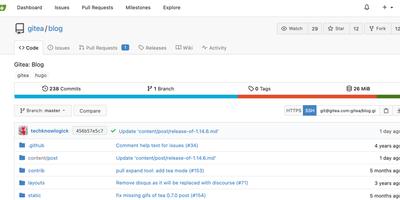
Get ready to turbocharge your code capers with Gitea, the DevOps dynamo that's lighter than a feather and slicker than a greased byte! This nifty platform is your one-stop shop for herding those pesky code commits from the wild plains of planning all the way to the bustling metropolis of production. Fancy a stroll through the annals of commit history? Gitea's got you covered. Need to merge like a pro? Check. And for the Git gurus, we're talking tags, cherry-picking fiestas, and hooks that would make Captain Hook jealous. But wait, there's more! Unleash the power of Gitea Actions, the CI/CD sidekick that plays nice with GitHub Actions, ensuring your deployment dance is as smooth as a robot doing the moonwalk. Juggle issues, labels, and kanban boards like a coding circus star, and manage over 20 flavors of package management – because variety is the spice of source code. Hosted on RepoCloud, where the cost is as tiny as a bug in a nano-simulator, Gitea is the open-source hero that's all about flexing to fit your workflow, while keeping things tighter than a duck's waterproof feathers when it comes to security. So why settle for less when you can customize, collaborate, and create with the best, all while saving your coins? Gitea and RepoCloud: where code dreams come true, without the nightmare bills!
Unleash
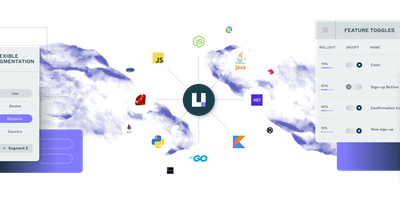
Deployment decoupled from release: Unleash, the most popular open-source feature management platform on GitHub, is a Node.js server backed by PostgreSQL. Ship code dark, then control who sees it through activation strategies: gradual percentage rollouts, targeting by user ID, IP, hostname, or application name, custom constraints against your own context fields, and scheduled or time-limited releases. Strategies stack - a flag activates if any strategy matches - and strategy variants layer A/B versions on top of the on/off decision. Each flag carries per-environment configurations, so a feature can run at 100% in staging while canarying at 5% in production. Backend SDKs (Node.js, Java, Go, Python, Ruby, .NET, PHP, Rust, and more) fetch configuration and evaluate flags locally, so a flag check adds zero network latency to request paths; frontend SDKs for React, Vue, Svelte, iOS, Android, and Flutter evaluate through a proxy layer. Flag hygiene is built in: flags are typed (release, experiment, operational, kill-switch, permission) with expected lifetimes, and Unleash marks overdue flags as potentially stale and surfaces unknown flags your SDKs request but that don't exist. Self-hosting via Docker keeps flag data, targeting rules, and evaluation infrastructure entirely on your side.
Tianji
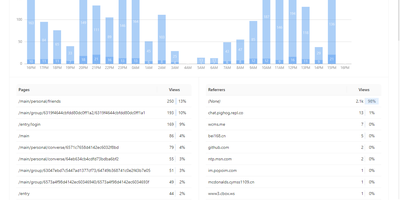
Website analytics, uptime monitoring, and server status - three tools most teams run separately - combined in Tianji, an open-source observability platform. The analytics layer tracks page views, unique visitors, referrers, and UTM parameters with a lightweight cookie-less script, which keeps collection GDPR and CCPA friendly. The uptime monitor checks availability and latency on configurable intervals, accepts passively reported results, and publishes public status pages for incident communication. Server status agents report CPU, memory, disk, and network metrics with threshold-based alerts, and notifications route through webhooks, Slack, Telegram, and other channels with noise control. It also includes anonymous telemetry for tracking deployments of your own open-source projects, surveys, waitlists, team collaboration, and an OpenAPI interface for integrations and exports. The consolidation is the point: traffic analytics, uptime checks, and server metrics share one interface and one alerting layer, so diagnosing an incident does not mean hopping between Google Analytics, Uptime Kuma, and Prometheus - and the built-in public status pages replace a separate paid Statuspage-style subscription. Because collection uses no cookies with IP truncation and aggregation by default, basic traffic measurement requires no consent banner. Built in TypeScript under the Apache 2.0 license and inspired by Umami and Uptime Kuma, it is deliberately right-sized for independent developers and small SaaS teams whose monitoring needs are real but lightweight.