Weaviate
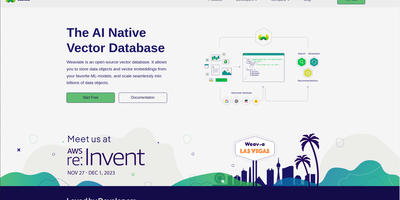
Embark on a semantic adventure with Weaviate, the open-source vector database that's like a GPS for your data! Imagine a world where your data points are like stars in the cosmos, and Weaviate is your trusty telescope, helping you navigate the galaxy of information based on the 'semantic vibes' they emit. With the ability to stand alone or play nice with a smorgasbord of vectorizing modules, this database is your ticket to a lightning-fast vector similarity search that zips through raw vectors or data objects with the speed of a comet, even when you throw in a few filters. It's like having a search party that combines the Sherlock Holmes of keyword sleuthing with the psychic predictions of vector search techniques for mind-blowingly accurate results. Want to play quiz master with your data? Pair it with any generative model and host a Q&A session right in your dataset! Hosting Weaviate on RepoCloud is like getting first-class seats for your apps on a spaceship, at economy prices. Buckle up for a next-gen vector database experience that will power your apps to infinity and beyond!
Langflow
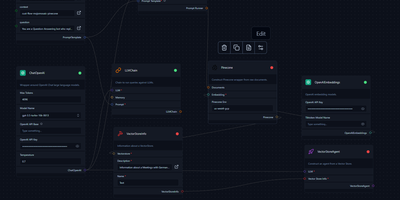
Get ready to unleash your inner language wizard with Langflow, the spellbinding app that turns the complex art of LangChain pipeline creation into a magical drag-and-drop extravaganza! Picture yourself crafting linguistic concoctions with the ease of a seasoned sorcerer, connecting mystical components like LLMs, prompt serializers, agents, and chains with a mere flick of your mouse. Tweak the secret ingredients (a.k.a. prompt parameters), bind together chains and agents in an enchanting dance, and peer into the crystal ball to witness an agent's thought process. When your potion is perfected, abracadabra! Export your masterpiece as a JSON file, ready to charm the socks off LangChain. And for the grand finale, with a wave of your wand (and a single command), you can deploy your creation to Jina AI Cloud faster than you can say 'Presto chango!' Thanks to RepoCloud's hosting, you'll save a dragon's hoard of gold compared to other cloud hosts. Langflow is your trusty sidekick in the quest to build and deploy LangChain pipelines with the ease of a fairy tale ending.
phpMyAdmin
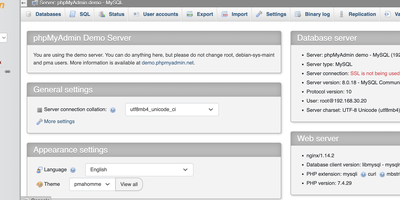
Since 1998, phpMyAdmin has been the standard web interface for MySQL and MariaDB - the tool millions of developers, DBAs, and hosting companies reach for when a database needs inspecting, fixing, or migrating. Written in PHP, it covers effectively the entire administration surface: create, browse, alter, and drop databases, tables, views, columns, and indexes; insert and edit rows through a tabular editor; manage user accounts and granular privileges; and maintain stored procedures, triggers, and events - all without touching a command line. The SQL editor executes arbitrary queries with syntax highlighting, autocompletion, history, and bookmarkable statements, including batch queries. Import/export is a migration workhorse: read SQL, CSV, XML, and OpenDocument spreadsheets in; write out to SQL dumps, CSV, JSON, XML, PDF, Word, LaTeX, and more - the fastest path for moving a WordPress database or handing a schema to a colleague. The Designer view renders your schema as an interactive ER diagram with drag-and-drop relationship editing, and data transformations display BLOBs as images or download links inline. Server maintenance views surface configuration suggestions. Multi-server support, dark mode, and translations into 72 languages round out a tool that earns its ubiquity. GPL-licensed.
PocketBase
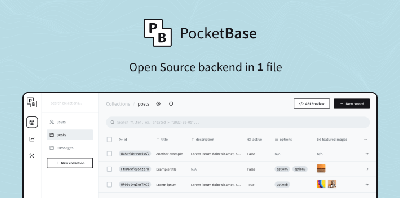
An entire backend in a single Go executable: PocketBase embeds SQLite with realtime subscriptions, authentication and user management, file storage, and an admin dashboard, all behind a REST-ish API. SQLite runs in WAL mode, which outperforms client-server databases for the read-heavy workloads typical of small and mid-sized apps. Authentication supports email/password, one-time passwords, and 15+ OAuth2 providers including Google, Apple, and GitHub, with stateless tokens. Clients subscribe to record changes over server-sent events, and official JavaScript and Dart SDKs cover web, mobile, and Flutter frontends. Collections, rules, and API access permissions are managed visually in the admin UI. When you need custom logic, extend it with JavaScript hooks running in the embedded JS VM of the prebuilt binary, or import PocketBase as a Go library and compile custom business logic into your own single-file backend. File storage attaches uploads to records with thumbnail generation for images and optional S3-compatible external storage. All state lives in one pb_data directory, so backup is a directory copy and upgrade is replacing a binary - one of the lowest-maintenance backends you can run. The contrast with Firebase is the point: where usage-based pricing scales with reads, writes, and bandwidth, PocketBase runs the entire backend at flat hosting cost, and the data is a plain SQLite file you can copy anywhere. MIT-licensed.
Nango
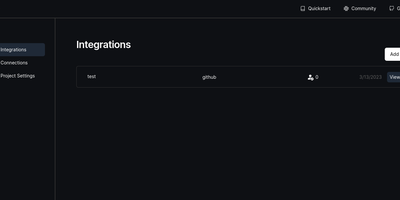
The integrations your SaaS product offers its own users - that is what Nango, an open-source product-integrations platform, exists to build. It solves the repetitive infrastructure work behind every third-party API connection: OAuth flows, API key handling, token refresh, encrypted credential storage, rate-limit backoff, retries, and multi-tenant connection management. It ships pre-built auth configurations for 800+ APIs. Your users connect their accounts through an embeddable, white-label Connect UI, and your backend then reads or writes data through Nango's proxy, SDKs, or REST API without ever touching raw credentials. Integration logic is written as TypeScript functions covering actions, scheduled data syncs, and webhook processing - all running on one runtime with retries, checkpointing, and per-connection logs built in. Syncs pull records incrementally on a schedule, one-way or two-way, which suits RAG pipelines, search indexing, and keeping local copies of external data current. Selected actions can also be exposed as tool schemas or through a built-in MCP server, so AI agents operate on user-connected accounts without ever handling provider credentials. Auth support spans OAuth 2.0, OAuth 1.0a, API keys, basic auth, and JWT, and observability - logs, metrics, failure detection, and a reconnect flow for expired credentials - is scoped per customer connection for easier support debugging. Works with any backend language. Self-hosting on RepoCloud keeps all customer credentials and synced data on infrastructure you control, which matters for data residency and compliance requirements.
Limesurvey
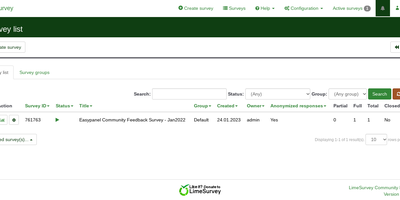
Step right up to the survey fiesta with LimeSurvey, the undisputed heavyweight champion of the survey world! This zesty platform is your golden ticket to survey nirvana, where you can whip up everything from a breezy poll to a brain-busting questionnaire with more twists and turns than a telenovela. Perfect for the curious student, the savvy professional, or the enterprise with questions galore, LimeSurvey is the Swiss Army knife of feedback tools – and it won't cost you a dime! Wave goodbye to the yawn-inducing forms of yesteryear and say 'Hola!' to a world where conditional logic dances the salsa with complex validation rules. And for the scholarly crowd, LimeSurvey rolls out the red carpet, offering a treasure trove of open-source goodies that'll make research institutes and universities do the academic conga. With templates so user-friendly they practically hold your hand, and a customer service squad ready to leap to your aid, LimeSurvey hosted on RepoCloud is the piñata of possibilities – just waiting for you to take a swing!
Soketi
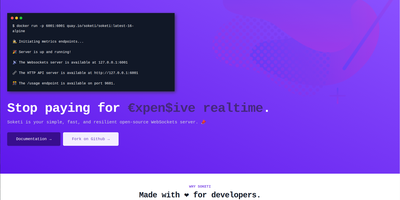
Get ready to turbocharge your real-time apps with Soketi Serverless – the WebSocket wizard that's so cost-effective, it's practically a steal! Wave goodbye to wallet woes because with Soketi, you're the maestro of your own infrastructure budget. This speed demon guarantees lightning-fast core message delivery in under 100ms, all thanks to its supercharged C backbone and Node.js nimbleness. And talk about compatibility – it's like the best friend your Pusher Protocol v7 ever had, letting you connect without the hassle of a code overhaul. Ready to rock right out of the box, Soketi scales like a champ across hundreds of servers with Redis or NATS, all while keeping its cool performance-wise. But wait, there's more! Built-in app management lets you whip up your own app credentials and tango with any database you fancy. Plus, with HTTP Webhooks on board, you'll get a heads-up via HTTP requests whenever your channels decide to throw a party. Deploying on Cloudflare Workers? Soketi's got you covered, bringing your server closer to your users than ever before. And it doesn't matter if you're a MySQL maven or a DynamoDB devotee – Soketi speaks your database language. Host it on RepoCloud, and you'll be the talk of the town with a WebSocket server that's not just brilliant, but brilliantly budget-friendly!