Typebot
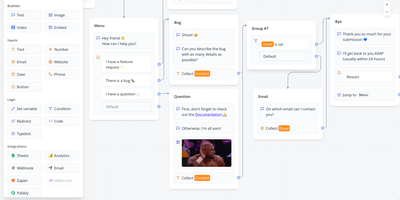
A fair-source chatbot and conversational-form builder: Typebot assembles conversations in a visual graph editor. In a visual graph editor you chain blocks from four categories: bubbles display text, images, video, audio, and embeds; inputs collect data through text fields, email, phone, buttons, picture choices, date pickers, file uploads, and Stripe payments; logic blocks handle conditional branching, variables, URL redirects, A/B testing, and custom JavaScript; integration blocks call webhooks, OpenAI, Google Sheets, Google Analytics, Meta Pixel, Zapier, Make, and Chatwoot. Build once, deploy anywhere: custom domains, WhatsApp, or embedded in any site as a container, popup, or chat bubble through a fast native JS library with no iframe and no external dependencies - plus an HTTP API for executing bots programmatically from any language. Theming covers fonts, colors, roundness, and shadows with custom CSS and reusable templates, and results arrive in real time with drop-off and completion analytics plus CSV export. Two Next.js apps (builder and viewer) self-host via Docker under the Functional Source License, which converts to Apache 2.0 after two years.
Matrix Synapse
Step into the Matrix, where the future of chatter is not just bulletproof, but decentralised to boot! This app is your golden ticket to gabbing with pals, kin, digital tribes, and office allies in a virtual space that's as snug as a bug in a rug. Wave goodbye to the digital overlords and hello to a world where you're the architect of your own cyber sanctuary. Fancy yourself a bit of a builder? Go wild creating snazzy, sophisticated chat apps atop the mighty Matrix. Part of a bustling bazaar of clients, servers, and robotic minions (we mean bots), this open-source extravaganza is snugly housed on RepoCloud, where your wallet won't weep over hosting fees. So, whether you're itching to gab, code, or conquer the universe of decentralised discourse, Matrix is your trusty sidekick in the quest for communication liberation!
Rocket.Chat
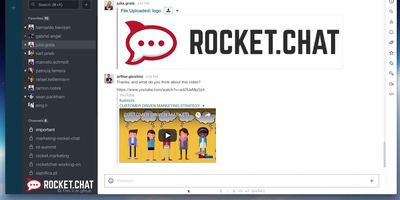
Blast off into productivity space with Rocket.Chat SIX, the ultimate team collaboration cosmos! Imagine a world where your data isn't just your own, it's your best-kept secret. With customization that's as vast as the universe and integration that's as seamless as a black hole, you're in for a stellar ride. This platform is like the Swiss Army knife for your messages, projects, and tasks, all orbiting harmoniously in one digital galaxy. But wait, there's more! It's not just about team efficiency; it's about making customer connections that are out of this world. Rocket.Chat SIX is your mission control for omnichannel customer service, creating conversations that sparkle like constellations. And for those who like their chats with a side of excitement, the in-built chat engine is like adding a turbo boost to your app or website's user engagement. Built for the control freaks in spacesuits, this platform offers end-to-end encryption and compliance with intergalactic data protection laws. Plus, with deployment options more flexible than a yoga instructor in zero gravity, your security needs are covered. So why settle for a cloud when you can have the whole cosmos with RepoCloud hosting? Get ready to take your team's productivity to infinity and beyond!
Owncast
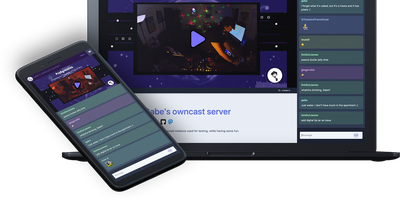
Twitch and YouTube Live, replaced by infrastructure you control: Owncast is a self-hosted live streaming and chat server. Point OBS, Streamlabs, or any RTMP-capable broadcaster at the server's ingest port, and Owncast transcodes the feed with FFmpeg into HLS with multiple quality variants, playing it in a built-in web page with a real-time chat beside it. Chat supports anonymous participation, custom emotes, and moderation tools - message removal, user bans and suspensions - with optional authentication via IndieAuth or a Fediverse account. ActivityPub integration puts the stream on the Fediverse: viewers on Mastodon and compatible services can follow a channel and get notified the moment it goes live. Video delivery can come straight off the server or offload HLS segments to S3-compatible object storage so a modest VPS handles thousands of concurrent viewers while only managing ingest and chat. The backend is a single Go binary with a React frontend - no accounts platform, no database server, no dependency stack - and the player embeds in any website. MIT-licensed, with roughly 9k GitHub stars, zero platform fees, and no algorithm or takedown policy between you and your audience.
Pidgin
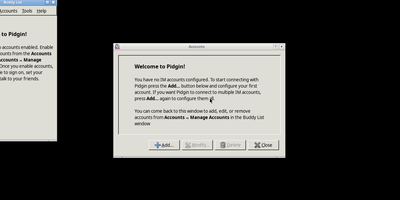
Get ready to juggle your social life like a circus pro with Pidgin, the chat app that's like a Swiss Army knife for your digital conversations! Imagine being the puppet master of your chat universe, where you can simultaneously whisper sweet nothings into XMPP and gossip in an IRC channel without breaking a sweat. Pidgin is your VIP pass to the who's who of chat networks, including the cool kids like Discord and Slack, the old guard like ICQ, and even the elusive Skype and Telegram. It's like having a backstage pass to every concert in town! With a treasure trove of default and third-party plugins, Pidgin is like that friend who always brings the best snacks to the party. And with Firefox on board, you'll be solving captchas like a riddle master before you even enter the chat room. Just hop onto http://yourhost:3000/ or for the security enthusiasts, https://yourhost:3001/, and let the chatstravaganza begin! Hosted on RepoCloud, you'll be chatting more and paying less, because who says you can't have your cake and eat it too? So, let's get the digital party started with Pidgin, where every chat network is just a click away!
Element
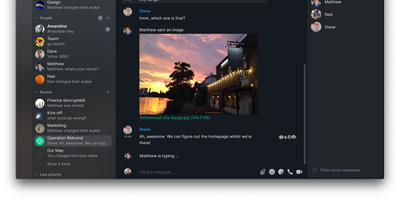
Matrix's flagship client, built by the protocol's creators: Element brings the decentralized open standard for real-time communication to web, desktop, iOS, and Android. Paired with a Matrix homeserver, it delivers Slack-quality team messaging where you own every message, file, encryption key, and byte of metadata. End-to-end encryption is on by default, built on Olm and Megolm - the Double Ratchet algorithm family Signal popularized, extended for large-room scalability and publicly audited by NCC Group. Messages encrypt per-device with cross-signed device verification, so even a compromised server yields nothing readable. Federation is the defining capability: like email, users on different homeservers converse seamlessly, and 30+ bridges connect Matrix rooms to Slack, Discord, WhatsApp, and Telegram, so moving to sovereign infrastructure doesn't sever contact with anyone. Rooms support threads, reactions, file sharing, and voice and video calls via Element Call. The result is digital sovereignty chosen by governments and enterprises across Europe: your data sits on your server in your jurisdiction, portable to any other Matrix host because the protocol is an open standard. Apache-2.0 licensed, with no per-user fees at any scale.
Chatwoot
description_humorous
Botpress
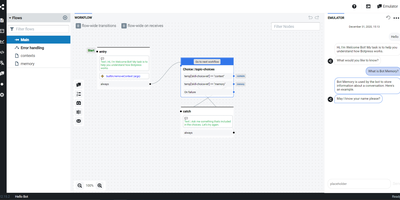
Build, deploy, and monitor chatbots and LLM-powered agents on one open-source conversational AI platform: Botpress. Its Studio is a visual development environment: a drag-and-drop canvas arranges conversation logic with nodes for messages, questions, choices, and actions, while a built-in emulator simulates conversations for debugging before anything goes live. Agents ground their answers in a knowledge base assembled from uploaded documents, ingested websites, and past conversations via retrieval-augmented generation, and the LLM layer connects to multiple model providers - GPT-4, Claude, Mistral - with a configurable model strategy. An autonomous engine handles reasoning, tool orchestration, persistent memory across sessions, and sandboxed code execution, and custom code actions in TypeScript extend agents past prebuilt workflows. Over 100 integrations deploy the same bot to WhatsApp, Telegram, Slack, Microsoft Teams, and web chat, and connect it to HubSpot, Zendesk, Zapier, and arbitrary APIs and webhooks. Human handoff, conversation analytics, and quality monitoring cover production operation. Originating in 2017 from a Montreal team, the community edition is developed openly on GitHub.