
Easyshortener
Get ready to shrink those lengthy URLs down to fun-size with Easyshortener, the link-shortening maestro that's as easy on the eyes as it is on your digital security! Wave goodbye to the days of sprawling links with this multi-user marvel, where each user can tame their own wild web addresses from the comfort of a sleek administration panel. It's like having a Swiss Army knife for your links, but without the risk of nicking your fingers. And for those who like their online life as secure as Fort Knox, Easyshortener comes strapped with two-factor authentication – it's like a bouncer for your bits and bytes. Deploying this little gem is a breeze with Docker, so you can launch it into the web-o-sphere with the grace of a containerized cannonball. Plus, with registration and redirect tracking, you'll be the Sherlock Holmes of link management, and the option to enforce HTTPS is like putting your links in an armored van. Host it on RepoCloud, and you'll be the link-shortening hero you never knew you needed, at a price that keeps your wallet just as happy as your links!
Cachet
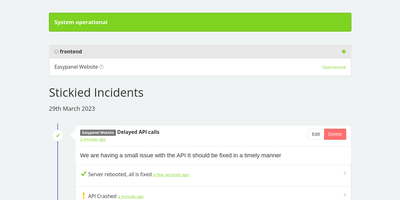
Introducing Cachet: the open-source superhero for managing those pesky downtime blues. Beloved by top-notch companies across the globe, Cachet is your go-to wingman for broadcasting those 'Oops, we'll be right back!' messages to customers, your squad, and the money folks. Sporting a snazzy outfit that looks fab on any device, Cachet is the epitome of style meets function. It's a polyglot, too, chatting in multiple languages and flexing a robust JSON API to keep your status updates as fresh as morning coffee. Want to pencil in some digital spa time for your servers? Cachet's got your back with pre-scheduled maintenance memos. And for the number crunchers, it's got a dashboard decked out with metrics to track your digital heartbeat. Plus, with two-factor authentication, it's like having a bouncer for your status page. Hosting it on RepoCloud? That's the cherry on top, giving you all the open-source goodness without burning a hole in your wallet. Cachet: because your status page should be as cool as your service.
PocketBase
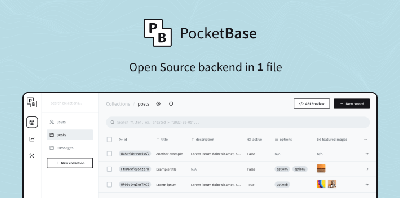
An entire backend in a single Go executable: PocketBase embeds SQLite with realtime subscriptions, authentication and user management, file storage, and an admin dashboard, all behind a REST-ish API. SQLite runs in WAL mode, which outperforms client-server databases for the read-heavy workloads typical of small and mid-sized apps. Authentication supports email/password, one-time passwords, and 15+ OAuth2 providers including Google, Apple, and GitHub, with stateless tokens. Clients subscribe to record changes over server-sent events, and official JavaScript and Dart SDKs cover web, mobile, and Flutter frontends. Collections, rules, and API access permissions are managed visually in the admin UI. When you need custom logic, extend it with JavaScript hooks running in the embedded JS VM of the prebuilt binary, or import PocketBase as a Go library and compile custom business logic into your own single-file backend. File storage attaches uploads to records with thumbnail generation for images and optional S3-compatible external storage. All state lives in one pb_data directory, so backup is a directory copy and upgrade is replacing a binary - one of the lowest-maintenance backends you can run. The contrast with Firebase is the point: where usage-based pricing scales with reads, writes, and bandwidth, PocketBase runs the entire backend at flat hosting cost, and the data is a plain SQLite file you can copy anywhere. MIT-licensed.
Nango
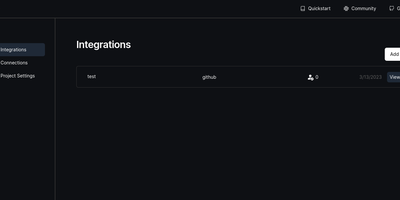
The integrations your SaaS product offers its own users - that is what Nango, an open-source product-integrations platform, exists to build. It solves the repetitive infrastructure work behind every third-party API connection: OAuth flows, API key handling, token refresh, encrypted credential storage, rate-limit backoff, retries, and multi-tenant connection management. It ships pre-built auth configurations for 800+ APIs. Your users connect their accounts through an embeddable, white-label Connect UI, and your backend then reads or writes data through Nango's proxy, SDKs, or REST API without ever touching raw credentials. Integration logic is written as TypeScript functions covering actions, scheduled data syncs, and webhook processing - all running on one runtime with retries, checkpointing, and per-connection logs built in. Syncs pull records incrementally on a schedule, one-way or two-way, which suits RAG pipelines, search indexing, and keeping local copies of external data current. Selected actions can also be exposed as tool schemas or through a built-in MCP server, so AI agents operate on user-connected accounts without ever handling provider credentials. Auth support spans OAuth 2.0, OAuth 1.0a, API keys, basic auth, and JWT, and observability - logs, metrics, failure detection, and a reconnect flow for expired credentials - is scoped per customer connection for easier support debugging. Works with any backend language. Self-hosting on RepoCloud keeps all customer credentials and synced data on infrastructure you control, which matters for data residency and compliance requirements.
Keycloak
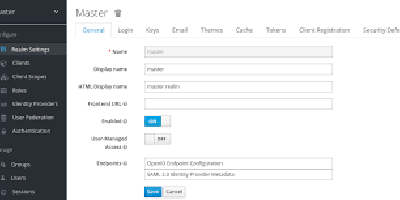
Unlock the magic of seamless sign-ins with Keycloak, the open-source locksmith for your app's identity and access needs! Wave goodbye to the headache of user storage and authentication woes. Keycloak is like a backstage pass to secure services, offering user federation, top-notch authentication, and user management that's as fine-tuned as a Swiss watch. With its Single-Sign On sorcery, users can glide effortlessly across multiple apps with just one golden key, making 'Forgot Password?' a thing of the past. Fancy a social butterfly login? Keycloak's got you covered, mingling with the cool kids of OpenID Connect and SAML 2.0. It's a socialite that also plays nice with the old school crowd, connecting to LDAP or Active Directory with the grace of a seasoned diplomat. Command your server's security from a centralized admin console that's more organized than a librarian's bookshelf, and give your users the power to manage their own accounts without sending out an SOS. Built on the rock-solid foundations of OpenID Connect, OAuth 2.0, and SAML, Keycloak is the guardian of advanced permission management, keeping your app's security tighter than a drum. Host it on RepoCloud, and you'll be singing 'Hallelujah' for the lower costs and the open-source camaraderie that's as warm and fuzzy as a basket of kittens!
Authorizer
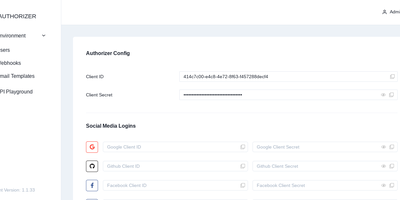
Your users belong in your own database - Authorizer, an open-source authentication and authorization server shipping as a single Go binary, keeps them there. It connects to 13+ backends - PostgreSQL, MySQL, SQLite, SQL Server, MariaDB, MongoDB, Cassandra, ScyllaDB, ArangoDB, DynamoDB, Couchbase, YugabyteDB, PlanetScale, and CockroachDB - so identity data lives beside the application it protects instead of in an auth vendor's cloud. The server is fully OAuth 2.0 and OpenID Connect compliant, including authorization code flow with PKCE, a JWKS endpoint, token revocation, and nine JWT signing algorithms. Login options cover email/password, magic links, TOTP multi-factor, SMS OTP via Twilio, and social providers including Google, GitHub, Apple, Microsoft, and Discord. Authorization goes beyond roles: an embedded OpenFGA engine provides Zanzibar-style relationship-based permission checks in process. APIs are exposed over GraphQL, REST, and gRPC, with SDKs for JavaScript, React, Go, and Python, plus themeable built-in login pages and an admin dashboard. Apache 2.0 licensed.
Vaultwarden
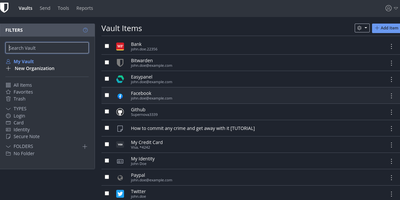
The Bitwarden server, reimplemented in Rust: Vaultwarden (formerly bitwarden_rs) is the unofficial lightweight edition. It speaks the same wire protocol as the official server, so every official Bitwarden client - browser extensions, iOS, Android, desktop, and the bw CLI - connects without modification, while the server itself runs as a single container against SQLite (or MySQL/MariaDB/PostgreSQL) instead of the official multi-container stack that wants gigabytes of RAM. Features Bitwarden gates behind paid tiers ship free: organizations with collections, groups, member roles, and policies; TOTP code storage; file attachments; Bitwarden Send; Emergency Access; event logs; and admin password reset. Two-factor options cover authenticator apps, email, FIDO2 WebAuthn, YubiKey, and Duo, and OIDC-based SSO landed natively in v1.35.0. Zero-knowledge encryption is unchanged - vault data is encrypted client-side and the master password never reaches the server. Attachments and Sends store on local disk or S3-compatible backends, an admin panel manages users and server settings, and backup is copying one data directory. Suited to individuals and teams up to roughly 50 users.
Supertokens Core
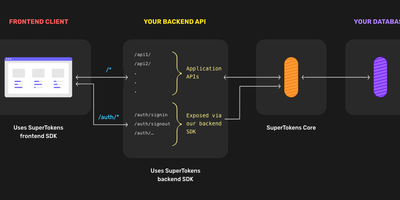
Authentication that lives inside your application rather than behind a redirect to an external identity provider - SuperTokens takes a fundamentally different architecture from Auth0 and AWS Cognito. Three tiers make that work - frontend SDKs (React, Angular, Vue, vanilla JS, React Native) render overridable login UI and manage tokens; backend SDKs (Node.js, Python, Go) expose auth endpoints on your own API domain; and SuperTokens Core, the piece you host here, is the stateless HTTP service handling core auth logic, password hashing, token signing, and database operations against PostgreSQL. The recipe system keeps features decoupled: use email/password, social login, passwordless (magic links, OTP), phone-password, multi-factor authentication (TOTP, WebAuthn), user roles, and microservice auth - individually or combined; you can even use SuperTokens purely for session management alongside another login provider. Sessions are where it shines: rotating refresh tokens with theft detection, automatic access-token refresh, CSRF protection, and secure cookie handling out of the box - the details that become vulnerabilities when hand-rolled. Verification happens locally in your backend via cached JWT signing keys, so the Core stays off the hot path. Self-hosted means no user limits, free forever, with all user data in your database. Apache-licensed.